
Sapporo’s soup curry culture rewards small rooms, patient queues, and broth-first cooking rather than luxury theatre. curry leaves sits in that tradition with Tabelog Curry EAST 100 recognition across multiple years, giving it credibility in a city where curry is judged with local precision rather than tourist sentiment.
Pearl is the En Primeur Club membership app — saves, bookings, and concierge access live there. Same editors, same standards.
- Address
- 北海道札幌市豊平区西岡四条7丁目7-10
- Phone
- +81118564447
- Website
- curry-leaves.com
 Saves & bookings on Pearl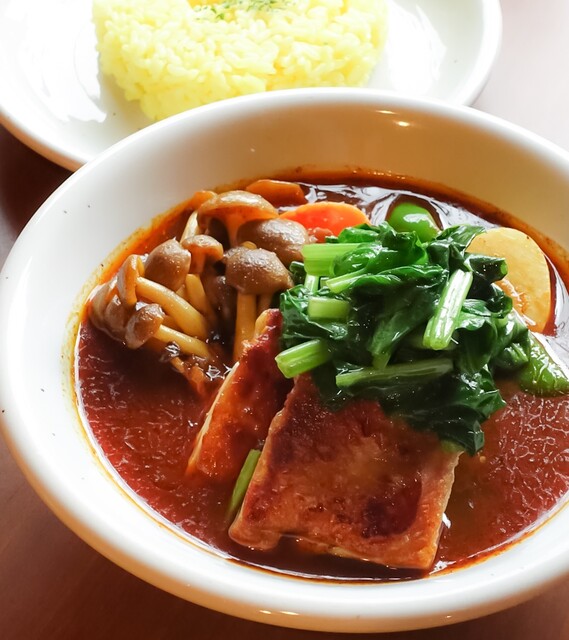
In Sapporo’s outer residential districts, a curry shop is often announced by rhythm rather than spectacle: cars easing into small parking spaces, friends arriving in pairs, the pause before soup curry lands. This is not polished hotel-dining Hokkaido cooking, but a local format of heat, broth, vegetables, and a compact room where the cooking carries the weight.
That matters because soup curry is a serious everyday cuisine in Sapporo, with hierarchy, loyal regulars, and a clear divide between thin novelty and bowls with depth. curry leaves belongs to the latter. Its repeated selection for Tabelog Curry EAST 100 in 2019, 2020, 2023, and 2024 places it among curry addresses Japanese diners keep rewarding, not as a high-price occasion but as a focused local table.
Sapporo soup curry, judged by broth rather than ceremony
Soup curry asks a different question from Japanese curry rice. The appeal is not density or sweetness alone, but how spice, stock, oil, and vegetables stay legible in one bowl. Sapporo’s stronger shops are measured by balance: spice that holds attention, broth with character rather than dilution, and enough structure for rice and soup to feel like partners.
The house direction combines Indian-style spicing with the slower depth associated with European-style curry, a useful clue to its place in the city’s curry grammar. Sapporo has bowls that chase heat first, and others that lean sweet or rich. This one fits the hybrid school: spice is present, but the draw is how the soup curry format absorbs different influences without becoming generic.
The award signal should be read correctly. Tabelog’s Curry EAST 100 is not a luxury ranking, which is why it matters here. It identifies places performing strongly in a crowded casual category, where diner repetition and category fluency count. In Sapporo, that puts curry leaves closer to the serious local-curry circuit than to polished destination restaurants, an important distinction for travellers planning around what the city actually eats.
Within Sapporo’s lower-priced comfort-food tier, Kitaro Sumikawa honten, Sapporo Junren Sapporo ten, SOUP CURRY KING Honten, Ramen Yoshi, and Mendokoro Maruha BEYOND show how much everyday dining authority sits outside formal fine dining. The shared lesson: Sapporo’s casual rooms often carry more local specificity than grander dining rooms. Soup curry and ramen reward repetition, small differences, and neighbourhood loyalty.
A compact room suits a cuisine built for close attention
The 26-seat room, with counter seating and small tables, is intimate without turning precious. Soup curry benefits from that proximity: the bowl becomes the centre, the room stays secondary. No tasting-menu arc is needed. The meal is choosing a bowl, matching appetite to spice and rice, then letting the broth set the pace.
Take-out also says something about the category. In Sapporo, serious curry need not be protected by ceremony. A shop can be recognised by national dining media, operate in a residential ward, and remain part of ordinary meal planning. For travellers who have scheduled sushi, kaiseki, or seafood counters elsewhere in Japan, this explains a distinctly Sapporo habit without performing as fine dining.
Soup curry has a sensory directness formal dining often loses. The visual register is generous: broth, vegetables, rice, and protein read immediately. The soundscape is modest, closer to spoons, conversation, and kitchen movement than choreographed service. The pleasure is not surprise courses, but the clarity of a bowl for lunch, early dinner, or a planned detour through Toyohira-ku.
That residential setting matters. Toyohira-ku does not function like Susukino, where nightlife density shapes dining, or Sapporo Station, where convenience dominates. A curry meal here fits a slower city map, where local buses, parking, and neighbourhood errands are part of dining culture. Travellers who treat Sapporo only as a seafood-and-beer stop miss this layer of its food identity.
How to fit it into a Sapporo eating itinerary
Position this meal as a local-cuisine anchor, not a blowout. Its price tier sits with everyday Sapporo dining, while its recognition gives it more editorial weight than a random casual stop. That rare combination can carry lunch between sightseeing plans, or a low-ceremony dinner when the rest of the itinerary is heavy with reservations.
It also pairs well with Sapporo’s curry ecosystem. Travellers comparing styles should look at [Curry Senmon Ten] Maruyama Kyoju., Ajanta Indo Curry Ten, and Ajanta Sohonke alongside curry leaves. For another spice-led casual meal, 175°DENO Tantanmen Sapporo kitaguchi ten is a useful counterpoint, while Aigues Vives shows how Sapporo-area dining stretches beyond curry and ramen into destination baking.
For wider planning, use Our full Sapporo restaurants guide to build the food map, then layer in Our full Sapporo hotels guide, Our full Sapporo bars guide, Our full Sapporo wineries guide, and Our full Sapporo experiences guide. Readers mapping Japanese casual dining beyond Hokkaido may compare formats with -Grilled beef Sukiyaki- KAMAKURA TANUKIAN 鎌倉 たぬき庵 in Kamakura. 鮪と炭火焼き うお炭 秋葉原店 in Tokyo.cafe in Osaka.know in Kumamoto, (Shoku) Vietnam in Kawasaki, and [ki:] in Kyoto. For a broader North American contrast in Japanese-influenced casual formats, see Jōdo Saké Bar in Los Angeles and Onigiri Time in Pasadena.
The editorial case is clear: this is a Sapporo soup-curry stop with credible recognition, modest pricing, and a neighbourhood setting that keeps the meal grounded. It belongs on itineraries for travellers who want to understand the city through bowls locals take seriously, not only seafood markets and brewery history.
How It Stacks Up
Side-by-side context: comparable cuisine and price.
| Venue | Cuisine | Price | Notes |
|---|---|---|---|
| curry leavesThis venue — the venue you are viewing | Sapporo-style soup curry | $ | Not listed |
| Curry House Colombo | Classic Japanese curry house near Sapporo Station | $ | Chūō |
| Menya Rei | Hokkaido Ramen & Tsukemen Shop | $ | Chitose |
| Ramen Arata | Sapporo ramen with Korean-inspired options | $ | Chūō |
| Menya hide | Sapporo ramen shop | $ | Kita |
| Hachinoki | Classic Sapporo Ramen | $ | Nishi |
Recognition history
Dated appearances from independent guides and award organizations, with the underlying list record or original source where available.
Tabelog 100 #24 · No. 24
Tabelog · Tabelog 100 - Curry - EAST - 2024


At a Glance
- Cozy
- Intimate
- Solo
- Casual Hangout
- Family
- Standalone
- Local Sourcing
A small, homey neighborhood soup curry shop with a relaxed, low-key atmosphere; the owner-chef still cooks in the open kitchen, and the space is kept clean and regularly ventilated and disinfected, giving it a casual but cared-for feel.