
Tabelog 100 #36
Our verdict
Ajanta Indo Curry Ten belongs to Sapporo’s curry culture at its older, more ritualized end: soup curry and Indian curry served in a compact, counter-led room rather than a high-design dining room. Its Tabelog Curry EAST 100 selections in 2019, 2023, and 2024 give it a clear place in the city’s competitive curry conversation.

Pearl is the En Primeur Club membership app, where members save venues, book tables and use the concierge.
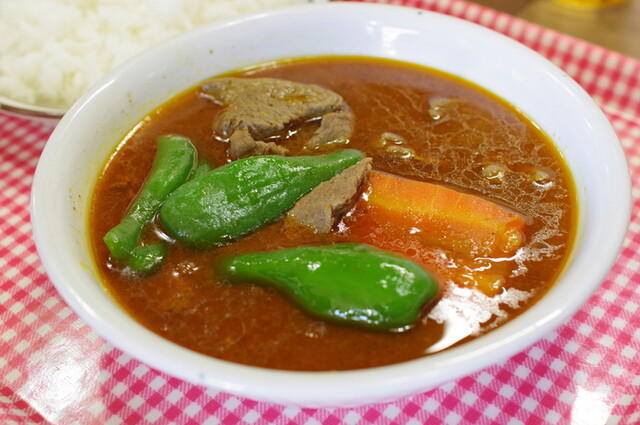
South of central Sapporo, the curry ritual becomes quieter and more deliberate: a small room, counter seats, a single table, and a meal built around heat, broth, rice, and pace. This is not the urban theatre of a multi-course counter or the quick turnover rhythm of station ramen. It is the Sapporo curry habit in its older form, where lunch can feel both functional and specific, and where the measure of a restaurant is less about novelty than continuity.
Ajanta Indo Curry Ten sits inside that tradition with unusual tenure. Founded in 1971 and selected for Tabelog Curry EAST 100 in 2019, 2023, and 2024, it occupies a narrow but meaningful lane in Hokkaido dining: curry as a local institution rather than imported trend. Sapporo is often discussed through miso ramen, seafood, and winter drinking rooms, but curry has its own local grammar here. Soup curry in particular rewards a different kind of attention, closer to a bowl-and-rice custom than a plated curry house model.
Sapporo curry as a ritual of broth, rice, and restraint
The defining move in Sapporo soup curry is separation. Rice and curry do not arrive as a single merged plate in the standard Japanese curry-rice format; the diner controls the ratio, the soaking, and the sequence. That changes the tempo of the meal. A spoonful of rice can be dipped, covered, or kept clean between tastes. Heat builds gradually rather than landing all at once. The ritual asks for small decisions, repeated until the bowl is finished.
That format explains why compact curry rooms in Sapporo often feel more serious than their price category suggests. A 14-seat layout, with 8 counter seats and one table for 6, puts the focus on throughput, proximity, and the practical choreography of bowl service. It also makes solo dining natural. Counter seating is not a consolation prize in this category; it is often the correct way to read the room, especially at lunch, when the meal’s pace matters as much as the recipe.
Ajanta Indo Curry Ten is categorized around soup curry and Indian curry, a pairing that says much about Sapporo’s curry evolution. The city’s curry culture has long absorbed spice frameworks from outside Hokkaido and turned them into a local dining form, especially through broth-forward bowls suited to cold weather and quick daytime meals. The result is not a museum version of Indian cooking, nor a generic Japanese curry shop. It is a local adaptation with its own etiquette.
Why the recognition matters in a crowded curry city
Tabelog’s Curry EAST 100 list is useful here because curry in Japan is too broad a category for casual ranking. It spans specialist soup curry rooms, old-school curry-rice counters, Indian and Nepalese kitchens, and hybrid shops that belong to no single lineage. Repeated selection across 2019, 2023, and 2024 places Ajanta Indo Curry Ten in a documented group rather than relying on neighbourhood reputation alone. The listed Tabelog score of 3.57 is not the whole story, but it gives a public benchmark in a category where small differences in consistency tend to matter.
Within Sapporo, the comparison set is also revealing. Ramen-focused rooms such as 175°DENO Tantanmen Sapporo kitaguchi ten, Aji no Daiou Souhonten, and Sapporo Junren Sapporo ten usually trade on noodles, fat, miso, and speed. Curry specialists such as [Curry Senmon Ten] Maruyama Kyoju., Ajanta Sohonke, and SOUP CURRY KING Honten ask a different question: how much structure can a bowl carry before comfort turns heavy? Ajanta Indo Curry Ten belongs to the latter conversation, with age and awards doing the credibility work.
The distinction matters for travellers because Sapporo’s casual dining can look deceptively interchangeable from the outside. A sub-2,000-yen curry lunch and a sub-1,000-yen ramen bowl may both read as simple daytime meals, but they sit in different eating cultures. Ramen usually compresses the experience into aroma, noodles, and broth temperature. Soup curry spreads it out through rice management, spice tolerance, and the gradual absorption of broth. The value is not only in the bowl; it is in learning the local rhythm.
How to place it in a Sapporo itinerary
This is a daytime curry stop rather than a destination tasting-menu anchor, which is exactly its strength. It pairs better with a neighbourhood day than with a formal evening plan. The compact room, take-out availability, non-smoking policy, family-friendly setup, and counter seating all point to a practical local restaurant with a defined ritual, not a luxury performance. For visitors mapping Sapporo by meal type, curry should not be treated as a backup to ramen. It is one of the city’s central casual forms.
The wider Sapporo map rewards category switching. Bread and pastry can be followed through places such as Aigues Vives; curry lineage can be extended at Ajanta Sohonke; broader city planning sits in Our full Sapporo restaurants guide. For travellers building a full stay rather than a single meal, the surrounding guides to Sapporo hotels, Sapporo bars, Sapporo wineries, and Sapporo experiences help separate meal-led days from drinking-led nights.
Japan’s casual dining range is broad enough that one curry shop in Sapporo should be read against other regional formats, not isolated as a curiosity. Compare the ritual discipline here with beef-focused dining at -Grilled beef Sukiyaki- KAMAKURA TANUKIAN 鎌倉 たぬき庵 in Kamakura, seafood-and-fire formats such as. 鮪と炭火焼き うお炭 秋葉原店 in Tokyo, café culture at.cafe in Osaka, contemporary small-format dining at.know in Kumamoto, Vietnamese cooking at (Shoku) Vietnam in Kawasaki, Kyoto’s modern dining rooms such as [ki:] in Kyoto, and overseas Japanese-adjacent formats including Jōdo Saké Bar in Los Angeles and Onigiri Time in Pasadena. Against that wider field, Sapporo curry reads as a disciplined local custom: modest in price, specific in form, and dependent on repetition rather than spectacle.
Frequently asked questions
When is Ajanta Indo Curry Ten open?
Hours at Ajanta Indo Curry Ten: Mon: Closed; Tue: 11 AM–3 PM; Wed: 11 AM–3 PM; Thu: 11 AM–3 PM; Fri: 11 AM–3 PM; Sat: 11 AM–3 PM; Sun: 11 AM–3 PM.
What's Ajanta Indo Curry Ten's location?
Ajanta Indo Curry Ten is located in Sapporo.
Is Ajanta Indo Curry Ten more mid-range or high-end?
Pricing at Ajanta Indo Curry Ten is listed as JPY 1,000 - JPY 1,999.
What is Ajanta Indo Curry Ten known for?
Ajanta Indo Curry Ten is known for soup curry and Indian curry in Sapporo, plus its selection for Tabelog Curry EAST 100 in 2024. The room is compact, with 14 seats and counter seating, and it has operated since 1971.
Where It Fits
Side-by-side context: comparable cuisine and price.
| Venue | Cuisine | Price | Awards | Notes |
|---|---|---|---|---|
| Ajanta Indo Curry TenThis venue (the venue you are viewing) | Japanese-Indian Curry / Soup Curry | $10–20 | Tabelog 100 #36 | Not listed |
| Okami Soup | Sapporo miso ramen specialty shop | $1–10 | Tabelog 100 #86 | Chūō |
| European Curry Domon | Japanese European-style curry house | $10–20 | Tabelog 100 #13 | Toyohira |
| Saera | Japanese kissaten & sandwich shop | $10–20 | Tabelog 100 | Chūō |
| Curry House Colombo | Classic Japanese curry house near Sapporo Station | $10–20 | Tabelog 100 #84 | Chūō |
| Curry SAVoY | Japanese Soup Curry | $1–10 | Tabelog 100 #94 | Kita |
Recognition history
Dated appearances from independent guides and award organizations, with the underlying list record or original source where available.
Tabelog 100 #36 · No. 36
Tabelog · Tabelog 100 - Curry - EAST - 2024
Continue exploring
More in Sapporo
Restaurants in Sapporo
All restaurants in Sapporo →
Bars in Sapporo
All bars in Sapporo →
Details
- Classic
- Cozy
- Casual Hangout
- Family
- Solo
- Group Dining
- Standalone
- A La Carte
Current opening hours
- Monday
- Closed
- Tuesday
- 11 AM–3 PM
- Wednesday
- 11 AM–3 PM
- Thursday
- 11 AM–3 PM
- Friday
- 11 AM–3 PM
- Saturday
- 11 AM–3 PM
- Sunday
- 11 AM–3 PM
Hours can change for holidays and private events. Hours as of .
A direct, casual curry-house atmosphere with a neighborhood feel rather than a destination dining scene.