Cook Kai
Cook Kai occupies a quiet address in Amsterdam's Jordaan, where the city's growing appetite for ethical sourcing and low-waste cooking finds a focused expression. The restaurant operates within a neighbourhood tradition of intimate dining, with an approach that places seasonal procurement and environmental accountability at the centre of the menu. For Amsterdam's sustainability-conscious dining circuit, Cook Kai represents a considered rather than performative commitment to that agenda.
Pearl is the En Primeur Club membership app — saves, bookings, and concierge access live there. Same editors, same standards.
- Address
- Tweede Rozendwarsstraat 3, 1016 PD Amsterdam, Netherlands
- Phone
- +31205287887
- Website
- cookkai.nl
- Directions
- Get directions
 Saves & bookings on Pearl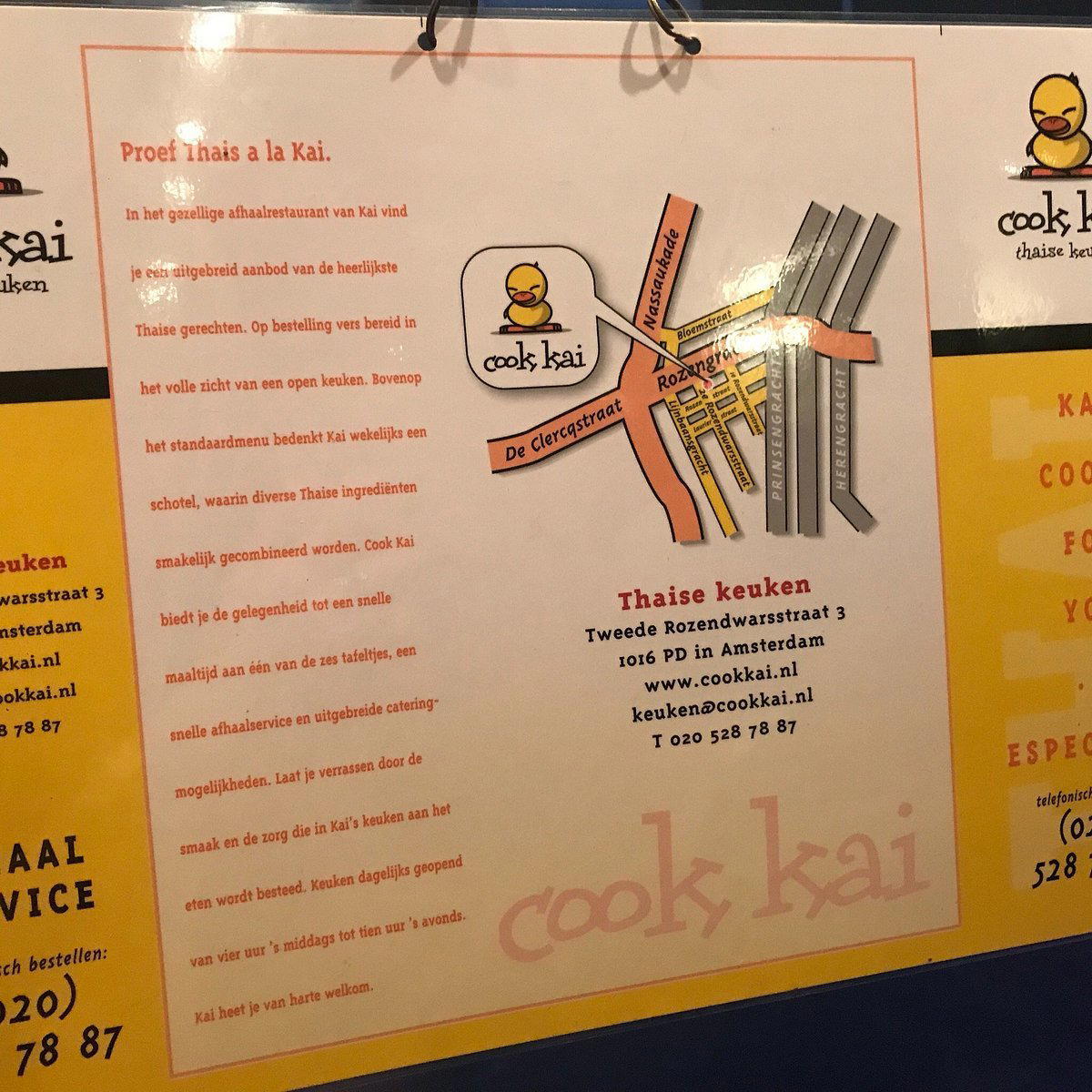
A Jordaan Address Where Sustainable Practice Is the Menu Logic
The Tweede Rozendwarsstraat is the kind of Amsterdam side street that still functions at a human scale: narrow, canal-adjacent, lined with the sort of ground-floor premises that have housed small neighbourhood restaurants for decades. Cook Kai sits on that street at number 3, as an Authentic Thai Takeaway & Snackbar in Amsterdam's Jordaan. Amsterdam's dining scene in the 2020s has split noticeably between larger-footprint restaurants built around prestige ingredients and a smaller cohort that treats supply-chain accountability as a structural principle rather than a marketing note. Cook Kai belongs to the second group.
That distinction matters because Amsterdam already has a serious sustainability-forward dining tier. De Kas, operating out of a greenhouse in Frankendael Park, set an early standard for grow-your-own procurement. BAK, in the Van Buiksloterweg area, built its reputation around farm-to-table sourcing with named producer relationships. Bolenius positioned modern Dutch cooking against a kitchen garden that supplied a meaningful portion of the menu. Against that context, any restaurant making environmental claims in this city is measured against a reasonably demanding comparable set. Cook Kai's appeal lies in how that commitment shapes the daily menu and service.
The Jordaan Setting and What It Signals
The Jordaan has long been Amsterdam's most legible neighbourhood for understanding how the city balances preservation and ambition. Its 17th-century street grid, protected canal houses, and tradition of small independent businesses make it inhospitable to the kind of scaled-up restaurant formats that require large floor plates and high table counts. What survives there tends to be specific, owner-operated, and calibrated to a local rather than tourist economy. A sustainable-practice restaurant in the Jordaan is, by the nature of the neighbourhood, unlikely to be large, likely to rely on return custom, and positioned to attract the kind of diner who cross-references sourcing credentials the way others cross-reference wine lists.
That neighbourhood character is relevant context for understanding Cook Kai's positioning. The address itself is a signal: small-street Jordaan real estate doesn't suit high-volume operations, and the format that works on Tweede Rozendwarsstraat is by definition intimate. Within Amsterdam's broader restaurant geography, that places the restaurant in a different register from the four-star hotel dining rooms that represent the city's highest-tier creative restaurants. Ciel Bleu, Flore, Spectrum, and Vinkeles all operate within formal hotel structures, with the procurement budgets and kitchen infrastructure that entails. Neighbourhood restaurants working a sustainability-first model operate with different constraints and, often, different priorities.
Sustainability as Kitchen Logic, Not Brand Decoration
Across Europe's most serious sustainability-oriented restaurants, the distinction between genuine low-waste practice and surface-level positioning has become easier to read. Kitchens that treat environmental accountability as a structural commitment show it in specific ways: whole-animal or whole-vegetable utilisation that drives the menu rather than supplementing it, producer relationships that are long-term and verifiable, and a willingness to let supply availability shape what appears on the plate rather than forcing year-round consistency through freight. This is a different discipline from listing seasonal ingredients on a menu that is otherwise built around convenience and margin.
The Netherlands has a particular advantage and a particular tension in this area. Dutch agricultural infrastructure is among the more technologically advanced in the world, producing large volumes of high-quality produce, but often through intensive, energy-heavy systems. Restaurants that are serious about low-impact sourcing in the Netherlands tend to work with smaller-scale growers specifically because the dominant supply chains don't align with their stated values. That sourcing work is labour-intensive and often expensive, which is why it tends to concentrate in smaller, independently operated restaurants rather than group operations.
For Amsterdam's sustainability-aligned restaurants, the Dutch network of serious producers extends well beyond the city. Places like De Nieuwe Winkel in Nijmegen have built menus almost entirely around plant-based, low-impact principles and earned Michelin recognition for it. De Groene Lantaarn in Staphorst and Brut172 in Reijmerstok represent the rural end of that same commitment. The Amsterdam restaurants that take this seriously are operating within a national conversation about what Dutch food identity means when removed from its industrial-scale defaults. De Librije in Zwolle and Inter Scaldes in Kruiningen anchor the higher-decoration end of that broader Dutch dining scene, providing a reference point for how far the national conversation about ingredient integrity extends.
Amsterdam's Neighbourhood Dining Circuit
The restaurant occupies a specific position within Amsterdam's mid-tier neighbourhood dining circuit, a category that has grown considerably in the past decade as the city's dining culture matured beyond its tourist-facing centre. The restaurants in this tier tend to have fewer seats, shorter menus, and stronger neighbourhood identities than their hotel-anchored counterparts. Bistro de la Mer sits nearby in the classic cuisine bracket, illustrating how the Jordaan and adjacent streets support a range of formats within the same general neighbourhood footprint.
For visitors building a broader Amsterdam dining itinerary, understanding the restaurant's position in that tier helps set expectations. This is not the category where you book six months ahead through a waiting-list system, as you might for Amsterdam's Michelin-starred rooms. It is the category where the return visitor relationship matters, where the menu reflects what the market delivered that week, and where the kitchen's priorities are legible in how the plate is composed rather than announced through press materials.
Internationally, the format the restaurant represents has clear reference points. Restaurants like Lazy Bear in San Francisco have demonstrated that ethical sourcing and serious technique can coexist at high price points, while Le Bernardin in New York City shows how ingredient-first philosophy can anchor a long-standing fine-dining reputation. The Amsterdam version of this conversation is more distributed across smaller, less formally categorised restaurants, of which the restaurant is one.
Know Before You Go
- Address: Tweede Rozendwarsstraat 3, 1016 PD Amsterdam
- Neighbourhood: Jordaan, central-west Amsterdam
- Format: Small-scale neighbourhood restaurant; intimate setting consistent with the street's character
- Booking: Walk-in-friendly service makes casual visits direct, including weekend evenings.
- Getting there: The Jordaan is walkable from Centraal Station and served by tram via Westermarkt and Elandsgracht stops.
- Context: Sits within Amsterdam's sustainability-forward dining tier alongside De Kas, BAK, and Bolenius; useful to cross-reference these when planning a longer Amsterdam visit
How It Stacks Up
Comparable venues nearby, for context on price, style, and recognition.
| Venue | Cuisine | Price | Notes |
|---|---|---|---|
| Cook KaiThis venue — the venue you are viewing | Authentic Thai Takeaway & Snackbar | $ | Not listed |
| Ree 7 | European Lunchroom | $ | Felix Meritisbuurt |
| Café Brakke | Dutch Brown Café | $$ | Bloemgrachtbuurt |
| CatuaBar Amsterdam | South American & South African Fusion | $$ | Oosterparkbuurt Noordwest |
| Canvas | Dutch & International Rooftop | $$ | Weesperzijde Midden/Zuid |
| 湖南常德牛肉粉 | Hunan Changde Beef Noodle Soup | $$ | 市中心/达姆广场 |
Continue exploring
More in Amsterdam
Restaurants in Amsterdam
Browse all →
Bars in Amsterdam
Browse all →
Hotels in Amsterdam
Browse all →

Wineries in Amsterdam
Browse all →
At a Glance
- Cozy
- Casual
- Casual Hangout
- Solo
- After Work
- Open Kitchen
- Standalone
Current opening hours
- Monday
- 4–10 PM
- Tuesday
- 4–10 PM
- Wednesday
- 4–10 PM
- Thursday
- 4–10 PM
- Friday
- 4–10 PM
- Saturday
- 4–10 PM
- Sunday
- 4–10 PM
Hours can change for holidays and private events. Last verified .
Simple, unpretentious interior with minimal decoration; small dining area (approximately 4 tables) with a visible, busy kitchen; cozy and local-focused rather than tourist-oriented.