Michelin Plate · Tabelog 100 #47
Our verdict
A Michelin Plate-recognised French restaurant in Shirokanedai, CIRPAS operates at the intersection of classical technique and seasonal Japanese produce. The name encodes its philosophy: circulation between producers, guests, and food culture, driven by passion. Geometric vegetable presentations and crab-and-caviar courses signal a kitchen that treats classical French structure as a starting point, not a ceiling.

Pearl is the En Primeur Club membership app, where members save venues, book tables and use the concierge.
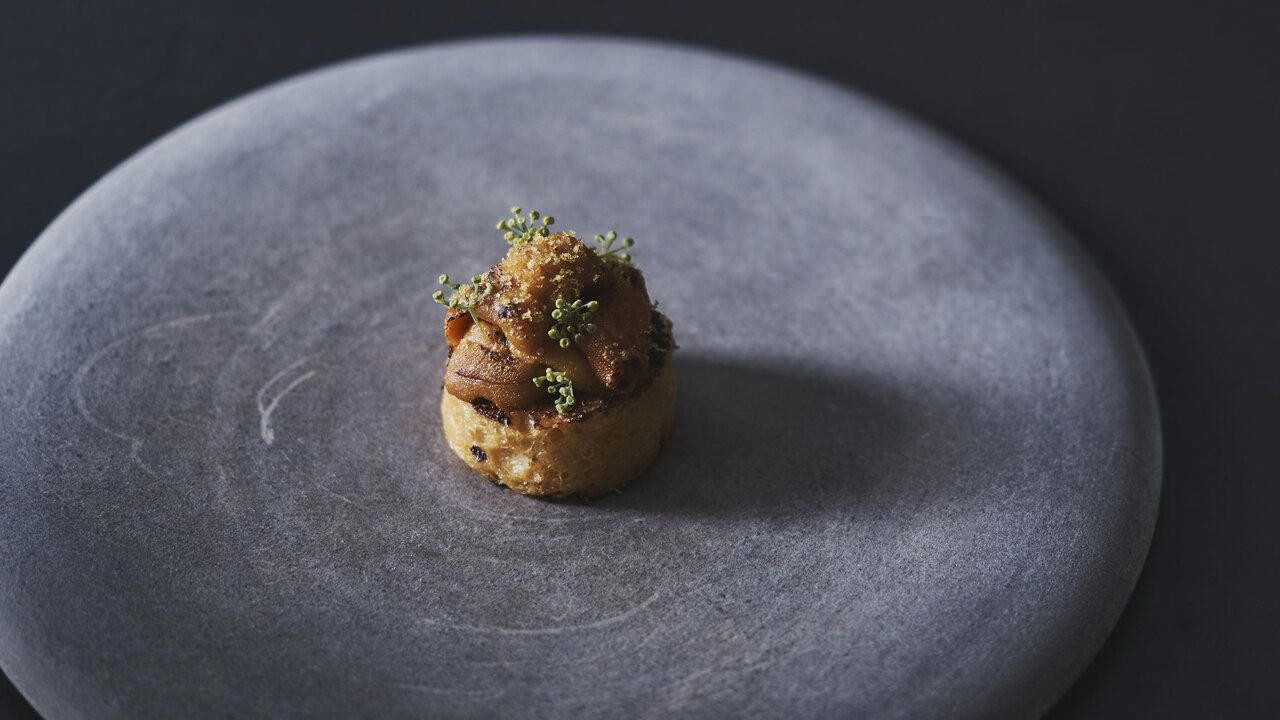
A Street-Level Counter in Shirokanedai Where French Classicism Meets Seasonal Precision
Shirokanedai is not the address most visitors associate with Tokyo's French dining scene. Ginza has the grand rooms; Omotesando draws the international press. But the quieter residential belt running south of Azabu-Juban has long sheltered a particular kind of serious cooking: smaller spaces, fewer covers, less theatre. CIRPAS sits on the ground floor of a building along the cherry-blossom-lined street the address references, in a neighbourhood where the dining proposition tends to be intimate by design rather than by accident.
The physical approach matters here. Shirokanedai's streets are unhurried in a way that central Tokyo rarely is, and arriving at a ground-floor restaurant in a low-rise building on a tree-lined block sets a register that a tower-lobby entrance cannot. Whatever the room holds, you reach it without the usual vertical transit through a hotel or a commercial tower. That ground-level immediacy is a meaningful part of how the meal begins.
What the Name Tells You About the Kitchen
The name CIRPAS is a compression of two ideas: circulation, meaning the movement of guests, producers, and food culture through the restaurant; and passion, the force that sustains it. This is not incidental branding. The framing signals a kitchen that understands itself as a node in a supply chain, not merely a destination. French cooking in Japan, at its most considered, has often worked this way: treating local producers as collaborators rather than suppliers, and letting ingredient provenance shape the menu's logic.
Tokyo's French restaurant tier is crowded at the leading. L'Effervescence and Sézanne occupy the three-star category; ESqUISSE and Florilège operate at the two-star level with strong international recognition. CIRPAS, holding a Michelin Plate in both 2024 and 2025, sits in a different bracket: recognised for cooking quality without the organisational scale or price ceiling of the starred tier. Its ¥¥¥ pricing positions it meaningfully below Château Restaurant Joël Robuchon and its starred peers, which at the top end of Tokyo French can reach ¥¥¥¥ territory with considerable distance between the two tiers.
The Sensory Architecture of the Cooking
Two documented elements of the menu illustrate how the kitchen works. The first is a crab and caviar dish, a pairing that appears across Tokyo's high-end French and contemporary Japanese rooms but rarely without a specific point of view. The interest in such a dish lies not in the ingredients themselves, both are familiar in luxury menus across the city, but in how the kitchen resolves the textural and salinity tension between them. Caviar's brine against crab's sweetness requires a calibrated hand; neither element should dominate.
The second is more telling: seasonal vegetable presentations that change throughout the year, rendered with geometric cuts and a deliberate use of colour contrast. This is a specific aesthetic choice, not a generic seasonal commitment. Geometric cutting in French technique descends from classical brigade training, where precise brunoise, julienne, and tourné shapes were markers of kitchen discipline. Applied to Japanese seasonal produce, those cuts bring a visual formality that frames each ingredient without obscuring its character. The result, at its finest, is a plate that reads as architecture before it reads as food.
The kitchen's self-description as classical French that embraces new sensibilities is a familiar positioning in Tokyo's contemporary French rooms. What distinguishes the stronger practitioners is whether that claim is visible on the plate, whether the classical foundation is genuinely load-bearing or merely decorative. The vegetable work at CIRPAS, as documented, suggests the former: a kitchen using technique to heighten ingredient rather than to perform it.
Where CIRPAS Sits in Tokyo's French Dining Structure
Tokyo's French restaurant population divides more clearly by price and format than by culinary approach. At the Michelin Plate level, the expectation is serious cooking without the full ceremony, shorter menus, more direct service, lower per-head spend. This bracket tends to attract a local clientele that returns regularly, rather than the international visitor making a single high-investment booking.
The Shirokanedai location reinforces this reading. Restaurants that rely on tourist traffic or corporate expense-account dining tend to cluster in higher-visibility postcodes. A residential address in Minato City, away from the main dining corridors, suggests a kitchen that earns its covers through word-of-mouth and repeat visits rather than location advantage. For the French dining tradition in particular, that model has significant precedent: some of the most technically rigorous French cooking in Japan has always happened in rooms that require some effort to find.
For comparison across Japan's French dining spectrum, HAJIME in Osaka and akordu in Nara each demonstrate how French-rooted kitchens operate outside Tokyo, and how the prefecture shapes the ingredient logic. Within the global French tradition, Hotel de Ville Crissier in Switzerland and Les Amis in Singapore offer reference points for how classical technique travels across different dining cultures. Within Tokyo itself, exploring the full picture requires moving across price tiers and formats: see our full Tokyo restaurants guide for the broader map, alongside our guides to Tokyo hotels, Tokyo bars, Tokyo wineries, and Tokyo experiences.
Elsewhere in Japan's premium dining geography, Gion Sasaki in Kyoto, Goh in Fukuoka, 1000 in Yokohama, and 6 in Okinawa each signal how regional identity inflects fine-dining ambition differently from Tokyo's denser competitive environment.
Know Before You Go
| Detail | Information |
|---|---|
| Address | 4 Chome-2-7, Shirokanedai, Minato City, Tokyo 〒108-0071 |
| Cuisine | French (classical with seasonal Japanese produce) |
| Price Range | ¥¥¥ |
| Recognition | Michelin Plate 2024, Michelin Plate 2025 |
| Nearest Area | Shirokanedai, Minato City |
| Booking |
Frequently asked questions
What kind of cuisine does CIRPAS serve?
Is CIRPAS award-winning?
CIRPAS has received recognition including: The restaurant’s name stems from ‘Circulation’—the flow of guests, producers, and food culture—and ‘Passion,’ the driving force behind it. One dish features crab and caviar. The presentation of seasonal vegetables changes throughout the yea….
What should I eat at CIRPAS?
The crab and caviar course is the clearest expression of CIRPAS's classical French luxury register and the most documented dish from the kitchen. Alongside it, the seasonal vegetable presentation shifts across the year with geometric cuts designed to foreground each ingredient's individual character. Between the two, you see the kitchen's range: rich, produce-led luxury on one plate and restrained, technique-forward precision on the other. Both reflect the Michelin Plate-recognised cooking that has appeared in the 2024 and 2025 guides.
What's the price range at CIRPAS?
Pricing at CIRPAS is listed as ¥¥¥.
How It Stacks Up
| Venue | Cuisine | Price | Awards | Notes |
|---|---|---|---|---|
| CIRPASThis venue (the venue you are viewing) | Modern French Omakase | $200–300 | Michelin Plate · Tabelog 100 #47 | Not listed |
| Harutaka | Edo-Style Omakase Sushi | $200–300 | 3 Michelin Stars · World's 50 Best #76 | Sushi |
| RyuGin | Modern Kaiseki | $500+ | 3 Michelin Stars · World's 50 Best #41 | Kaiseki, Japanese |
| L'Effervescence | Modern French with Japanese Influences | $200–300 | 3 Michelin Stars · World's 50 Best #69 | French |
| HOMMAGE | Modern French with Japanese Influences | $150–200 | 2 Michelin Stars · World's 50 Best #78 | Innovtive French, French |
| MAZ | Innovative Peruvian-Japanese Fusion | $150–200 | 2 Michelin Stars · World's 50 Best #28 | Innovative |
Recognition history
Dated appearances from independent guides and award organizations, with the underlying list record or original source where available.
Michelin Plate
Michelin
Tabelog 100 #47 · No. 47
Tabelog · Tabelog 100 - French - TOKYO - 2025
Full recognition history (4 entries)
Michelin Plate
Michelin
Michelin Plate
Michelin