
Tabelog 100 #5
Our verdict
Chinese Sai Oil places Sichuan and broader Chinese cooking in Osaka’s Fukushima ward into a compact, ingredient-led frame: oil, heat, and seasoning carry the argument rather than ceremony. Its Tabelog Chinese WEST 100 selections in 2021, 2023, 2024, and 2026 make it a useful marker for how Kansai diners judge serious Chinese cooking outside hotel dining rooms.

Pearl is the En Primeur Club membership app, where members save venues, book tables and use the concierge.
The menu
What to order
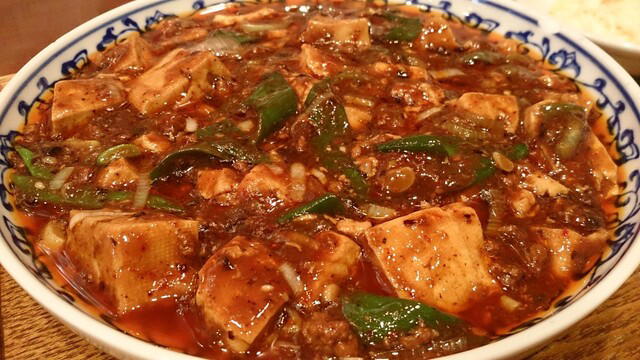
- Mapo tofu with house-made Sichuan chili oil
- Chicken and scallop shumai
- Hong Kong–style dried meats (seasonal)
- Chinese New Year osechi assortment
Approaching the small house-restaurant format in Fukushima, the first cue is scale rather than spectacle: a compact room, counter seating, and the rhythm of a neighbourhood Chinese kitchen built for repeat local use. In Osaka, Chinese dining often splits between polished hotel rooms, ramen-adjacent casual counters, and small specialist addresses where technique has to carry the room. Chinese Sai Oil belongs to that last group, with Sichuan and Chinese categories doing the heavy lifting and oil treated as a core cooking medium rather than a background fat.
That matters because Sichuan cooking is not simply about chilli volume. The better Kansai examples read through layering: aromatic oils, fermented seasonings, stock, heat management, and the way vegetables, tofu, meat, and seafood absorb seasoning at different speeds. In a city where diners can be exacting about texture and value, the restaurant’s repeated inclusion in Tabelog’s Chinese WEST 100, including 2021, 2023, 2024, and 2026, signals a place judged by consistency as much as novelty.
Oil, heat, and seasoning define the Fukushima Chinese niche
Osaka’s Fukushima ward has become a useful dining district because it is not locked into a single category. The area can support a serious counter, a family dinner, a post-work table, and a small-room specialist without demanding the theatre of central Umeda. That gives Chinese cooking space to be direct: portions, seasoning, and pacing matter more than room choreography.
The ingredient angle here starts with the restaurant’s own name. In Chinese cooking, oil is not garnish; it carries fragrance, extracts spice, and gives vegetables and proteins a different surface. That is especially relevant to Sichuan cooking, where chilli, peppercorn, aromatics, vinegar, and fermented components need a vehicle. The point is not excess, but control. A kitchen that can keep that control in a small room has an advantage over larger formats that dilute intensity for broad service.
Within the local category, this is also a value signal. Sweet Basil, listed outside the metro comparison group, sits in a similar dinner and lunch spend band, while Makino sits a step higher at dinner. Those references help frame the decision: this is not formal destination dining priced as ceremony, but a compact Chinese address operating in the serious neighbourhood tier. For readers mapping Osaka meals, compare it with other small-format choices such as age, Asia Shokudo Chouku, Bistro Mikasa, and CAFE BAHNHOF, where the same neighbourhood logic applies: limited scale, clear identity, and little tolerance for vague cooking.
A small-room format that rewards diners who care about sourcing and prep
Ingredient sourcing in this style is visible less through luxury produce and more through how the kitchen treats everyday materials. Sichuan and Chinese cooking can make a modest ingredient feel deliberate when cutting, blanching, frying, oil temperature, and seasoning sequence are handled with precision. That is why a compact counter-and-table room can be the right frame. Diners are close enough to understand pacing, but the meal does not become a performance.
The format also narrows the practical decision. Lunch and dinner serve different needs in Osaka: lunch pulls in office workers and local regulars; dinner allows more deliberate ordering and, for course meals, advance planning. The room’s small capacity and maximum seated party size make it better suited to pairs, small groups, and diners who are comfortable with a focused neighbourhood room rather than a long, leisurely banquet format. Families are part of the stated audience, though the setting favours compact logistics.
Recognition from Tabelog’s Chinese WEST 100 is not the same as a Michelin star, and it should not be read that way. Its usefulness is local: it reflects the kind of restaurant Japanese diners repeatedly shortlist within a specific cuisine and region. For Chinese Sai Oil, that places the kitchen among Kansai Chinese addresses where seasoning balance, value, and repeatability matter. It is a more relevant signal here than international glamour.
How to place it in an Osaka dining itinerary
The smart use case is a Fukushima-focused meal rather than a cross-city trophy dinner. Osaka rewards diners who build around districts: one serious restaurant, then a nearby bar, coffee stop, or second small plate if the evening runs long. For planning wider routes, Our full Fukushima restaurants guide is the natural starting point, with adjacent planning through Our full Fukushima hotels guide, Our full Fukushima bars guide, Our full Fukushima wineries guide, and Our full Fukushima experiences guide.
Readers comparing Japanese regional dining styles can also look beyond Osaka: Agu Buta Shabushabu Senmon Ten Toriou Bettei shows how a tightly defined specialty works in another register, while -Grilled beef Sukiyaki- KAMAKURA TANUKIAN 鎌倉 たぬき庵 in Kamakura. 鮪と炭火焼き うお炭 秋葉原店 in Tokyo.cafe in Osaka.know in Kumamoto, (Shoku) Vietnam in Kawasaki, [Curry Senmon Ten] Maruyama Kyoju. in Sapporo, Jōdo Saké Bar in Los Angeles, and Onigiri Time in Pasadena each illustrate how narrow formats travel across cities. The common thread is discipline: a venue does not need breadth when the central technique is clear.
For Chinese Sai Oil, the appeal is that clarity. The cooking sits in a category where ingredient handling, oil work, and seasoning structure decide the meal. In Fukushima’s dining mix, that makes it a sharp choice for diners who want Chinese food with local credibility, compact scale, and enough critical recognition to justify planning ahead.
Frequently asked questions
Where is Chinese Sai Oil in Fukushima?
Chinese Sai Oil is located in Fukushima.
What's the price range at Chinese Sai Oil?
Pricing at Chinese Sai Oil is listed as JPY 4,000 - JPY 4,999 JPY 1,000 - JPY 1,999.
What time does Chinese Sai Oil open and close?
Hours at Chinese Sai Oil: Mon: 11:30 AM–2:30 PM, 6–8:30 PM; Tue: 11:30 AM–2:30 PM, 6–8:30 PM; Wed: 11:30 AM–2:30 PM, 6–8:30 PM; Thu: 11:30 AM–2:30 PM, 6–8:30 PM; Fri: 11:30 AM–2:30 PM, 6–8:30 PM; Sat: 11:30 AM–2:30 PM, 6–8:30 PM; Sun: Closed.
What's Chinese Sai Oil best at?
Its strongest point is the combination of Sichuan and Chinese cooking in a 17-seat house restaurant, backed by selection for Tabelog 100 WEST 2026. The counter seating and small room format suit a focused meal rather than a sprawling banquet.
Is Chinese Sai Oil good for vegetarians?
It can work for vegetarians who are comfortable with Sichuan and Chinese cooking, but Those details are not published. The fixed-format details point more to a general Chinese kitchen than a plant-based specialist, so checking the course in advance is sensible. Check the venue's official channels for the latest details.
At-a-Glance Comparison
Nearby venues at a similar price tier for orientation.
| Venue | Cuisine | Price | Awards | Notes |
|---|---|---|---|---|
| Chinese Sai OilThis venue (the venue you are viewing) | Sichuan-style Chinese | Not listed | Tabelog 100 #5 | Not listed |
| Koubai Honrou | Chinese Omakase | $100–150 | Tabelog 100 #12 | Fukushima |
| Asia Shokudo Chouku | Pan-Asian set-menu restaurant and Asian tapas in Osaka | $30–50 | Tabelog 100 #56 | Fukushima |
| Ichijuu | Yakitori & Izakaya | $30–50 | Tabelog 100 #52 | Fukushima |
| PANE PORCINI | Italian-style artisan bakery | $1–10 | Tabelog 100 #85 | Fukushima |
| CAFE BAHNHOF | Specialty coffee & German-style sweets cafe | $1–10 | Tabelog 100 #79 | Fukushima Ward |
Recognition history
Dated appearances from independent guides and award organizations, with the underlying list record or original source where available.
Tabelog 100 #5 · No. 5
Tabelog · Tabelog 100 - Chinese cuisine - WEST - 2026
Continue exploring
More in Fukushima
Restaurants in Fukushima
All restaurants in Fukushima →



Bars in Fukushima
Browse all →



Hotels in Fukushima
Browse all →



Wineries in Fukushima
Browse all →
Details
- Cozy
- Lively
- Intimate
- After Work
- Casual Hangout
- Family
- Group Dining
- Solo
- Standalone
- Local Sourcing
- A La Carte
- Set Menu
Current opening hours
- Monday
- 11:30 AM–2:30 PM, 6–8:30 PM
- Tuesday
- 11:30 AM–2:30 PM, 6–8:30 PM
- Wednesday
- 11:30 AM–2:30 PM, 6–8:30 PM
- Thursday
- 11:30 AM–2:30 PM, 6–8:30 PM
- Friday
- 11:30 AM–2:30 PM, 6–8:30 PM
- Saturday
- 11:30 AM–2:30 PM, 6–8:30 PM
- Sunday
- Closed
Hours can change for holidays and private events. Hours as of .
A small, cozy neighborhood Chinese spot in Fukushima with a relaxed, welcoming atmosphere that serves office workers at lunch and families or after-work diners at night.