Cafe Americain
Cafe Americain occupies one of Amsterdam's most architecturally significant dining rooms, a grand Art Nouveau interior on Leidsekade that has drawn writers, artists, and travellers since the early twentieth century. The kitchen operates within a European brasserie tradition, positioned between the city's casual brown cafes and its Michelin-tier tables. For visitors wanting substance over spectacle, it remains a reliable address in the Leidseplein quarter.
Pearl is the En Primeur Club membership app — saves, bookings, and concierge access live there. Same editors, same standards.
- Address
- Leidsekade 97, 1017 PN Amsterdam, Netherlands
- Phone
- +31205563000
- Website
- ad.doubleclick.net
- Directions
- Get directions
 Saves & bookings on Pearl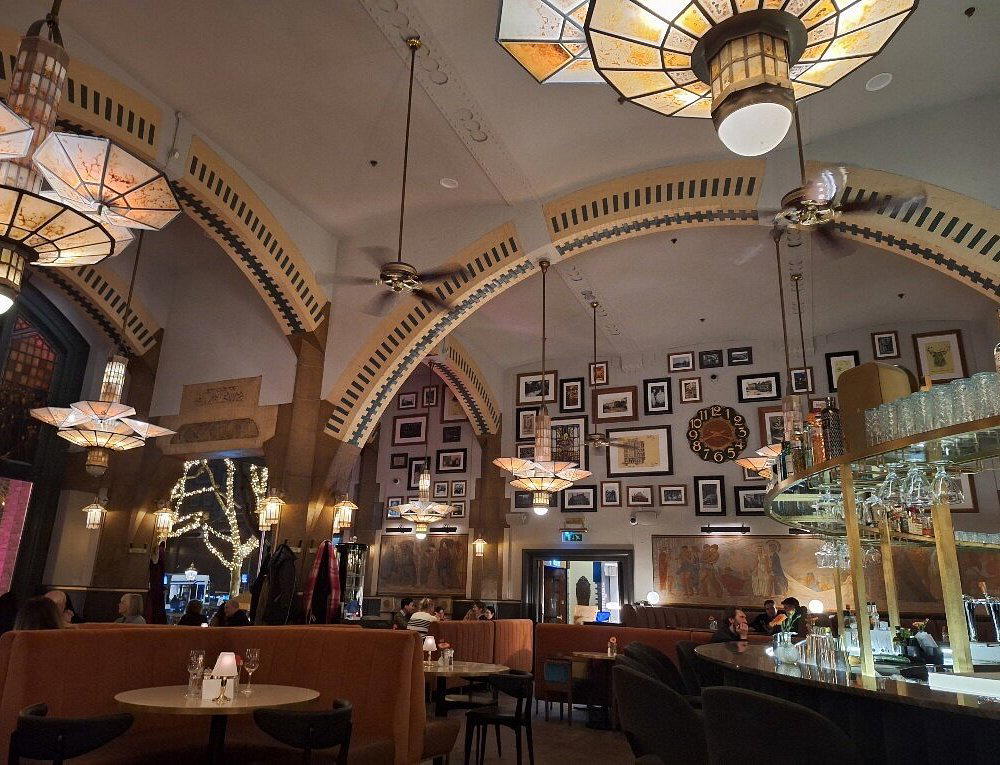
The Room Before the Menu
There are dining rooms that exist primarily as backdrops for food, and then there are rooms that function as destinations in their own right. Cafe Americain on Leidsekade belongs firmly to the second category. The interior reads as a document of early twentieth-century Amsterdam ambition: stained glass, high ceilings, bronze lamp fittings, and the particular patina that accumulates only through decades of continuous use. Walking in, the architecture announces itself before any menu arrives at the table.
The Leidseplein neighbourhood has long operated as one of Amsterdam's social hubs, drawing a mix of tourists, theatre-goers (the Stadsschouwburg sits directly adjacent), and locals who treat the square as a transit point between the Jordaan and the Oud-Zuid. Within that context, Cafe Americain occupies a position that most venues in the area do not: it has architectural weight. The building itself, part of the American Hotel complex, dates to 1902, and the dining room has been listed as a protected monument. That status shapes the experience before a single dish is considered.
Where European Brasserie Tradition Meets Dutch Sourcing
Amsterdam's dining spectrum runs from brown cafe stamppot to Michelin-starred tasting menus, and the brasserie format sits at a productive middle distance from both poles. At the high end, restaurants like Ciel Bleu, Flore, Spectrum, and Vinkeles operate in the €€€€ creative tier with extended tasting menus and sourcing narratives built around single producers. At the other end, Bistro de la Mer anchors the classic brasserie tradition around seafood in a more focused format. Cafe Americain occupies the generalist brasserie register, where the expectation is a broad European kitchen capable of handling the full arc of a meal without the formality of a set menu.
The Netherlands has developed a sophisticated ingredient infrastructure over the past two decades. Dutch greenhouse production supplies much of northern Europe with tomatoes, peppers, and herbs, and the country's proximity to the North Sea means access to some of the continent's most consistent fish landings. The polders around Flevoland and the market gardens of Westland feed a supply chain that reaches Amsterdam's kitchens with reliability that inland European cities frequently cannot match. For a brasserie operating at the restaurant's scale, that infrastructure matters practically: consistent produce availability supports the kind of broad menu that a grand cafe format requires.
Across the Netherlands, a smaller tier of kitchens has pushed ingredient sourcing toward greater specificity. De Nieuwe Winkel in Nijmegen has built its entire program around plant-based sourcing from named regional farms. De Lindenhof in Giethoorn and De Lindehof in Nuenen both anchor menus in Dutch seasonal produce within formats that are far more intimate than a city-centre grand cafe. The contrast is instructive: the brasserie model and the destination-restaurant model make fundamentally different demands on sourcing, and the restaurant's historical identity is rooted in the former.
The Grand Cafe in a City That Has Largely Moved On
The grand cafe as a format has narrowed considerably across European cities. In Paris, Vienna, and Amsterdam alike, the category that once dominated urban dining has split: some venues have drifted toward tourist-facing menus with little kitchen ambition, while a smaller group has invested in the format as a serious alternative to the tasting-menu circuit. The latter approach tends to rest on three pillars: a room with genuine character, a kitchen that sources and executes with care, and a service register that feels appropriate to the all-day format rather than borrowed from fine dining.
Amsterdam's version of this story is complicated by the city's dining boom of the 2010s, which refined restaurants like Aan de Poel in Amstelveen and saw international attention land on Dutch cooking more broadly, from De Librije in Zwolle to De Bokkedoorns in Overveen and Brut172 in Reijmerstok. That wave raised expectations for what Dutch kitchens could do with local ingredients. The grand cafe, by contrast, operates on different terms: consistency over innovation, breadth over depth, atmosphere as a primary value rather than a secondary one.
Internationally, the shift toward ingredient-transparent, tasting-focused dining has reshaped expectations at the highest tier. Restaurants like Le Bernardin in New York City and Atomix in New York City have defined what rigorous sourcing and kitchen discipline look like at the global level. The brasserie format makes no claim to compete in that register, and the better examples of the type are honest about where their value lies: in the room, the accessibility of the menu, and the ease of a meal without ceremony.
Reading the Room: Who Eats Here and Why
The restaurant's protected monument status and position inside the American Hotel places it within Amsterdam's hospitality infrastructure in a specific way. Hotel dining rooms of this vintage tend to serve three overlapping audiences: guests staying in the hotel, theatre-goers looking for a meal before or after a performance at the adjacent Stadsschouwburg, and visitors to the city seeking a setting with architectural substance rather than a contemporary fit-out. The Leidsekade address, walking distance from the Rijksmuseum and the Vondelpark, keeps it well within the range of the museum quarter's visitor circuit.
For a broader picture of where the restaurant fits within Amsterdam's full dining range, the EP Club Amsterdam restaurants guide maps the city's tables from neighbourhood bistros to Michelin-starred counters. Visitors planning a more extensive Dutch dining itinerary might also consider destinations further afield, including 't Nonnetje in Harderwijk, De Groene Lantaarn in Staphorst, and De Treeswijkhoeve in Waalre, each of which represents a different regional strand of Dutch fine dining.
Practically, the restaurant operates as a hotel restaurant within the American Hotel on Leidsekade, which means walk-in access is generally more viable than at standalone restaurants with tighter seat counts. The restaurant’s regular hours are Mon to Wed 5 PM to 12 AM, Thu 4 PM to 1 AM, Fri and Sat 1 PM to 1 AM, and Sun 1 PM to 12 AM. Reservations are recommended.
Comparable Venues
Comparable venues nearby, for context on price, style, and recognition.
| Venue | Cuisine | Price | Notes |
|---|---|---|---|
| Cafe AmericainThis venue — the venue you are viewing | Modern French Brasserie | $$$ | Not listed |
| Van De Kaart | French Regional Bistro | $$$ | Spiegelbuurt |
| Johannes | Modern French Fine Dining | $$$ | Leidsegracht Noord |
| Le Hollandais | Classic French Bistro | $$$ | Hemonybuurt |
| Verlan | Modern French Bistro | $$$ | Felix Meritisbuurt |
| Red | French Steakhouse with Lobster | $$$ | Spiegelbuurt |
Continue exploring
More in Amsterdam
Restaurants in Amsterdam
Browse all →
Bars in Amsterdam
Browse all →
Hotels in Amsterdam
Browse all →
Wineries in Amsterdam
Browse all →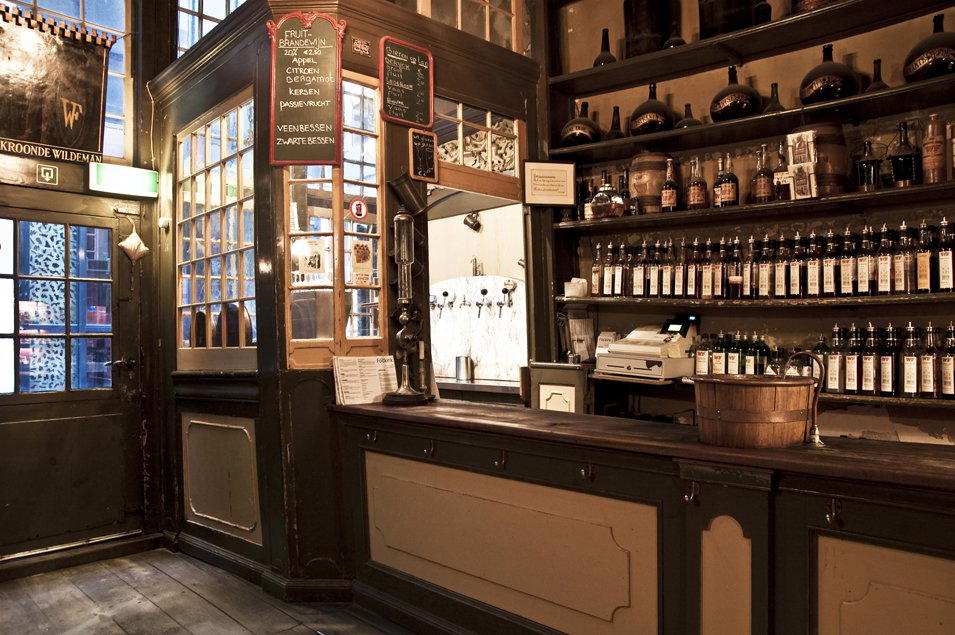
At a Glance
- Well Known
- Classic
- Elegant
- Lively
- Date Night
- Business Dinner
- Group Dining
- Casual Hangout
- Celebration
- Historic Building
- Design Destination
- Hotel Restaurant
- Terrace
- Extensive Wine List
- Beer Program
- Local Sourcing
Current opening hours
- Monday
- 5 PM–12 AM
- Tuesday
- 5 PM–12 AM
- Wednesday
- 5 PM–12 AM
- Thursday
- 4 PM–1 AM
- Friday
- 1 PM–1 AM
- Saturday
- 1 PM–1 AM
- Sunday
- 1 PM–12 AM
Hours can change for holidays and private events. Last verified .
Lively 1920s Art Deco interior with stained glass, fine woodwork, and mosaic floors; described as Amsterdam's living room with a theatrical, refined atmosphere.