Falstaff Restaurant - 92 Falstaff Points · Macarfi 6.7 Food Rating
Our verdict
Older than the Spanish state itself, Botín occupies a 1725 building on Calle Cuchilleros and holds the Guinness World Record as the oldest continuously operating restaurant. The wood-fired horno that has roasted suckling pig and lamb since the eighteenth century remains the kitchen's defining instrument.

Pearl is the En Primeur Club membership app, where members save venues, book tables and use the concierge.
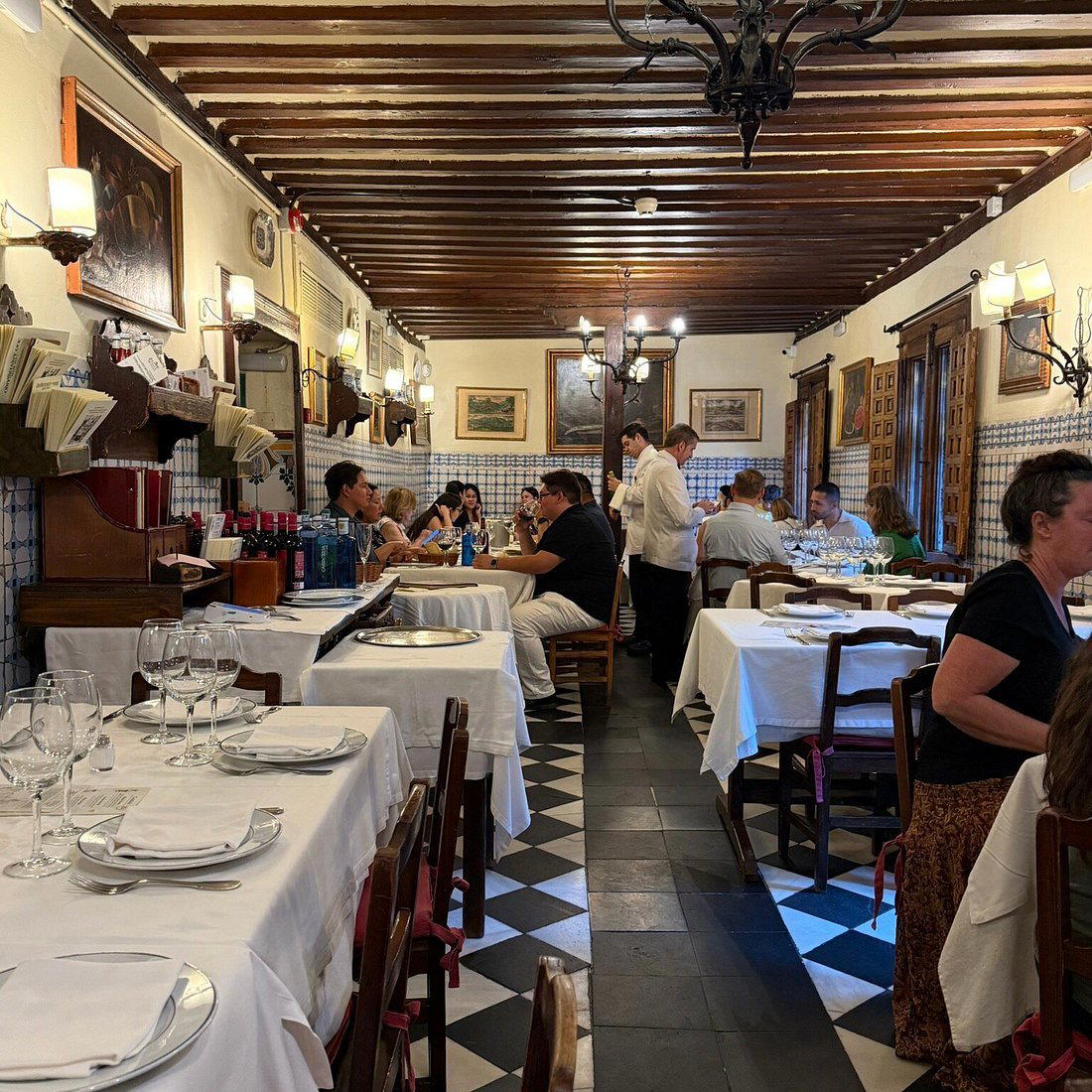
Where the Cuchilleros Cobblestones Lead
Calle de Cuchilleros drops steeply away from the southeast corner of Plaza Mayor, and the descent alone signals that you have left the tourist-facing perimeter and entered one of Madrid's oldest surviving street grids. The building at number 17 dates to 1725, its stone facade worn to the particular grey of a structure that has absorbed three centuries of wood smoke, winter cold, and the noise of the surrounding meseta capital. This is Botín, and its defining quality before you even open the door is continuity: the Guinness World Record for oldest continuously operating restaurant is not a marketing construct but a verifiable chronology that stretches back to when Felipe V was still consolidating the Bourbon line.
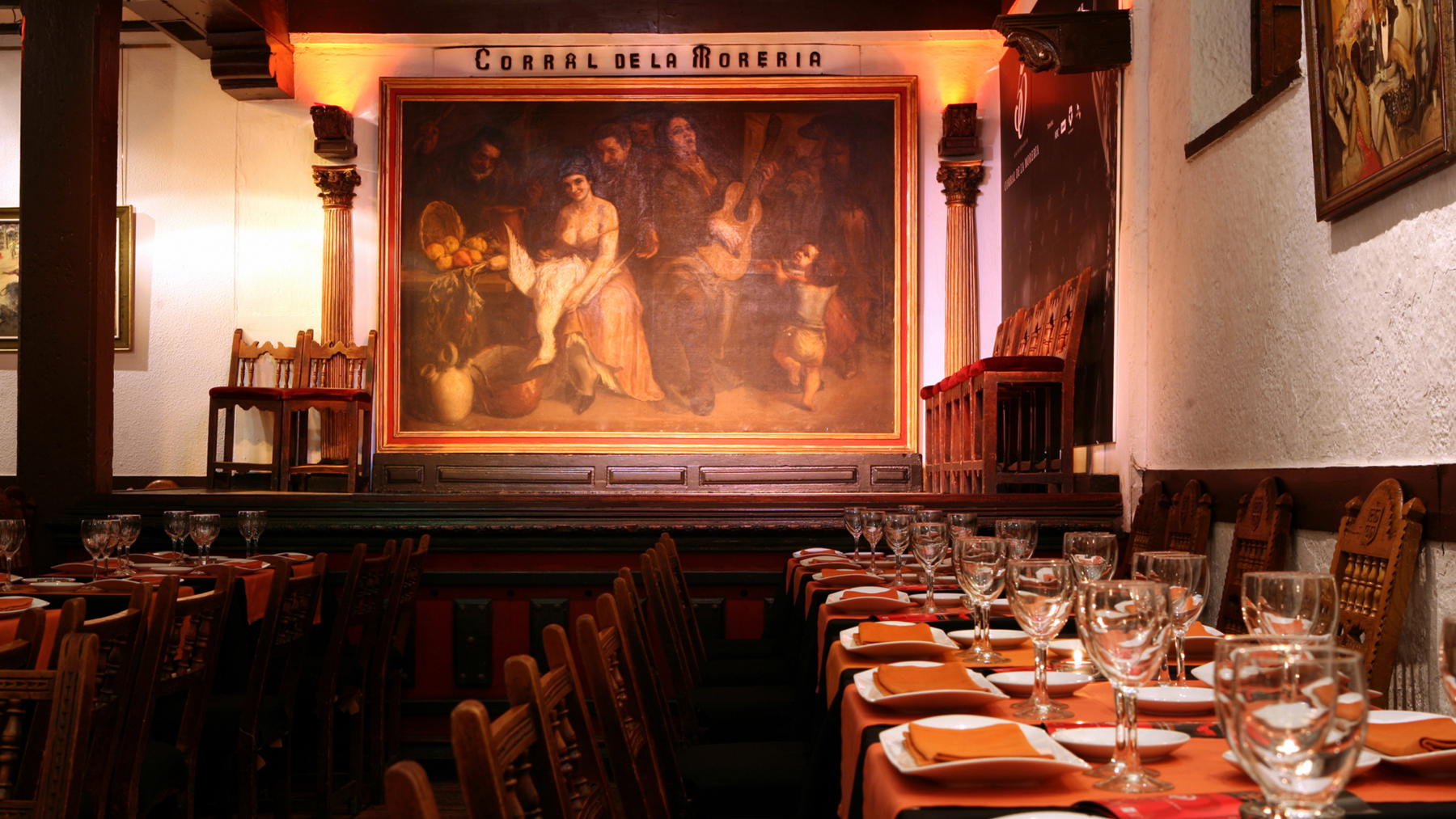
That context matters because it changes how you read the room. The ceramic tile work, the heavy wooden beams, and the horno de leña in the basement are not a designed evocation of old Castile, they are old Castile, in the plainest documentary sense. Chef José Manuel Santos oversees a kitchen that has long since folded this history into practical daily cooking rather than treating it as a performance.
The Horno as Editorial Argument
Spanish cooking at its most confident has always been wood-fire-anchored. The asador tradition that produced the northern roasting houses of Castile and Aragon operates on a simple principle: the leading animal, the right heat, and very little interference. Botín's basement horno has been running on that logic since the eighteenth century, and the cochinillo and cordero asado it produces represent the benchmark against which every other Madrid roast is implicitly measured. The 2025 Opinionated About Dining Casual Europe ranking at position 750 places Botín in assessed peer company that extends well beyond Spain, but the reference point for the cooking itself is strictly local: the meseta's livestock traditions and the firewood available from the surrounding region.
This is a restaurant that sits at a considerable remove from the creative Spanish cooking visible at DiverXO, Coque, or Deessa, all of which operate in the Michelin bracket and use the tasting-menu format to argue for a distinctly contemporary Spanish identity. Botín's argument is the opposite: that the techniques settled centuries ago are the most honest expression of the ingredient. Neither position cancels the other, but they require different expectations from the reader deciding where to book. For readers who want to trace the arc of Spanish cuisine from its foundations, Botín is the appropriate starting point; for Arzak in San Sebastián or El Celler de Can Roca in Girona or Martin Berasategui in Lasarte - Oria, the trajectory moves in a different direction entirely.
Reading the Wine List Through a Spanish Education
The wine program at a roast-focused Castilian restaurant has a clear structural logic. The suckling pig and lamb that come out of the horno have sufficient fat and richness to handle tannin, which makes the Rioja Reserva and Gran Reserva tier the natural pairing axis. Tempranillo-based wines from older vintages cut through the rendered fat without overwhelming the clean pork flavour, and a restaurant that has been serving this dish for three centuries has accumulated the institutional knowledge to match bottle age to dish in a way that newer kitchens simply cannot replicate through training alone.
But the fuller Spanish wine education at a table in this room extends beyond Rioja. Priorat, which came to international attention in the 1990s through producers working with old Garnacha and Cariñena on the llicorella slate soils of Tarragona province, offers a denser, more mineral alternative for those who want to test how the roast performs against a different structural profile. The contrast is instructive: where a well-aged Rioja Gran Reserva tends to soften and integrate, a younger Priorat from a serious producer pushes the savouriness of the crust in a different direction.
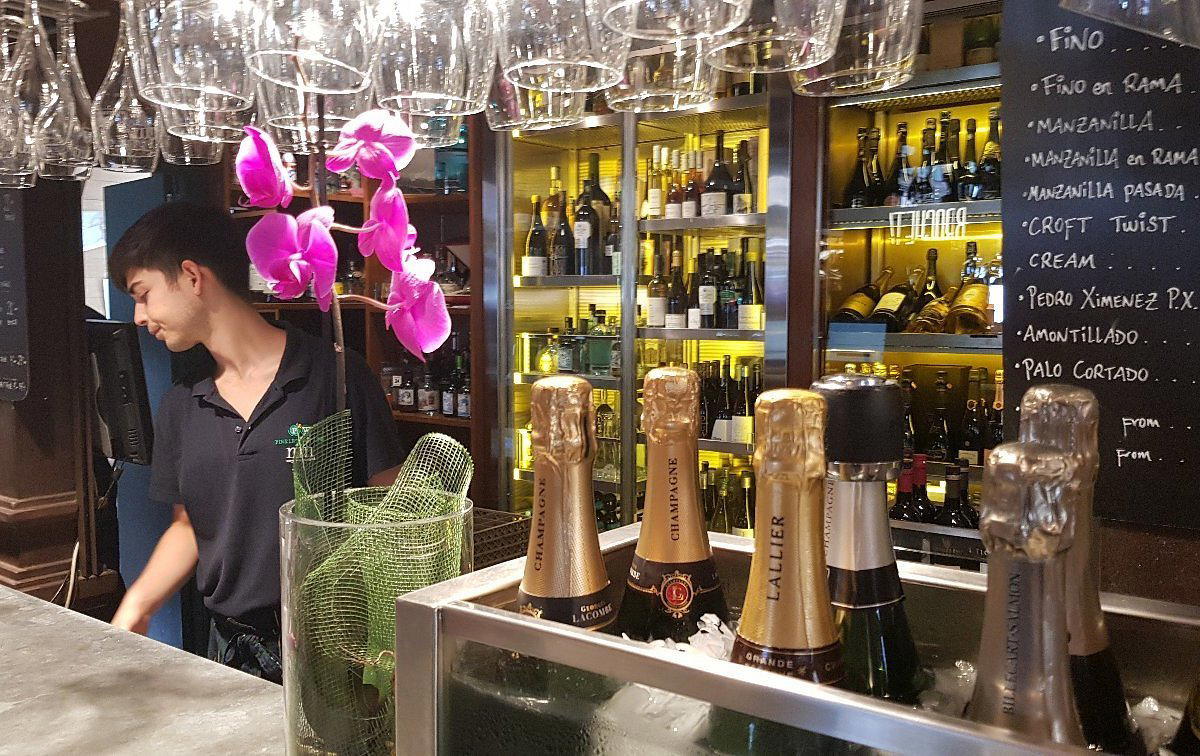
Fino and manzanilla deserve a specific mention in this room, not as an afterthought but as the most intellectually honest way to open a meal built around wood-fire cooking. Fino Sherry, served cold and fresh from a recently opened bottle, has a saline, oxidative edge that cleanses the palate before the fat of the roast arrives. The Andalusian winemaking tradition that produced these styles is formally distinct from Castile's grape-growing heritage, but the two converge in a sensible Spanish meal: the fino as aperitif, the Rioja as the main pairing, and perhaps a Pedro Ximénez or Amontillado with any sweet finish. For the reader who has been through Aponiente in El Puerto de Santa María and understands what serious Sherry country cooking looks like, the fino-to-Rioja arc at Botín completes a complementary picture of how Spain's two great wine traditions interact at the table.
The Broader Madrid Context
Centro's eating geography around Plaza Mayor and the Latina neighbourhood has its own internal logic. Casual tapas anchored by fried cod and house vermouth, represented nearby by Casa Revuelta, operate at the quick-lunch register. A more considered traditional Spanish table, with broader wine depth, puts you closer to Cuenllas or El Fogón de Trifón.
For readers building a broader Madrid itinerary, the full picture extends well beyond the Centro. Our full Madrid restaurants guide maps the city across categories and price tiers, while our full Madrid bars guide and our full Madrid wineries guide cover the drinking side of the city's food culture in more detail. Gran Café Santander and Desencaja represent two other registers worth adding to a multi-day programme. For hotel context, our full Madrid hotels guide and our full Madrid experiences guide round out the planning picture.
Spanish cooking beyond Spain also has its own geography. ZURRIOLA in Tokyo and Arco by Paco Pérez in Gdańsk show how Basque and Catalan techniques translate into contexts far removed from the meseta, while Azurmendi in Larrabetzu and Cocina Hermanos Torres in Barcelona represent the contemporary Spanish fine dining track that runs parallel to the tradition Botín represents.
Planning the Visit
The kitchen operates on a disciplined split-service model: lunch runs from 1 to 4 pm and dinner from 8 to 11:30 pm, seven days a week. That consistency is itself a signal about the operation's stability. The address, Calle de Cuchilleros 17 in the Centro district, is walkable from both the Tirso de Molina and La Latina metro stops, and the descent down the cobbled street is part of the arrival sequence.
What Should I Eat at Botín Restaurante?
The wood-roasted suckling pig (cochinillo asado) and roast lamb (cordero asado) are the kitchen's anchoring dishes and have been produced in the same horno since the eighteenth century. These are the primary reason the room exists at the cooking level: the crust, the rendered fat, and the clean animal flavour are the product of that specific heat source over that specific duration. The roast is the argument. Ordering around it, rather than treating it as one option among many, is the appropriate approach for a first visit. On the wine side, a fino or manzanilla at the start and a Rioja Reserva or Gran Reserva with the roast represents the most coherent Spanish pairing structure the menu supports.
Frequently asked questions
How do I find Botín Restaurante?
Botín Restaurante is located at C. de Cuchilleros, 17, Centro, 28005 Madrid, Spain, Madrid.
Who's behind the kitchen at Botín Restaurante?
The chef associated with Botín Restaurante is José Manuel Santos.
What should I eat at Botín Restaurante?
Order the cochinillo asado (wood-roasted suckling pig) or cordero asado (roast lamb). Both come from the same horno that has anchored the kitchen's identity since the restaurant's founding, and represent the core of the Castilian asador tradition. The wood-fire roasting method gives the dishes their structural authority on the menu, and the OAD Casual in Europe ranking (2025) reflects this focused approach over any broader ambition.
What cuisine category does Botín Restaurante fall under?
The Minimal Set
Comparable venues nearby, for context on price, style, and recognition.
| Venue | Cuisine | Price | Awards | Notes |
|---|---|---|---|---|
| Botín RestauranteThis venue (the venue you are viewing) | Traditional Spanish Roast Meats | $50–100 | Falstaff Restaurant - 92 Falstaff Points · Macarfi 6.7 Food Rating | Not listed |
| El Fogón de Trifón | Traditional Spanish Madrid Classics | $50–100 | Macarfi 8 Food Rating | Goya, Traditional Spanish Madrid Classics |
| La Mi Venta | Traditional Spanish Castilian | $30–50 | Not listed | Palacio, Traditional Spanish Castilian |
| Ramón Freixa Tradición | Traditional Spanish Cuisine | $100–150 | Guía Repsol 1 Sol · Macarfi 7.9 Food Rating | Recoletos, Traditional Spanish Cuisine |
| Los Montes de Galicia | Traditional Galician Haute Gastronomy | $50–100 | Macarfi 7.3 Food Rating | Guindalera, Traditional Galician Haute Gastronomy |
| Casa Julian de Tolosa | Basque Steakhouse | $50–100 | Macarfi 7 Food Rating | La Latina, Basque Steakhouse |
Recognition history
Dated appearances from independent guides and award organizations, with the underlying list record or original source where available.
Falstaff Restaurant - 92 Falstaff Points
Falstaff
Macarfi 6.7 Food Rating
Macarfi
Opinionated About Dining Casual in Europe Recommended
Opinionated About Dining
Full recognition history (4 entries)
Opinionated About Dining Casual in Europe Ranked #750
Opinionated About Dining