Tabelog Bronze
Our verdict
The numbered ticket system and social-media-only scheduling have generated a following that consistently pushes its Tabelog score to 3.98, backed by a 2025 Bronze Award.

Pearl is the En Primeur Club membership app, where members save venues, book tables and use the concierge.
The Queue Before the Curry
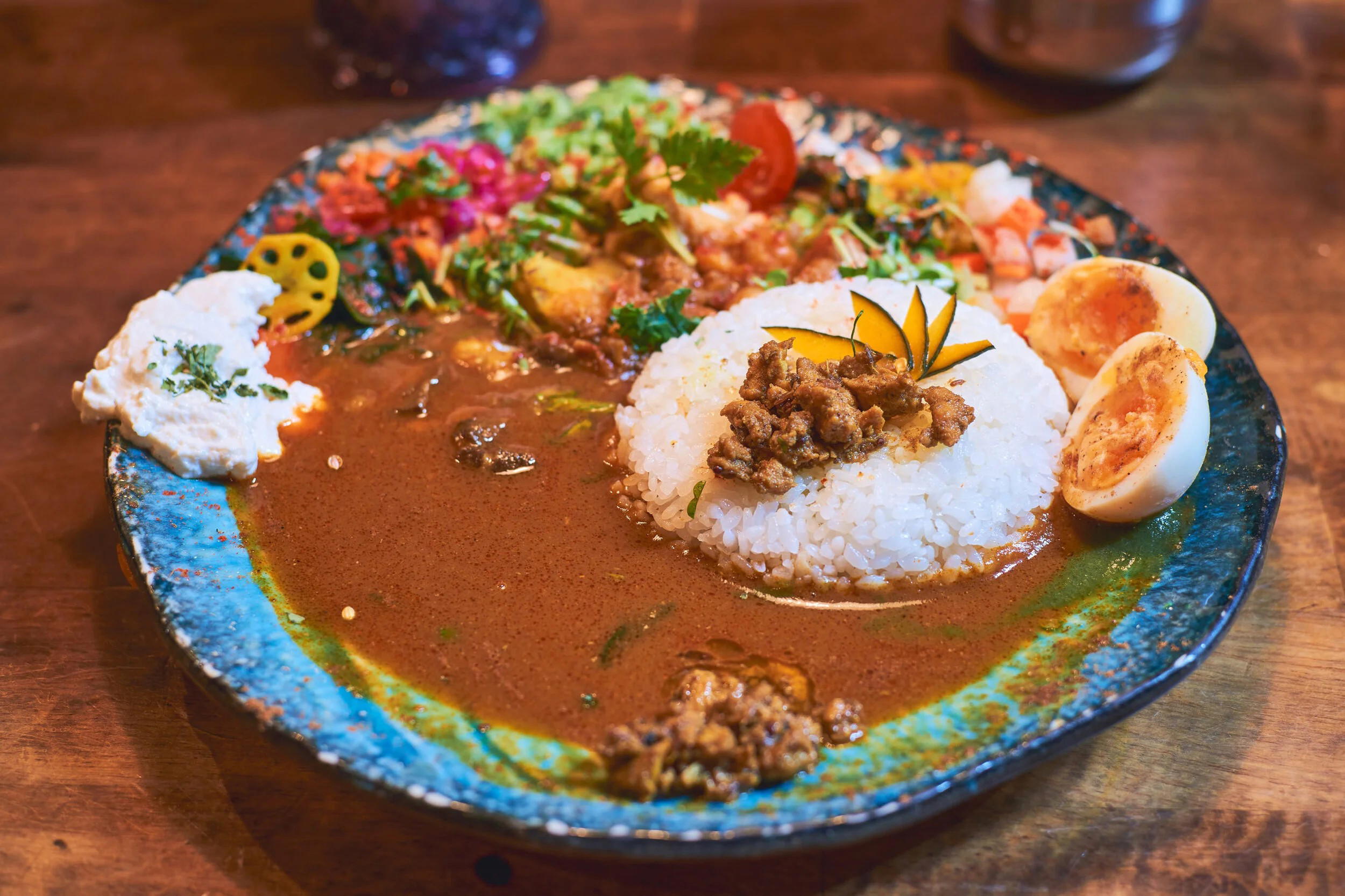
In a city whose dining culture is often framed around abundance, long restaurant streets, department-store basement food halls, izakayas open past midnight, BOTANI:CURRY operates on a deliberately contrary logic. The Nishi-Honmachi address in Chuo Ward opens one, sometimes two days a week, with no fixed schedule and no reservations. The announcement comes through social media. The doors open at 11:00 AM and close when the pot is empty. On busier service days, numbered tickets are distributed from 10:00 AM, occasionally earlier to manage the crowd that forms around the surrounding blocks. This is not a gimmick layered onto an otherwise conventional restaurant. The scarcity is structural, and the queue is the first sensory experience the venue offers: a line of people on a quiet commercial street, checking their phones for stock updates posted to Twitter in real time.enprimeurclub.enprimeurclub. BOTANI:CURRY is one of the more disciplined recent examples. Nishi-Honmachi is a mid-city district that sits between the office corridors of Honmachi and the denser commercial activity further east, not a neighbourhood tourists typically move through, and not one that announces itself as a dining destination in the way that Shinsaibashi or Namba do.
The ticket system enforces a particular rhythm on the experience. Tickets are issued one per person, and no time-specific reservations exist within the ticket framework. When tickets run out, service continues on a walk-in basis until the food is gone. The Twitter feed becomes a live dashboard for anyone waiting: stock levels, estimated wait, whether service has concluded for the day. This real-time transparency replaces the maître d' function with a kind of crowd-sourced queue management, and it generates a low-level social atmosphere outside the venue that functions as its own form of pre-meal context. By the time you are seated, there is already a shared sense of occasion among the people around you, not because anyone orchestrated it, but because the format selected for a self-selecting audience willing to organise their morning around a curry that may or may not still be available when they arrive. The Tabelog classification places BOTANI:CURRY in the Asian/Ethnic/Curry category, which is a broad tent. Within it, the venues that tend to accumulate the kind of scores and award recognition BOTANI:CURRY has achieved, a 3.98 Tabelog score and a 2025 Bronze Award, typically share a small number of characteristics: a focused menu, a consistent product that rewards repeat visits, and an operation lean enough to maintain quality without the overhead that dilutes attention.
A Tabelog score of 3.98 is meaningful context. These are not the numbers of a place people stumble into; they are the numbers of a place people plan around.enprimeurclub.enprimeurclub.enprimeurclub. BOTANI:CURRY operates on the opposite structural logic: no advance booking, no fixed schedule, no guaranteed access. The two ends of the market are not in competition; they appeal to different modes of engagement with the city's food. Our Gion Sasaki in Kyoto and akordu in Nara.
Planning a Visit
The practical reality of visiting BOTANI:CURRY requires a different kind of preparation than booking a conventional restaurant. There is no website to check and no phone number to call. The operational calendar lives entirely on the venue's Twitter and Instagram accounts, which announce open days and post stock updates during service. The ticket distribution begins at 10:00 AM, with the caveat that distribution may start earlier when the surrounding area is busy. Arriving at 10:00 AM on an announced open day is a reasonable baseline; arriving earlier improves the odds on a high-traffic day. Once tickets are distributed, service runs until sold out from the 11:00 AM open, at which point the Twitter feed confirms closure.enprimeurclub.enprimeurclub.com/restaurants/harutaka-tokyo-restaurant">Harutaka in Tokyo and Goh in Fukuoka, both of which operate with booking constraints that create a similar dynamic of intentional scarcity. For international comparison, venues like Atomix in New York City represent a different expression of the same underlying logic: the operational format itself as a signal of seriousness.enprimeurclub.com/restaurants/1000-yokohama-restaurant">1000 in Yokohama and 6 in Okinawa for readers building multi-city itineraries. For those crossing into international comparison at the premium end, Le Bernardin in New York City represents the opposite pole of operational permanence and institutional stability, a useful reference for understanding how differently the same level of dedication to craft can be organised.
What to Eat at BOTANI:CURRY
What should I eat at BOTANI:CURRY?
The Tabelog classification as Asian/Ethnic/Curry, combined with a score of 3. The practical advice is to arrive early, follow the venue's Twitter account for open-day confirmation and stock updates, and approach the visit with the flexibility the format requires rather than fixed expectations about specific dishes. The venue's social media presence is the authoritative source for current menu information on any given service day.enprimeurclub.
Frequently asked questions
Where exactly is BOTANI:CURRY?
BOTANI:CURRY is located at Japan, 〒541-0048 Osaka, Chuo Ward, Kawaramachi, 4 Chome−5−3 NIPPO 西本町ビル 日宝西本町ビル1F, Osaka.
What are the opening hours for BOTANI:CURRY?
Hours at BOTANI:CURRY: ■Business hoursCurrently open 1 to 2 days a week, as announced on our social media. Open from 11:00 until sold out. During busy hours, a numbered ticket is required for each person. After ticket distribution ends, we will continue regular service without tickets. Stock updates are provided on Twitter during business hours.*Tickets are distributed starting at 10:00 AM (may be distributed earlier to accommodate the surrounding area). Tickets cannot be reserved for specific times, and multiple tickets cannot be issued to one person.■Closed onNot fixed; currently open 1 to 2 days a week. Please check our Twitter and Instagram for updates on business and closure days.
Is BOTANI:CURRY award-winning?
BOTANI:CURRY has received recognition including: Tabelog Bronze Award 2025 Score: 3.98 Cuisine: Asian/Ethnic/Curry / Osaka Hours: ■Business hoursCurrently open 1 to 2 days a week, as announced on our social media. Open from 11:00 until sold out. During busy hours, a numbered ticket is requi….
What should I eat at BOTANI:CURRY?
What is confirmed is the botanical curry focus that earned the restaurant a Tabelog Bronze Award in 2025 with a score of 3.98, placing it among the more closely watched curry counters in Osaka's Chuo Ward. Given that the kitchen runs until sold out, arriving at ticket distribution (from 10:00 AM) rather than mid-service gives you the widest choice of whatever is on that day.
Comparable Venues
Comparable venues nearby, for context on price, style, and recognition.
| Venue | Cuisine | Price | Awards | Notes |
|---|---|---|---|---|
| BOTANI:CURRYThis venue (the venue you are viewing) | Osaka Spice Curry | $10–20 | Tabelog Bronze | Not listed |
| Moeyo Mensuke (燃えよ麺助) | Duck & Shellfish Ramen | $10–20 | Tabelog 100 #71 | Fukushima |
| Watanabe Curry Shinsaibashi ten | Japanese Curry House | $20–30 | Tabelog 100 #30 | Chūō |
| Grill Baranoki | Japanese-style Western (Yoshoku) | Not listed | Tabelog 100 #21 | Chūō |
| Stand Aida | Standing yakitori & chicken dishes | $30–50 | Tabelog 100 #93 | Chūō |
| Taisho Salon Hige to Boin | Creative Japanese Standing Bar (Obanzai) | $20–30 | Tabelog 100 #42 | Taishō |
Recognition history
Dated appearances from independent guides and award organizations, with the underlying list record or original source where available.
Tabelog Bronze
Tabelog
Full recognition history (2 entries)
Tabelog 100 #90 · No. 90
Tabelog · Tabelog 100 - Curry - WEST - 2024