Airside Dining at Leonardo da Vinci: What the Airport Format Reveals Most airport restaurants exist in a category defined by low expectations and captive customers. Bistro by Mastercard, located in Boarding Area E of Rome's Leonardo da Vinci...
- Address
- Floor, Boarding Area E, Leonardo da Vinci International Airport E2nd, Via Leonardo da Vinci, 320, 00054 Fiumicino RM, Italy
- Phone
- +396659565919
- Website
- opentable.com
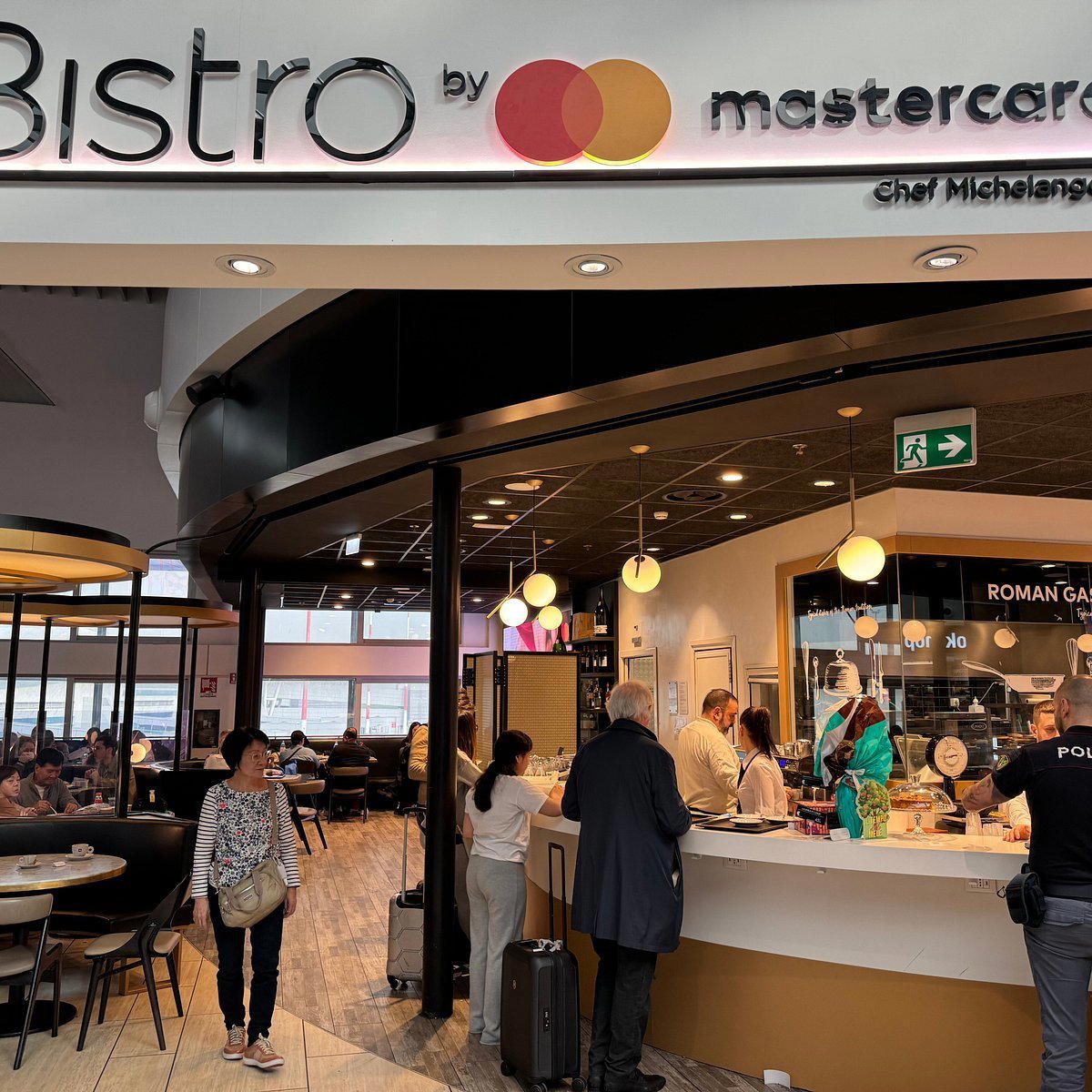
Airside Dining at Leonardo da Vinci: What the Airport Format Reveals
Most airport restaurants exist in a category defined by low expectations and captive customers. Bistro by Mastercard is a casual Traditional Roman Bistro in Boarding Area E at Rome's Leonardo da Vinci International Airport, priced at about $19 per person. The airport terminal format has been evolving across major European hubs, and Fiumicino's E gates have emerged as something of a test case for whether travel dining can connect meaningfully to regional food culture rather than defaulting to generic international fare. Sitting in that context, the Bistro by Mastercard concept is worth reading as a signal of what payment-brand hospitality partnerships are attempting to achieve in the transit space.
The physical environment of Boarding Area E at Fiumicino places the venue inside one of the busier international departure zones at Italy's largest gateway airport. The E terminal handles long-haul and Schengen departures, meaning the dining crowd is genuinely mixed: business travellers, leisure passengers in transit, and Italians heading abroad. Airport dining in this zone sits within walking distance of gates, which sets the rhythm of any meal taken here. You eat with one eye on the departure board. That temporal pressure is the defining atmospheric condition, and any honest assessment of the venue has to begin there rather than pretend the setting is something it is not.
Ingredient Sourcing in the Transit Context: A Different Kind of Supply Chain
The broader question that airport restaurants in Italy raise is whether proximity to one of the world's most ingredient-rich food cultures translates into what lands on the plate. Rome's agricultural hinterland, the coastal waters of the Tyrrhenian Sea to the west, and Lazio's wine country all sit within a radius that, in theory, makes sourcing from quality producers feasible even for a high-throughput transit operation. Whether a branded bistro concept within an airport structure can build those sourcing relationships is a different question from whether a dedicated independent like L'Osteria dell'Orologio in Fiumicino town can do so, and the comparison is instructive. Established restaurant operations with direct chef relationships to local fishermen and produce suppliers have both the time and the negotiating position to make ingredient provenance central to the offer. Airport food-and-beverage outlets face contract structures, logistics constraints, and volume requirements that complicate that relationship considerably.
This is not a small distinction. Italy's dining culture is built on the idea that ingredients carry the argument: that fish landed the same morning, or tomatoes grown in volcanic soil, or aged Parmigiano Reggiano at a specific maturation point communicate something that technique alone cannot replicate. Venues like Uliassi in Senigallia or Quattro Passi in Marina del Cantone have built significant reputations precisely around that sourcing discipline. At the other end of the spectrum, airport formats typically standardize for consistency across service periods, which works against seasonal, producer-specific purchasing.
What the Mastercard Partnership Format Signals
Payment-brand restaurant partnerships have become a recognizable category in premium travel, most visible in airport and hotel contexts. The model typically combines cardholder access benefits with a hospitality concept that signals quality without anchoring to a specific culinary identity the way a chef-led venue does. This positioning has trade-offs. The benefit is accessibility and consistency across the brand's footprint. The limitation is that without a named culinary program or defined sourcing philosophy, the food offer can default to a broadly Italian menu that reads competently but does not reflect the specificity that makes the regional food culture worth engaging with in the first place.
For comparison, Italy's serious dining addresses, from Osteria Francescana in Modena to Reale in Castel di Sangro to Piazza Duomo in Alba, are defined almost entirely by the sourcing relationships and culinary positions their teams have staked out over years. Dal Pescatore in Runate and Le Calandre in Rubano represent a similar long-game approach built on specific regional identities. Bistro by Mastercard is not competing in that category and should not be assessed against it. The more relevant peer comparison is other payment-brand or airport-format dining concepts at major European hubs, where the question is whether the food offer rises above the category baseline.
Fiumicino's Broader Dining Context
The town of Fiumicino itself has a more interesting food identity than its airport-adjacent reputation suggests. The harbour area supports a cluster of seafood restaurants that draw from the day's catch at Fiumicino's fishing port, and the local dining scene skews toward honest coastal Italian cooking rather than tourist-oriented generics. Clementina and 4112 represent the more casual end of that scene, while Il Tino (Creative) and L'Osteria dell'Orologio push toward more considered cooking. Doppio Malto covers a different register entirely, leaning into craft beer and pub-format dining. This range matters because it illustrates how much the food culture surrounding the airport differs from what travelers typically encounter inside it.
For anyone with time before a flight, the decision between eating airside and eating in Fiumicino town is a meaningful one. The logistics require accounting for transfer time back through security and passport control, and the E-gate location specifically means additional transit. The practical calculus generally favors eating in town only with a layover of three hours or more. Our full Fiumicino restaurants guide covers the town options in detail for those planning accordingly.
Planning a Visit
Bistro by Mastercard is located on the second floor of Boarding Area E at Fiumicino, accessible only after security and passport control for international departures. Pricing is around $19 per person.
Quick Comparison
Comparable venues nearby, for context on price, style, and recognition.
| Venue | Cuisine | Price | Awards | Notes |
|---|---|---|---|---|
| Bistro by MastercardThis venue — the venue you are viewing | Traditional Roman Bistro | $$ | , | |
| Doppio Malto | Italian Steakhouse & Brewery | $$ | , | Fiumicino Airport |
| 4112 | Traditional Italian Seafood Osteria | $$ | , | Fiumicino |
| L'Osteria dell'Orologio | Modern Italian Seafood | $$$ | Michelin Plate | Fiumicino |
| Clementina | Modern Roman Pizza | $$$ | 2 recognitions | Fiumicino |
| QuarantunoDodici | Riverside Lazio Seafood Osteria | $$$ | Bib Gourmand | Nautilus Marina |
Continue exploring
More in Fiumicino
Restaurants in Fiumicino
Browse all →
Bars in Fiumicino
Browse all →
Hotels in Fiumicino
Browse all →

Wineries in Fiumicino
Browse all →
At a Glance
- Modern
- Casual Hangout
- After Work
Modern airport bistro atmosphere designed for quick yet quality dining.