
Tabelog 100 #57
Our verdict
Banri belongs to Yokohama’s everyday dumpling culture rather than its ceremonial dining tier: a Noge address, Chinese-dumpling category, counter and tatami seating, and repeat selection for Tabelog’s Dumplings 100 in 2019, 2021, and 2024. Its appeal is the regulars’ equation: gyoza, Chinese comfort cooking, sake or shochu, and a room built for friends and families rather than spectacle.

Pearl is the En Primeur Club membership app, where members save venues, book tables and use the concierge.
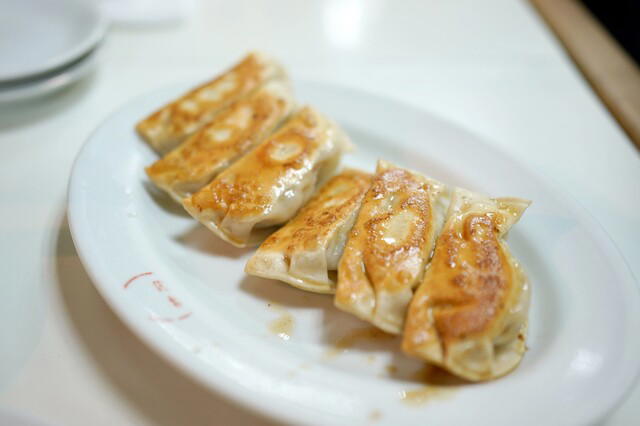
Noge announces itself at pavement level: low-rise storefronts, drinking rooms, quick dinners, and the after-work rhythm that keeps Yokohama from feeling like a satellite of Tokyo. In that setting, dumplings are not a side order to be dressed up. They are the point of the stop, the thing that decides whether a table becomes a habit. Banri fits that local grammar: Chinese cooking, gyoza recognition, counter seats downstairs, tables and tatami upstairs, and a clientele pattern that reads more like routine than occasion.
Yokohama has always had a stronger Chinese-food identity than many Japanese port cities, but Noge’s version is less about banquet formality and more about democratic appetite. The useful comparison is not with polished tasting-menu rooms; it is with neighbourhood places where the check stays modest, the drinks are familiar, and the measure of quality is return traffic. Within Yokohama’s casual bracket, Sumire Yokohama ten, Shinki, Yoshoku Kimura Noge ten, Hanamichi, and Noge Highball all sit in the same broader spending conversation. Banri’s distinction is narrower: dumplings and Chinese plates, backed by selection for Tabelog’s Dumplings 100 in 2019, 2021, and 2024.
Noge regulars read dumpling houses by rhythm, not ceremony
The regulars’ perspective matters here because gyoza shops are judged through repetition. A first-time diner may look for a famous dish or a dramatic room; locals look for consistency, speed, seating that works for the group, and enough drink structure to turn dinner into a casual session. The listed drinks, sake and shochu, place the meal in a familiar Japanese-Chinese register rather than a wine-led or cocktail-led format. Take-out adds another signal: this is a dumpling address with a life beyond the table.
The category also explains the award signal. Tabelog’s Dumplings 100 is not a luxury ranking; it rewards a specialist field where small differences in dough, filling, cooking, and turnover carry weight with diners. A score of 3.50 on Tabelog, paired with repeat Dumplings 100 selection, puts Banri in the conversation for visitors who care about Yokohama’s everyday food culture, not just its premium reservations. That makes it a sharper choice than a generic Noge dinner when the point of the evening is gyoza rather than a wide survey of Japanese cuisine.
Its physical setup reinforces that role. A 42-seat layout spread across counter seating, table seating, and tatami seating means the room can absorb solo diners, pairs, families, and small groups without forcing one mode of dining onto everyone. The maximum seated party size is listed at eight, which suits the kind of friends’ dinner where dumplings and Chinese plates are ordered in multiples. Private rooms and private use are not part of the format, so the experience stays public and neighbourhood-facing.
The value is in Yokohama's casual Chinese lane
Yokohama dining often gets reduced to two images: Chinatown for visitors and Minato Mirai for waterfront polish. Noge offers the third version, more useful for repeat travellers: compact, social, and built around modest checks. In that ecosystem, Banri’s pricing band keeps it aligned with casual restaurants rather than destination fine dining. The smarter read is to treat it as a specialist stop before or after drinks, not as a long-form evening built around ceremony.
That matters for planning a Yokohama food day. A premium itinerary might put sushi, kaiseki, or French-Japanese cooking in the anchor slot, then use Noge for contrast: dumplings, Chinese comfort cooking, and a looser room. For travellers mapping the city by genre, Our full Yokohama restaurants guide is the wider dining frame, while Our full Yokohama bars guide helps explain why Noge works so well after dinner. Hotels, wineries, and experiences sit in separate planning lanes through Our full Yokohama hotels guide, Our full Yokohama wineries guide, and Our full Yokohama experiences guide.
Within Yokohama, it also helps to separate specialist comfort food from broader casual dining. 1000 (Yakitori (Grilled chicken skewers)) points toward the grilled-skewer lane, Aichun keeps the Chinese conversation in view, Ajowan and Alpenjiro Honten sit closer to curry culture, and Anzen Shokudo shows how far the casual Japanese spectrum runs outside Yokohama’s waterfront image. The useful point is not that these are interchangeable; it is that Yokohama rewards choosing a lane before choosing a table.
How to place it in a wider Japan eating itinerary
For travellers moving through Japan, Banri works as a reminder that city dining is often clearest at the category level. Dumplings in Yokohama are a different proposition from beef sukiyaki in Kamakura, tuna and charcoal grilling in Tokyo, café culture in Osaka, or curry in Sapporo. The comparison is useful because it keeps expectations precise: this is a compact, casual Chinese-dumpling address in Noge, not a chef-led dégustation or a hotel-restaurant set piece.
That wider map can be built through genre rather than prestige. -Grilled beef Sukiyaki- KAMAKURA TANUKIAN 鎌倉 たぬき庵 in Kamakura belongs to a different regional appetite, while. 鮪と炭火焼き うお炭 秋葉原店 in Tokyo.cafe in Osaka.know in Kumamoto, (Shoku) Vietnam in Kawasaki, and [Curry Senmon Ten] Maruyama Kyoju. in Sapporo show how specific each local food decision becomes once the cuisine lane is fixed. Across the Pacific, Jōdo Saké Bar in Los Angeles and Onigiri Time in Pasadena extend the same principle: Japanese food culture travels, but context changes the meal.
The verdict is practical rather than grand. Banri is for diners who want Yokohama’s Noge side at table height: dumplings, Chinese plates, a casual seating mix, and enough recognition to justify singling it out from the neighbourhood’s many easy dinners. Its reputation rests on a narrow promise, which is exactly why it belongs on a serious Yokohama list.
Frequently asked questions
How much does it cost to eat at Banri?
Pricing at Banri is listed as JPY 2,000 - JPY 2,999 - JPY 999.
Where is Banri located?
Banri is located in Yokohama.
What are the opening hours for Banri?
Hours at Banri: Mon: 12–3 PM, 4:30–9 PM; Tue: 12–3 PM, 4:30–9 PM; Wed: 12–3 PM, 4:30–9 PM; Thu: 12–3 PM, 4:30–9 PM; Fri: 12–3 PM, 4:30–9 PM; Sat: 12–9 PM; Sun: 12–9 PM.
What has Banri built its reputation on?
Banri has built its name on dumplings, backed by selection in Tabelog 100 Dumplings in 2024, 2021, and 2019. In Yokohama’s Nogecho area, that puts it in the category of dependable, no-frills Chinese dining rather than destination theatrics.
Recognition Snapshot
Comparable venues for orientation by cuisine and category.
| Venue | Cuisine | Price | Awards | Notes |
|---|---|---|---|---|
| BanriThis venue (the venue you are viewing) | Chinese Dumplings | $20–30 | Tabelog 100 #57 | Not listed |
| Saiko Shinkan | Traditional Cantonese & Dim Sum | $30–50 | Tabelog 100 #23 | Naka |
| Yokohama Tonton | Chinese Dumpling House | Not listed | Tabelog 100 #86 | Hodogaya |
| Chen Kenichi Mapo Tofu Restaurant (陳建一麻婆豆腐店) | Sichuan Mapo Tofu Specialist | Not listed | Not listed | Minatomirai |
| Juraku | Traditional Chinese sweets and bakery | $1–10 | Tabelog 100 #58 | Naka |
| Manchin ro Honten | Historic Cantonese fine dining in Yokohama Chinatown | $50–100 | Tabelog 100 #87 | Naka |
Recognition history
Dated appearances from independent guides and award organizations, with the underlying list record or original source where available.
Tabelog 100 #57 · No. 57
Tabelog · Tabelog 100 - Dumplings - 2024
Continue exploring
More in Yokohama
Restaurants in Yokohama
All restaurants in Yokohama →



Bars in Yokohama
Browse all →





Details
- Classic
- Cozy
- Energetic
- Family
- Group Dining
- Casual Hangout
- Solo
- Standalone
- Sake Program
- Beer Program
- A La Carte
- Counter Dining
- Sake
- Shochu
- Vegetarian Friendly
Current opening hours
- Monday
- 12–3 PM, 4:30–9 PM
- Tuesday
- 12–3 PM, 4:30–9 PM
- Wednesday
- 12–3 PM, 4:30–9 PM
- Thursday
- 12–3 PM, 4:30–9 PM
- Friday
- 12–3 PM, 4:30–9 PM
- Saturday
- 12–9 PM
- Sunday
- 12–9 PM
Hours can change for holidays and private events. Hours as of .
Casual, busy local Chinese-dumpling house with counter, table, and tatami seating; reviews and category signals suggest a lively neighborhood atmosphere rather than a formal dining room.