
Tabelog 100 #87
Our verdict
Yokohama Chinatown’s grand Cantonese tradition reads differently in 2026: not as nostalgia, but as menu architecture built for families, private rooms, seafood-led ordering and dim sum alongside formal Chinese dining. Manchin ro Honten sits in the higher-priced tier of the district, with Tabelog Chinese EAST 100 selection in 2026 and a scale few destination restaurants attempt.

Pearl is the En Primeur Club membership app, where members save venues, book tables and use the concierge.
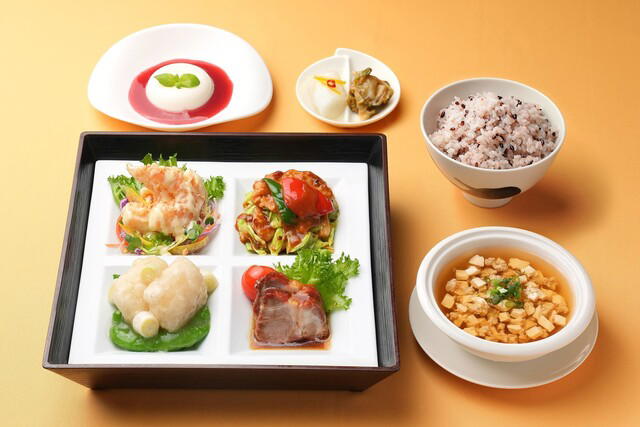
The menu
What to order
- Ryusen seafood congee
- Shark fin soup
- Gomoku fried noodles
- Bean curd with spicy bean paste
Approaching Yokohama, the restaurant conversation changes from counter intimacy to procession: larger dining rooms, shared meals, and a sense of occasion rather than single-dish tourism. This is where Chinese cooking in Japan can be read through occasion as much as technique. Manchin ro Honten belongs to that broader register, a restaurant in Yokohama where the menu can serve several roles at once: dim sum lunch, dinner, celebratory meals, and group dining that wants ceremony without hotel formality.
That breadth matters because Yokohama’s Chinese dining scene is not one market. Places such as Aichun, Juraku, Kinryo and Goku Chasou show one side of the city’s range, while Du Vin HACHISCH points to another kind of Yokohama dining. Manchin ro Honten occupies its own lane: higher than a casual stop, less about chef-counter scarcity, and more about the shared-dish grammar of a large Chinese restaurant with room for different kinds of occasions.
Chinese menu architecture built for groups, not solo spectacle
The useful way to read the restaurant is through structure. Chinese and dim sum sit together here, which gives the meal two tempos: smaller pieces suited to lunch or mixed tables, then larger dishes that make sense when ordered across a group. That combination supports the restaurant’s appeal without requiring one signature plate to carry the reputation. No single named dish needs to define the experience; the point is the range.
That range is also a Yokohama story. The city’s Chinese food culture can be approached through shared meals and family-style ordering rather than only the late-stage luxury model of tiny counters and severe reservation scarcity. A large house can sound unfashionable in an era that fetishises small rooms, but in Yokohama it signals another kind of authority: the ability to welcome broader ordering and longer meals without reducing the cuisine to a tasting-menu format. This is not the place to judge by minimalism. It should be judged by whether the menu supports a table that wants dim sum, shared dishes, dessert and drinks in one sitting.
The 2026 Tabelog Hyakumeiten recognition gives that scale a contemporary trust signal. Tabelog recognition is not the same as a Michelin-starred tasting room, and it should not be read that way. It is more useful as a signal of relevance inside Japan’s user-driven restaurant culture, especially for a category where regional Chinese cooking, established restaurants and higher-spend rooms coexist awkwardly on the same maps. The restaurant’s 3.69 Tabelog score places it in a serious bracket without pretending it is a tiny destination counter.
Yokohama's grand-room tradition still has a purpose
Large-format Chinese dining can look conservative from the outside, but it solves problems that smaller restaurants often cannot: group orders, shared dishes, and a meal that can stretch beyond a quick stop. That kind of infrastructure is part of the experience, not a footnote. In Japan, where many destination restaurants are built around compact counters and fixed rhythms, a Chinese house with scale gives travellers a different read on hospitality.
The price band reinforces that positioning. Dinner sits at JPY 10,000 to JPY 14,999, with lunch at JPY 4,000 to JPY 4,999, so this is not the cheap-snack version of a Yokohama Chinese meal. It asks to be treated as a planned meal, especially for travellers comparing it with a broader Yokohama itinerary. For a full city view, Our full Yokohama restaurants guide is the better starting point, while hotel planning belongs in Our full Yokohama hotels guide, drinks in Our full Yokohama bars guide, regional bottles in Our full Yokohama wineries guide, and culture-led scheduling in Our full Yokohama experiences guide.
There is also a practical editorial point here: Yokohama rewards diners who do not treat Chinese dining as a single stop between photo opportunities. A meal here can anchor the day, but it pairs better with a deliberate route through Yokohama than with a rushed snack crawl. Other Yokohama dining rooms show how varied the city’s restaurant map becomes once Chinese dining is treated as one chapter rather than the whole book. The wider field also adds casual counterpoints for travellers deciding how formal they want the meal to be.
How to place it within a wider Japan trip
For travellers moving through Japan, the comparison should be category-based rather than fame-based. Some Japanese meals are built around a narrower format, while other urban restaurants speak to different instincts of speed, specialisation or novelty. Across Japan, regional dining priorities shift by city and cuisine, so Manchin ro Honten is best understood through its Yokohama setting rather than forced into a single national hierarchy.
Seen that way, Manchin ro Honten is not trying to compete with every destination restaurant in Japan. Its value is narrower and clearer: a Yokohama Chinese house operating with enough breadth for group ordering while carrying Tabelog Hyakumeiten recognition for 2026. Travellers coming from overseas references should not expect the compact, concept-led logic of contemporary small-format dining. This is a meal shaped by Yokohama, shared ordering and Chinese range.
The editorial call is simple: choose it when the meal needs breadth, formality without stiffness, and a Yokohama setting with evidence behind the reputation. For two diners chasing novelty, the scale may feel larger than necessary. For mixed groups, dim sum ordering or a more formal shared meal, the format makes sense in a way many smaller restaurants cannot match.
Frequently asked questions
What days is Manchin ro Honten closed?
Current opening days and hours should be checked directly with Manchin ro Honten before visiting.
Is Manchin ro Honten more mid-range or high-end?
Pricing at Manchin ro Honten is listed as Dinner: JPY 10,000 - JPY 14,999; Lunch: JPY 4,000 - JPY 4,999.
What part of town is Manchin ro Honten in?
Yokohama.
What is Manchin ro Honten known for?
Manchin ro Honten is known for Chinese, dim sum and yum cha service in Yokohama, plus its Tabelog Hyakumeiten recognition for 2026. Its broad restaurant format makes it a strong fit for shared meals and group dining in Yokohama.
Is Manchin ro Honten good for vegetarians?
Vegetarian diners can use the Chinese, dim sum and yum cha menu as a starting point, but should confirm suitable dishes directly with the restaurant. In Yokohama, it is best approached as a broad shared-dining restaurant rather than a dedicated vegetarian venue.
Nearby-ish Comparables
Comparable venues at a glance for context.
| Venue | Cuisine | Price | Awards | Notes |
|---|---|---|---|---|
| Manchin ro HontenThis venue (the venue you are viewing) | Historic Cantonese fine dining in Yokohama Chinatown | $50–100 | Tabelog 100 #87 | Not listed |
| Juraku | Traditional Chinese sweets and bakery | $1–10 | Tabelog 100 #58 | JPY 999 - JPY 999 |
| Du Vin HACHISCH | French | Not listed | Tabelog 100 #55 | JPY 15,000 - JPY 19,999 JPY 8,000 - JPY 9,999 |
| Kinryo | Traditional Cantonese roast meats | $10–20 | Tabelog 100 #21 | JPY 1,000 - JPY 1,999 JPY 1,000 - JPY 1,999 |
| Goku Chasou | Traditional Chinese Teahouse & Cafe | $10–20 | Tabelog 100 #12 | JPY 2,000 - JPY 2,999 JPY 1,000 - JPY 1,999 View spending breakdown |
| Aichun | Traditional Cantonese in Yokohama Chinatown | $10–20 | Tabelog 100 #82 | JPY 1,000 - JPY 1,999 JPY 1,000 - JPY 1,999 |
Recognition history
Dated appearances from independent guides and award organizations, with the underlying list record or original source where available.
Tabelog 100 #87 · No. 87
Tabelog · Tabelog 100 - Chinese cuisine - EAST - 2026
Continue exploring
More in Yokohama
Restaurants in Yokohama
All restaurants in Yokohama →



Bars in Yokohama
Browse all →






Details
- Classic
- Elegant
- Well Known
- Sophisticated
- Business Dinner
- Group Dining
- Family
- Celebration
- Special Occasion
- Private Event
- Private Dining
- Historic Building
- Standalone
- Design Destination
- Local Sourcing
- Street Scene
- A La Carte
- Set Menu
- Family Style
- Small Plates
- Allergy Accommodating
Current opening hours
- Monday
- Closed
- Tuesday
- 11 AM–3 PM, 5–10 PM
- Wednesday
- 11 AM–3 PM, 5–10 PM
- Thursday
- 11 AM–3 PM, 5–10 PM
- Friday
- 11 AM–3 PM, 5–10 PM
- Saturday
- 11 AM–10 PM
- Sunday
- 11 AM–10 PM
Hours can change for holidays and private events. Hours as of .
Large, classic Chinatown landmark with a striking exterior, formal yet welcoming service, and a lively dining room suited to families and celebratory groups.