
A small soba house in Sumida, Azumabashi Yabusoba belongs to Tokyo’s everyday noodle culture rather than its luxury tasting-menu circuit. Its appeal is grounded in buckwheat, a short lunch service, an 18-seat room, and repeated selection for Tabelog’s Soba EAST 100 list, including 2025.
Pearl is the En Primeur Club membership app — saves, bookings, and concierge access live there. Same editors, same standards.
- Address
- 1 Chome-11-2 Azumabashi, Sumida City, Tokyo 130-0001, Japan
- Phone
- +81 3-3625-1550
- Website
- azumabashi-yabusoba.jp
 Saves & bookings on Pearl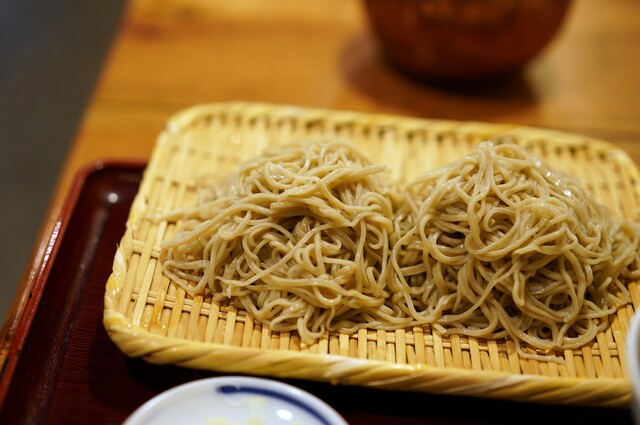
Approaching the Sumida side of Asakusa, the city changes register: temple traffic, river crossings, low-rise shopfronts, and the practical rhythm of lunch. This is the right setting for soba. Tokyo’s buckwheat tradition has never needed theatrical plating or long explanations; it works through milling, water, broth, timing, and the discipline of serving noodles before they lose tension. Azumabashi Yabusoba sits inside that older grammar, in a small house-style room where the format is closer to a local craft counter than a destination dining room.
The point here is not luxury, but selectivity. Soba is one of Tokyo’s great calibration tests because the dish appears simple until the margins matter: buckwheat aroma, noodle cut, dipping sauce balance, and the temperature contrast between noodle and tsuyu. In that field, repeat recognition carries weight. Selection for Tabelog’s Soba EAST 100 in 2025, with earlier selections listed across 2024, 2022, 2021, 2019, 2018, and 2017, places this address in a narrow group of soba specialists that regular diners and Japanese restaurant obsessives treat seriously.
Buckwheat, broth, and the discipline of a short service
Ingredient sourcing matters more in soba than the category’s modest pricing suggests. Buckwheat behaves differently from wheat: it is fragile, aromatic, and unforgiving once cooked. Tokyo’s better soba shops tend to focus less on elaborate toppings than on the grain itself, the cut of the noodle, and a dipping broth that can carry salt, sweetness, and bonito depth without burying the buckwheat. That is why a soba meal can feel austere next to sushi or tempura and still demand equal technical control.
Azumabashi Yabusoba is listed as a soba specialist with sake and shochu, a useful clue to how the meal is meant to function. The category can be quick at lunch, but it also belongs to the older sobaya drinking pattern: a small table, a few side dishes if offered, nihonshu or shochu, then noodles to finish. No specific signature dish is published here, so the safer read is categorical rather than item-specific: come for buckwheat noodles and the classic soba-shop structure around them, not for a chef-branded tasting format.
Compared with the surrounding Asakusa dining mix, the address sits on the quieter Sumida side rather than directly in the temple-side churn. Nearby comparison points show the range: Namiki Yabu Soba represents the historic Asakusa soba lane; 浅草むぎとろ本店 speaks to the area’s older Japanese dining habits; Kameju pulls sweet-shop crowds; Nabeno-Ism and ÉTAPE belong to a different, French-leaning register. Against that spread, this room reads as a focused buckwheat stop rather than a broad Asakusa itinerary restaurant.
An 18-seat room built for regulars, not spectacle
The physical scale matters. Eighteen seats, arranged across small tables, changes the experience from the beginning: pacing is governed by turnover, noodle timing, and the finite production of a short daytime service. This is not the multi-course Tokyo model where the room explains itself through ceremony. It is closer to the city’s compact specialist culture, where a narrow menu category, limited seats, and repeat recognition do the editorial work.
That compactness also affects how travelers should read the restaurant. The address is close to Asakusa Station and sits at 1 Chome-11-2 Azumabashi in Sumida City, but the practical mode is local: daytime hours, closures early in the week, no private rooms, no parking, and cash-oriented payment rules with credit cards, electronic money, and QR payments not accepted. Reservations are unavailable, which makes timing part of the meal rather than an administrative detail.
The strongest argument for including Azumabashi Yabusoba in a Tokyo food plan is its category clarity. Tokyo rewards diners who separate genres instead of asking every meal to perform the same role. Sushi counters, yakitori rooms, curry shops, cafés, and noodle houses all operate by different codes. For broader context, compare it with Tokyo listings such as 124. KAGURAZAKA (Yakitori), 3 Chome no Curry Ya San, 12/10 Shinjuku ten, 2D Cafe, and . 鮪と炭火焼き うお炭 秋葉原店. Each belongs to a different Tokyo habit; soba’s habit is restraint, speed, grain, and broth.
Know Before You Go
- Format: Soba specialist with sake and shochu listed.
- Recognition: Selected for Tabelog Soba EAST 100 in 2025, with multiple earlier Soba 100 selections listed.
- Scale: 18 seats, with small table seating rather than private rooms.
- Typical spend: Lunch is listed at JPY 1,000–1,999; dinner at JPY 2,000–2,999.
- Service pattern: Daytime service runs Wednesday to Sunday, with Monday and Tuesday closed.
- Access context: Asakusa Station is the nearest station; the restaurant is on the Sumida side of the river.
- Payments: Credit cards, electronic money, and QR code payments are not accepted.
- Family use: Children are welcome, and the price band makes it practical for a daytime family meal.
For wider planning, use Our full Tokyo restaurants guide alongside Our full Tokyo hotels guide, Our full Tokyo bars guide, Our full Tokyo wineries guide, and Our full Tokyo experiences guide. Broader Japan and overseas comparisons include -Grilled beef Sukiyaki- KAMAKURA TANUKIAN 鎌倉 たぬき庵 in Kamakura.cafe in Osaka.know in Kumamoto, (Shoku) Vietnam in Kawasaki, [Curry Senmon Ten] Maruyama Kyoju. in Sapporo, [ki:] in Kyoto, Jōdo Saké Bar in Los Angeles, and Onigiri Time in Pasadena.
Accolades, Compared
Comparable venues by price and recognition.
| Venue | Cuisine | Price | Notes |
|---|---|---|---|
| Azumabashi YabusobaThis venue — the venue you are viewing | Traditional Soba Noodle Shop | $ | Not listed |
| Tsuruse Yushima honten | Traditional Japanese wagashi & tea cafe | $ | Bunkyō |
| Curry & Wine Bistro Beppinsha Ochanomizu ten | Japanese Curry | $ | Chiyoda |
| Ginza Kanra Ginza honten | Japanese wagashi & daifuku shop | $ | Chūō |
| Hendrix curry | Japanese Spice Curry Bar | $ | Shibuya |
| Takagiya Roho | Japanese Traditional Sweets Cafe | $ | Katsushika |
Recognition history
Dated appearances from independent guides and award organizations, with the underlying list record or original source where available.
Tabelog 100 #64 · No. 64
Tabelog · Tabelog 100 - Soba - EAST - 2025








At a Glance
- Classic
- Cozy
- Quiet
- Solo
- Family
- Casual Hangout
- After Work
- Standalone
- Sake Program
Current opening hours
- Monday
- Closed
- Tuesday
- Closed
- Wednesday
- 11:30 AM–3 PM
- Thursday
- 11:30 AM–3 PM
- Friday
- 11:30 AM–3 PM
- Saturday
- 11:30 AM–3 PM
- Sunday
- 11:30 AM–3 PM
Hours can change for holidays and private events. Last verified .