Arrieros




Michelin Bib Gourmand · Macarfi 7.7 Food Rating · Guía Repsol 1 Sol
Our verdict
A Michelin Bib Gourmand recipient for 2024 and 2025, Arrieros sits in a whitewashed mountain property in the Sierra de Aracena and makes a compelling case for Andalucian regional cooking at its most honest. Chef Luismi López puts Iberian pork at the centre of every meal, with offal-forward tasting menus and a famous tomato soup that draw visitors well beyond the village itself.
The menu
What to order
- Iberian pork tongue
- Pork castañetas with curry
- Tomato soup
Where the Sierra de Aracena Eats
Arrive in Linares de la Sierra on a weekday lunchtime and the cobbled streets are quiet enough that the sound of a single car carries. The Sierra de Aracena is not a dining destination in the way the Basque Country is, or Barcelona, or Valencia. Restaurants here do not compete for international attention the way Arzak in San Sebastián or El Celler de Can Roca in Girona do. What they do instead is anchor themselves to a specific larder and a specific tradition, and the leading among them do that with considerable precision. Arrieros, on Calle Arrieros at the centre of this small Huelva village, belongs to that category.
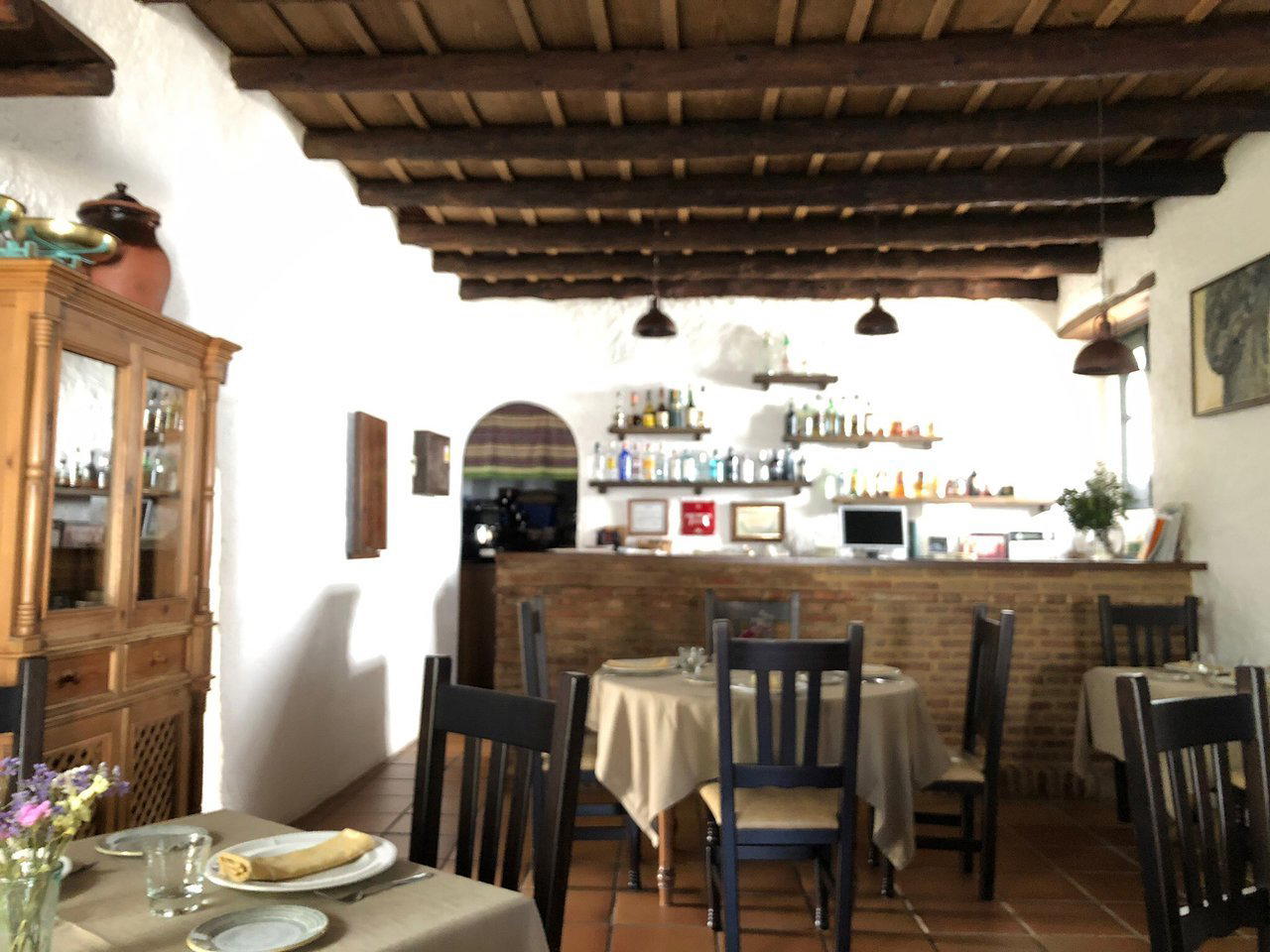
The building itself signals what is coming before you step inside: a whitewashed mountain property, typical of the Sierra's architectural vernacular, with a fireplace visible from the entrance and wood ceilings overhead. The furnishings read as rustic-contemporary, chosen with care rather than assembled from a regional-hospitality catalogue. It is a room that communicates seriousness without stiffness, which is a harder balance to achieve than it sounds. The kitchen is run by chef Luismi López, and the house is owned and operated as a family venture, in the tradition of small regional Spanish restaurants where the dining room and the household share their geography and their stakes.
The Iberian Pig as Organising Principle
Spain's small-plates tradition works differently in mountain Andalucia than it does along the coast or in the capital. In cities, tapas culture is about grazing across a wide range of ingredients and techniques, the table accumulating plates from different registers. In the Sierra de Aracena, the logic is more focused: the Iberian pig is not one ingredient among many but the defining one, and a kitchen that takes it seriously tends to build a menu around its depth rather than its breadth.
At Arrieros, that focus is made explicit through the two tasting menus: Ruta de Jabugo and La Dehesa. The names locate the cooking geographically and ecologically. Jabugo, a few kilometres away, is the town whose name has become synonymous with the highest grade of Iberian jamón. La Dehesa refers to the oak-dotted landscape where Iberian pigs range on acorns during the montanera season. Both names are doing editorial work: they tell you what the kitchen considers important before the first dish arrives.
The emphasis on offal is where Arrieros pushes furthest from tourist-facing Andalucian cooking. Iberian pork tongue and pork castañetas (the jowl or cheek glands, depending on interpretation) appear among the signature preparations, the latter served with curry and mashed potato in a pairing that reads as updated rather than fusion. This is the kind of cooking that requires confidence in its audience: offal-forward menus succeed where diners are either local enough to consider it normal or curious enough to seek it out. The Bib Gourmand recognition from Michelin in both 2024 and 2025 suggests the audience exists.
The Tasting Menu Format in a Regional Context
Tasting menus at the €€ price point sit in a different competitive register from the multi-course experiences at Spain's starred addresses. Consider the gap: restaurants like DiverXO in Madrid, Azurmendi in Larrabetzu, or Aponiente in El Puerto de Santa María operate at the €€€€ tier with full Michelin star recognition and dining experiences priced accordingly. The Bib Gourmand designation, by contrast, is Michelin's signal for good cooking at moderate prices, and it carries its own logic: it identifies places where the quality-to-cost relationship is notably favourable, not places trying to approximate a starred experience on a reduced budget.
Arrieros is not attempting to be a rural version of Mugaritz in Errenteria or Martin Berasategui in Lasarte - Oria. The two tasting menus here serve a different purpose: they organise the kitchen's regional argument into a sequence rather than leaving it to ad hoc ordering. For a kitchen centred on a single animal and a specific territory, that structure makes sense. It means the poleá, the tomato soup that has become the house signature and Arrieros' version of the traditional Andalucian preparation, arrives in context rather than as a standalone curiosity.
Visiting Arrieros: What to Know
Linares de la Sierra sits within the Sierra de Aracena y Picos de Aroche Natural Park, one of the largest protected areas in Andalucia and a region that draws visitors for its walking routes, its chestnut forests, and its village architecture as much as for its food. The town itself is known for its cobbled streets and the quality of its whitewashed buildings. Arrieros operates lunch service from Tuesday through Sunday, opening at 1:30 pm and closing at 4 pm, with Mondays closed. That timetable reflects the lunch-centred eating culture of southern Spain and means evening arrivals will need to plan around it. Booking in advance is advisable given the limited scale of a village restaurant operating with this level of regional recognition. For further orientation on where to eat, drink, and stay in the area, see our full Linares de la Sierra restaurants guide, our full Linares de la Sierra hotels guide, our full Linares de la Sierra bars guide, our full Linares de la Sierra wineries guide, and our full Linares de la Sierra experiences guide.
For those mapping a broader Andalucian or Spanish itinerary, Arrieros sits comfortably alongside other regionally grounded restaurants that prioritise territory over technique-for-its-own-sake. Lera in Castroverde de Campos and Atrio in Cáceres offer points of comparison for what Spanish regional cooking looks like when it operates with similar conviction in different landscapes. Further afield, Ricard Camarena in Valencia, Cocina Hermanos Torres in Barcelona, and Quique Dacosta in Dénia represent what the starred tier looks like when similar regional precision is applied at higher investment levels. The comparison is useful not to rank them against each other but to understand where Arrieros sits in the full range of what Spain currently offers. And for international reference, Le Bernardin in New York City demonstrates how ingredient-focused cooking organised around a single category can sustain decades of recognition at the highest level. The principle is not exclusive to any one country or price point.
Frequently asked questions
What dish is Arrieros famous for?
Is Arrieros formal or casual?
Is Arrieros child-friendly?
Side-by-Side Snapshot
| Venue | Cuisine | Price | Awards | Notes |
|---|---|---|---|---|
| ArrierosThis venue (the venue you are viewing) | Modern Andalusian Regional | Not listed | Michelin Bib Gourmand · Macarfi 7.7 Food Rating | Not listed |
| Aponiente | Avant-Garde Marine Seafood | $200–300 | 3 Michelin Stars · World's 50 Best #84 | Progressive - Seafood, Creative |
| Arzak | Contemporary Basque Fine Dining | $300–500 | 3 Michelin Stars · World's 50 Best #31 | Modern Basque, Creative |
| DiverXO | Avant-Garde Spanish Tasting Menu | $300–500 | 3 Michelin Stars · World's 50 Best #4 | Progressive - Asian, Creative |
| El Celler de Can Roca | Creative Catalan Fine Dining | $300–500 | 3 Michelin Stars · World's 50 Best #2 | Progressive Spanish, Creative |
| Quique Dacosta | Avant-Garde Spanish Fine Dining | $300–500 | 3 Michelin Stars · World's 50 Best #65 | Creative |
Recognition history
Dated appearances from independent guides and award organizations, with the underlying list record or original source where available.
Michelin Bib Gourmand
Michelin
Guía Repsol 1 Sol
Guía Repsol
Macarfi 7.7 Food Rating
Macarfi
Opinionated About Dining Top Restaurants in Europe Highly Recommended
Opinionated About Dining
Full recognition history (6 entries)
Michelin Bib Gourmand
Michelin
Michelin Bib Gourmand
Michelin
Continue exploring
More in Linares de la Sierra
Restaurants in Linares de la Sierra
Browse all →
Details
- Rustic
- Cozy
- Intimate
- Special Occasion
- Family
- Date Night
- Terrace
- Extensive Wine List
- Local Sourcing
- Farm To Table
- Mountain
- Tasting Menu
- A La Carte
- Vegetarian Friendly
- Gluten Free Options
Current opening hours
- Monday
- Closed
- Tuesday
- 1:30–4 PM
- Wednesday
- 1:30–4 PM
- Thursday
- 1:30–4 PM
- Friday
- 1:30–4 PM
- Saturday
- 1:30–4 PM
- Sunday
- 1:30–4 PM
Hours can change for holidays and private events. Hours as of .
Welcoming rustic interior with fireplace, wood ceilings, and tasteful rustic-contemporary furnishings creating a cozy, homey atmosphere.