

Perched on the 49th floor of Toranomon Hills Station Tower, apothéose positions itself at the intersection of classical French technique and rigorous Japanese ingredient sourcing. Chef Keita Kitamura structures the menu around a three-part philosophy: reverence for French culinary tradition, deep inquiry into Japanese produce, and an improvisational spirit that keeps the format deliberately open. At the ¥¥¥¥ tier, it occupies the same price bracket as Tokyo's most decorated French and kaiseki tables.
 Discover on Pearl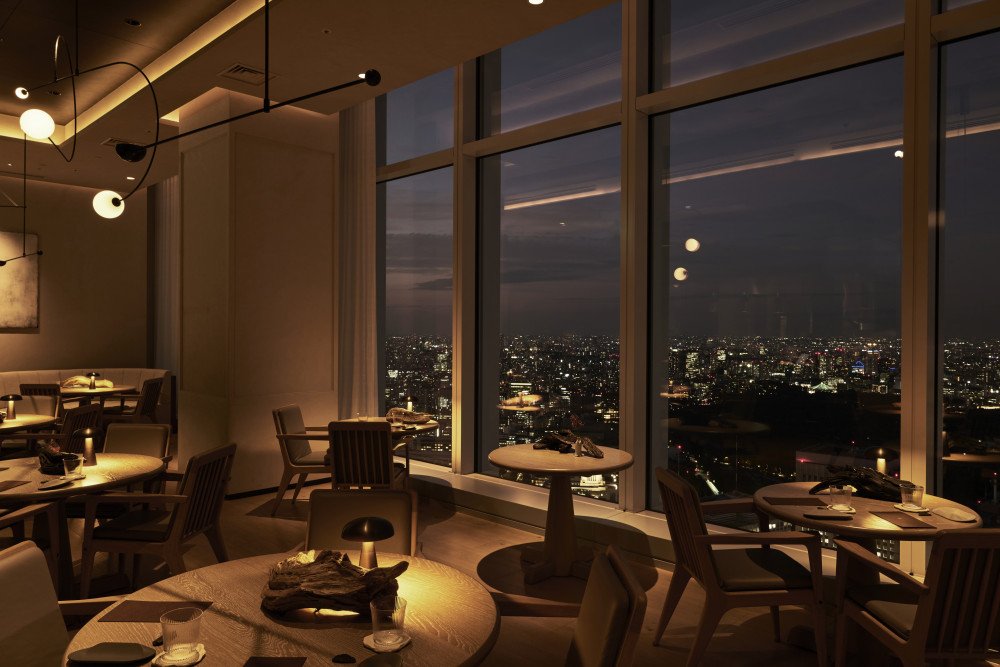
Altitude, Architecture, and the Franco-Japanese Kitchen
The 49th floor of Toranomon Hills Station Tower reconfigures how a dining room relates to the city below it. Tokyo spreads in every direction at this height, and the awareness of that scale enters the room before any dish arrives. The physical setting is not incidental to apothéose's premise: a restaurant whose name translates roughly as 'highest compliment' or 'apex' has staked its identity on the idea that cuisine can reach a ceiling, and the address makes that ambition legible in physical terms. Toranomon itself has transformed over the past decade from a quiet business district into one of the most architecturally consequential corridors in the city, and the Station Tower, completed in 2023, anchors that shift. Dining at altitude in Tokyo has a specific context: the view is never just decoration, it is part of the frame through which the meal is experienced.
The Cultural Architecture of the Menu
What distinguishes the Franco-Japanese approach at apothéose from the broader category of French-influenced cooking in Tokyo is the explicit structure of its guiding principles. The kitchen operates on three stated commitments: respect for French culinary culture, a sustained inquiry into Japanese ingredients, and an orientation toward the present moment rather than formula. This is not the fusion premise of an earlier generation, where French and Japanese cooking were blended to soften the edges of each. The aim here is to hold both traditions with equal seriousness, using French technique as a grammatical structure through which Japanese ingredients speak.
That framing matters in Tokyo specifically, because the city has produced several different answers to the question of how these two culinary cultures should meet. L'Effervescence operates in the ¥¥¥¥ French tier and has built its reputation on a different interpretation of the same dialogue: seasonal Japanese produce filtered through a French sensibility that is lighter and more forager-inflected. Sézanne, with its Michelin recognition, approaches French cooking in Tokyo with a more classically Parisian frame. Apothéose sits in that same competitive tier but pursues a more explicitly experimental path, unconstrained by convention in its own description.
The structural choice to place meat dishes at the centre of the progression, flanked by rice courses, is worth noting as a deliberate cultural statement. Rice in this position is not a neutral starch; it is an assertion that Japanese eating culture has a structural role, not merely a decorative one, within a French tasting format. Comparable thinking appears in the Korean-American tasting format at Atomix in New York City, where the architecture of a Western tasting menu is rebuilt around a non-Western ingredient logic. The questions both kitchens are asking have more in common than their geographies suggest.
Where apothéose Sits in Tokyo's French Tier
Tokyo's French dining scene at the ¥¥¥¥ level is more concentrated and more technically serious than almost any equivalent city outside Paris. The Michelin Guide's Tokyo edition has historically awarded French restaurants here with a generosity that reflects genuine technical depth in the kitchens, not just the accumulated prestige of French cuisine as a category. L'Effervescence and Sézanne both hold three Michelin stars, making the competitive set that apothéose enters unusually demanding. The city also has a parallel track of kaiseki at the same price tier, represented by restaurants like RyuGin, where the technical discipline comes from an entirely different tradition. A diner choosing between these tables is not just choosing a cuisine; they are choosing a philosophy of how Japanese ingredients and seasons should be framed and interpreted.
Chef Keita Kitamura's position in this field is that of a practitioner committed to ongoing experimentation rather than a fixed signature. The willingness to remain unconstrained by convention is stated as a structural principle, which creates a different relationship with the menu than one built around a stable set of signature dishes. This is a riskier commitment for a restaurant at the ¥¥¥¥ tier, where diners often arrive with calibrated expectations, but it is also the condition under which genuinely new cooking tends to emerge.
The comparison with HAJIME in Osaka is instructive here. HAJIME operates from a similarly philosophical position within French cuisine in Japan, with an emphasis on nature and ecological thinking that structures the entire menu. Both restaurants are asking what French cuisine means when practised in Japan by Japanese chefs with access to Japanese ingredients and no obligation to reproduce a Parisian original. The answers differ, but the seriousness of the question is the same.
The Broader Tokyo Dining Frame
Apothéose is one data point in a city with an extraordinary density of serious cooking across multiple traditions. Harutaka represents the sushi tradition at the same price tier, where the discipline and the aesthetic are entirely different but the commitment to ingredient sourcing is directly comparable. mærge operates in an innovative space that sits adjacent to, but distinct from, the Franco-Japanese conversation. The city supports all of these simultaneously because the dining culture here treats serious eating as a normal activity rather than a special-occasion category.
For visitors building an itinerary that reaches beyond Tokyo, the same spirit of French-inflected cooking with deep local ingredient sourcing appears at akordu in Nara and the kaiseki tradition continues at Gion Sasaki in Kyoto. Further afield, Goh in Fukuoka and 1000 in Yokohama extend the map of serious contemporary cooking across the archipelago, as does 6 in Okinawa for those travelling south. The cultural argument that Japanese ingredients deserve to be taken seriously on their own terms, not just as exotic additions to a European frame, runs through all of these rooms in different ways.
The transatlantic parallel worth holding in mind is Le Bernardin in New York City, which has spent decades demonstrating that a cuisine transplanted from one cultural context to another does not necessarily compromise in the process. The question apothéose is asking is something like the inverse: what happens when the transplantation goes the other direction, and French technique takes root in a Japanese context with full commitment on both sides.
Planning a Visit
Apothéose is located on the 49th floor of Toranomon Hills Station Tower, accessible via Toranomon Hills Station on the Hibiya Line, which makes the approach logistically direct from central Tokyo. The ¥¥¥¥ price designation places it at the top tier of Tokyo dining spend, comparable to the three-Michelin-star French and kaiseki tables the city is known for internationally. At this tier, advance booking is standard practice across Tokyo's serious dining rooms, and given the combination of limited seating at altitude and a format that requires preparation and sourcing at this level, reservations should be secured well ahead of any travel dates. Evening dining at this height in Toranomon carries an additional consideration: the Station Tower's position in a newly developed precinct means the skyline views remain relatively unobstructed compared to older high-rise dining rooms embedded deeper in the city's denser zones.
For a complete picture of Tokyo's dining, drinking, and accommodation options, see our full Tokyo restaurants guide, our full Tokyo hotels guide, our full Tokyo bars guide, our full Tokyo wineries guide, and our full Tokyo experiences guide.
Frequently Asked Questions
Similar Picks
A fast peer set for context, pulled from similar venues in our database.
Need a table?
Our members enjoy priority alerts and concierge-led booking support for the world's most difficult tables.
Get Exclusive Access