
Tabelog 100 #100
Our verdict
Angle brings Amagasaki’s everyday curry culture into sharper focus: modest pricing, counter seating, and repeated Tabelog Curry 100 WEST selection place it in a serious but accessible lane. The draw is not ceremony, but the Kansai habit of treating curry and yoshoku as daily food worthy of close attention.

Pearl is the En Primeur Club membership app, where members save venues, book tables and use the concierge.
The menu
What to order
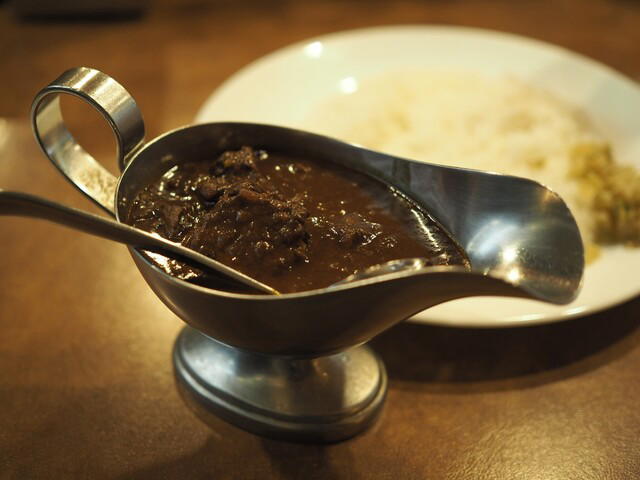
- Beef curry
- Stew dishes
- Frozen beef curry (take‑home)
Tsukaguchi’s station-side dining has a practical rhythm: commuters, families, and solo regulars move between counters where speed and repetition both matter. Angle fits a distinctly Kansai curry-shop category, where the plate sits between Japanese home comfort, yoshoku technique, and the spice-shop logic that shaped urban curry culture across western Japan.
Amagasaki is often read as an Osaka-Kobe corridor, but its restaurants are better judged on their own terms. The city rewards compact formats, fair pricing, and repeat traffic over destination theatrics. Curry is a useful lens because quiet sourcing choices, the sauce base, vegetables, rice, oil, and spice balance, decide whether a shop becomes a habit or a one-time stop.
Western Japan curry culture, seen through a counter format
Japanese curry is not one tradition. In Kansai, it often overlaps with yoshoku, the Japanese interpretation of Western dishes that made sauces, cutlets, rice plates, and stews part of everyday restaurant language. Angle is listed in both curry and yoshoku, explaining why it reads less like a specialist spice bar than a compact Japanese dining room built around familiar plates executed with discipline.
The trust signal is external rather than decorative: selection for Tabelog 100 Curry WEST in 2024, with earlier selections in 2023, 2022, 2020, and 2019. In Japan, Tabelog category lists matter because they surface restaurants local diners repeatedly rate and discuss within a genre. A western Japan curry selection places a shop against a deep field including Osaka, Kyoto, Hyogo, and other areas where curry has long moved beyond cafeteria shorthand.
Ingredients matter because curry’s personality is built before the plate reaches the counter. Yoshoku-style curry depends on roux, aromatics, sweetness, fat, and spice warmth; small changes in onion cookery, stock base, or rice handling shift the result. With no tasting-menu frame or chef mythology, fundamentals become visible: consistency, balance, and value.
Compared with Amagasaki’s higher-spend dining, the category has another seriousness. Ogitani sits in a Japanese cuisine and seafood bracket around JPY 15,000 to JPY 19,999, while Gyoraku Karakara is listed around JPY 8,000 to JPY 9,999. Curry at this level gives the city an award-recognised, repeatable meal at a daily price point, closer to how locals use neighbourhood restaurants.
The Amagasaki value lane is where the case becomes stronger
Angle’s JPY 1,000 to JPY 1,999 price band for both lunch and dinner matters as much as its recognition. In a city where serious meals run from sub-JPY 1,000 udon to multi-course seafood, this is the everyday middle: inexpensive enough for routine use, focused enough to reward a detour from central Osaka or Kobe dining plans.
The room reinforces the point. Sixteen counter seats make the experience direct, and counter-only curry shops reveal discipline through repetition: the same motions, plate architecture, and service pace. The format also sharpens the sourcing conversation. When a small counter serves a narrow, repeated category, procurement and prep are not background administration; they are the operating system.
Reservation-free dining suits the genre. Japanese curry has a democratic streak, from train-station plates to obsessive independent shops, and strong versions do not need luxury cues. No private rooms and a non-smoking policy keep the focus on turnover, proximity, and the plate rather than occasion dining.
For readers mapping Amagasaki through food, Angle fits a broader local crawl rather than a standalone luxury itinerary. Nearby comparisons include Dairen, in a slightly higher casual spend band, and Gyoraku Karakara, whose pricing signals a different evening-out category. For ramen and noodle context, Butanohoshi and Honkaku Sanuki Udon Honoka show how Amagasaki supports focused specialists beyond curry. majide hamal adds another reference point for casual dining depth.
How to read Angle within a wider Japan food itinerary
The sharper approach is not to treat this address as a trophy meal, but as a data point in Japan’s mature everyday-restaurant culture. Michelin-style hierarchy does not explain a place like this; category awards, local repetition, and price discipline do. A curry counter repeatedly selected by Tabelog across multiple years signals durability, not flash.
That helps when planning across Japan. A traveller might spend one night on beef sukiyaki at -Grilled beef Sukiyaki- KAMAKURA TANUKIAN 鎌倉 たぬき庵 in Kamakura, another on seafood-led izakaya cooking at. 鮪と炭火焼き うお炭 秋葉原店 in Tokyo, or make a lighter stop at.cafe in Osaka. The point is not to rank those meals against curry, but to see how Japan’s dining culture holds many forms of seriousness at once.
Curry has travelled well beyond Hyogo. [Curry Senmon Ten] Maruyama Kyoju. in Sapporo reflects another regional expression, while casual Japanese formats abroad, from Jōdo Saké Bar in Los Angeles to Onigiri Time in Pasadena, show how rice-based comfort food changes outside its local infrastructure. In Amagasaki, that infrastructure is the story: station access, modest spend, counter service, and a city that values useful restaurants.
Readers building a local plan should use Our full Amagasaki restaurants guide for the food map, then separate sleep, drinking, and cultural planning through Our full Amagasaki hotels guide, Our full Amagasaki bars guide, Our full Amagasaki wineries guide, and Our full Amagasaki experiences guide. For broader Japan comparison beyond the Kansai-Hyogo axis.know in Kumamoto and (Shoku) Vietnam in Kawasaki underline how regional cities and commuter districts often carry the meals that define daily eating more accurately than ceremonial restaurants do.
The editorial case for Angle is specific: a small counter curry shop in Amagasaki with repeated Tabelog Curry recognition, accessible pricing, and a format that puts Japanese curry fundamentals in plain view. For travellers who care where food culture actually lives, that is stronger than any grand narrative.
Frequently asked questions
Can I bring kids to Angle?
Yes. Angle is marked children welcome, and its 16-seat counter setup in Amagasaki keeps the room compact and easy to read.
How would you describe the vibe at Angle?
Angle runs as a counter-only room with take-out and delivery in the mix, so the feel is more utilitarian than polished. The Tabelog Curry WEST 2024 selection gives it local credibility without changing its everyday price band of JPY 1,000–1,999.
Is Angle more mid-range or high-end?
Pricing at Angle is listed as JPY 1,000 - JPY 1,999 JPY 1,000 - JPY 1,999.
What is Angle known for?
Angle is primarily known for its core concept and execution in Amagasaki.
Side-by-Side Snapshot
Comparable venues by cuisine and price in the same metro.
| Venue | Cuisine | Price | Awards | Notes |
|---|---|---|---|---|
| AngleThis venue (the venue you are viewing) | Japanese Stew & Curry House | $10–20 | Tabelog 100 #100 | Not listed |
| Udon Kobo Yuuyu | Udon and Tempura Shop | $10–20 | Tabelog 100 #21 | Tsukaguchi |
| Tenteko Mukonosou ten | Okonomiyaki | Not listed | Tabelog 100 #13 | Mukonoso |
| Miraku En | Yakiniku (Japanese BBQ) | Not listed | Tabelog 100 #52 | / Amagasaki Station area |
| Honkaku Sanuki Udon Honoka | Traditional Sanuki udon | $1–10 | Tabelog 100 #59 | Amagasaki |
| Ramen Senmon Nagomi | Specialty Ramen | $10–20 | Tabelog 100 #26 | Mukogawa |
Recognition history
Dated appearances from independent guides and award organizations, with the underlying list record or original source where available.
Tabelog 100 #100 · No. 100
Tabelog · Tabelog 100 - Curry - WEST - 2024
Continue exploring
More in Amagasaki
Restaurants in Amagasaki
All restaurants in Amagasaki →


Bars in Amagasaki
Browse all →




Hotels in Amagasaki
Browse all →


Wineries in Amagasaki
Browse all →
Details
- Cozy
- Classic
- Solo
- Casual Hangout
- After Work
- Family
- Standalone
- Local Sourcing
- A La Carte
- Soft Drinks
Current opening hours
- Monday
- 11 AM–9:45 PM
- Tuesday
- 11 AM–9:45 PM
- Wednesday
- 11 AM–9:45 PM
- Thursday
- 11 AM–9:45 PM
- Friday
- 11 AM–9:45 PM
- Saturday
- 11 AM–9:45 PM
- Sunday
- 11 AM–9:45 PM
Hours can change for holidays and private events. Hours as of .