Africana
Our verdict
Africana sits on Liberty Avenue in Jamaica, Queens, a corridor that has quietly become one of New York City's most concentrated strips of West African and Caribbean dining. The restaurant draws from a tradition where cooking is communal, seasoning is deliberate, and the room fills with a regularity that reflects neighbourhood loyalty rather than tourist traffic.

Pearl is the En Primeur Club membership app — saves, bookings, and concierge access live there. Same editors, same standards.
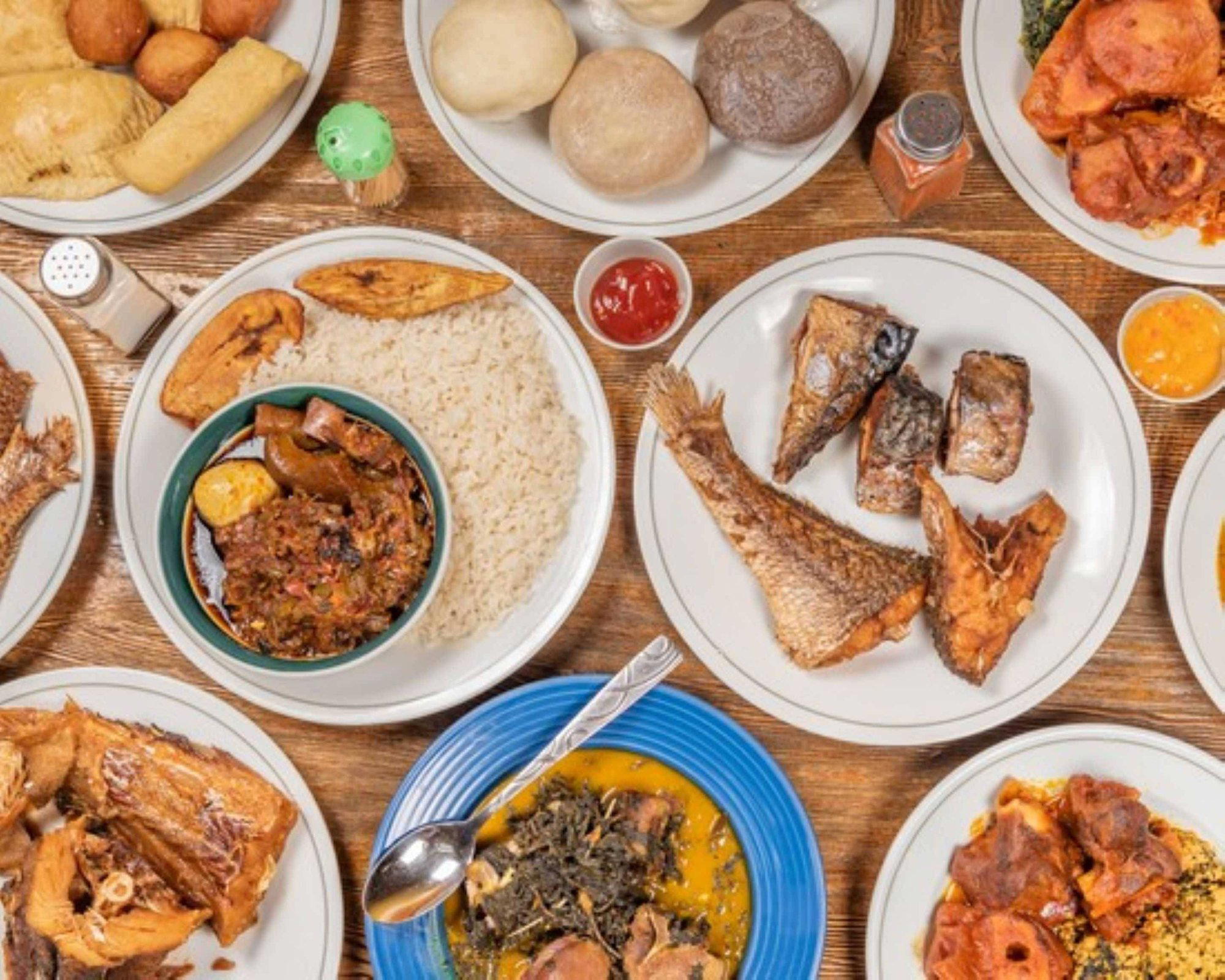
Liberty Avenue and the West African Dining Corridor
Jamaica, Queens holds a different kind of dining authority than the Manhattan addresses that dominate most conversations about New York restaurants. Along Liberty Avenue, the concentration of West African, Caribbean, and Afro-Caribbean establishments reflects decades of immigration from Ghana, Nigeria, Trinidad, and Sierra Leone, producing a strip where cooking is shaped by community expectation rather than critical attention. Africana, at 146-12 Liberty Avenue, sits inside that tradition. The neighbourhood does not position itself against the $$$$ tasting-menu circuit occupied by Le Bernardin, Atomix, or Masa. It operates on different terms entirely, where price accessibility and cultural continuity carry more weight than accolades.
West African cooking in New York does not receive the same critical infrastructure as, say, Korean cuisine, which has found institutional recognition at places like Atomix, or the plant-forward French tradition now anchored by Eleven Madison Park. That absence of critical scaffolding is not a reflection of culinary depth. It reflects the geography of food media, which has historically concentrated on certain postcodes. Liberty Avenue operates largely outside that attention economy, which means restaurants like Africana are assessed primarily by the communities they serve.
What the Cuisine Represents
West African cooking is among the most structurally complex traditions in the global canon. The use of fermented locust beans (dawadawa), palm oil, dried fish, and slow-cooked stews built over hours represents a culinary logic rooted in preservation, intensity, and layered fermentation that predates many European techniques by centuries. Dishes like egusi soup, jollof rice, fufu, and suya carry cultural weight that extends well beyond the plate: they are tied to ceremony, family structure, and regional identity across Ghana, Nigeria, Senegal, and beyond.
In New York, this tradition is most reliably found not in Chelsea or the West Village but in outer borough corridors: the Bronx's Arthur Avenue adjacent neighbourhoods, Flatbush in Brooklyn, and Liberty Avenue in Queens. These are the addresses where the cooking is made for a diaspora audience with lived reference points, not for a dining public encountering the cuisine for the first time. That distinction matters when assessing authenticity. A restaurant calibrated to its community will season, serve, and portion differently than one calibrated to introduction.
Africana in Its Neighbourhood Context
Africana on Liberty Avenue fits the structural pattern common to West African restaurants in New York's outer boroughs: a neighbourhood anchor operating with limited digital footprint, no published awards, and customer loyalty built over time rather than through media cycles. This is not an unusual profile for this category. Many of the most durable West African restaurants in New York and across the country, from spots in the Bronx to comparable establishments in Houston and Washington D.C. have operated for years without Michelin recognition or press profiles, sustained entirely by repeat custom.
That dynamic places Africana in a different evaluative frame than Per Se or Eleven Madison Park, where awards structure the conversation before a guest even books. Here, the relevant signals are longevity, neighbourhood standing, and whether the kitchen cooks to a standard its regular customers would recognize as correct. These are harder to quantify but no less meaningful as quality indicators. For comparable community-anchored dining outside New York, the pattern holds at places like Emeril's in New Orleans and community-rooted establishments across the country, though the cuisines and price points differ substantially.
Getting There and What to Expect
Jamaica is accessible via the A train and the Long Island Rail Road's Jamaica terminal, making it reachable from Midtown Manhattan in under 30 minutes by rail. Liberty Avenue itself is a dense commercial strip, and the restaurant sits within a block pattern that requires a short walk from the nearest subway stops.
Hours, seasonal changes, and current menu specifics are best confirmed in person or through community sources. This is not an anomaly for this restaurant type: many Liberty Avenue establishments operate with minimal digital infrastructure while maintaining consistent service for their regular customer base.
For those building a broader New York dining itinerary, our full New York City restaurants guide covers the range from outer borough community dining through to the Michelin-decorated rooms of Manhattan. The distance between Africana and, say, Blue Hill at Stone Barns in Tarrytown is not just geographic: these represent fundamentally different relationships between a restaurant and its community, its price structure, and its reason for existing.
Placing Africana in the Wider Picture
Across the United States, farm-to-table destination restaurants like Single Thread Farm in Healdsburg, Lazy Bear in San Francisco, or The French Laundry in Napa operate within a well-mapped critical ecosystem. Bookings run months out, tasting menus are priced above $300 per person, and the press attention is proportional. Addison in San Diego, Smyth in Chicago, and Providence in Los Angeles occupy comparable positions in their respective cities.
Africana operates in a different economic and cultural register, but that difference does not imply lesser cooking. It implies a different set of values: proximity over prestige, community over curation, repetition over novelty. West African cuisine at this level of community integration carries its own rigour. The cooking is assessed daily by guests who grew up eating the same dishes, which is a form of quality pressure that no critic's visit can replicate. International examples of this tradition, from Atelier Moessmer Norbert Niederkofler in Brunico to Dal Pescatore in Runate, show that community-anchored cooking can achieve critical recognition over time. Whether that arc applies to Liberty Avenue's West African corridor remains an open question in New York's dining development, though the trajectory of Korean cuisine from outer-borough invisibility to Michelin recognition suggests the pattern is possible.
For now, Africana represents the Jamaica corridor at its most direct: a restaurant whose standing is measured in return visits and neighbourhood word-of-mouth rather than published scores. That is, in its own way, a durable form of authority. Readers building a full picture of New York's dining range should also consult Frasca Food and Wine in Boulder and The Inn at Little Washington for contrast in how different culinary traditions develop their own critical frameworks over time.
Frequently asked questions
What's the address for Africana?
Africana is located at 146-12 Liberty Ave, Jamaica, NY 11435, New York City.
Is Africana a good option for someone new to West African cuisine in New York City?
Jamaica, Queens is one of the most concentrated nodes of West African cooking in New York City, and Liberty Avenue functions as a practical introduction to the cuisine in a context where it exists for the community rather than for newcomers. Africana at 146-12 Liberty Ave sits within that corridor, meaning the food reflects everyday West African cooking traditions rather than a version adapted for outside audiences. For first-time diners, that directness is the point: the flavour profiles built from dawadawa, palm oil, and slow-cooked proteins are presented without dilution.
What do regulars order at Africana?
Africana sits within the West African dining corridor on Liberty Avenue in Jamaica, Queens, where the kitchen tradition leans on fermented locust beans (dawadawa), palm oil, and dried proteins as structural building blocks. Regulars at restaurants in this mould typically return for slow-cooked stews and rice-based dishes that reflect those techniques.
How hard is it to get a table at Africana?
Africana operates as a neighbourhood anchor on Liberty Avenue in Jamaica, Queens, a format typical of West African restaurants in New York's outer boroughs that serve a loyal local community rather than destination-dining crowds. Walk-in access is generally more straightforward at this type of venue than at reservation-driven Manhattan counters. Contacting the restaurant directly before visiting is advisable, particularly on weekends when the corridor draws larger numbers.
What is Africana known for?
Africana is part of the Liberty Avenue West African dining corridor in Jamaica, Queens, one of the few stretches in New York City where this cuisine is represented with genuine neighbourhood depth rather than as a novelty. The restaurant reflects a tradition rooted in structurally complex techniques: fermentation, palm oil cookery, and dried proteins that carry flavour over long cooking times.
Do they accommodate allergies at Africana?
West African cooking at this level of neighbourhood operation typically involves shared cooking fats, fermented ingredients, and complex spice blends that can pose challenges for diners with specific allergies. Anyone with dietary restrictions should contact the restaurant at 146-12 Liberty Ave, Jamaica, NY 11435 before visiting to confirm what the kitchen can and cannot adjust.
Cost Snapshot
| Venue | Cuisine | Price | Awards | Notes |
|---|---|---|---|---|
| AfricanaThis venue — the venue you are viewing | Senegalese West African | $20–30 | Not listed | Not listed |
| Le Bernardin | French Seafood Fine Dining | $300–500 | 3 Michelin Stars · World's 50 Best #13 | French, Seafood |
| Atomix | Modern Korean Tasting Menu | $300–500 | 2 Michelin Stars · World's 50 Best #7 | Modern Korean, Korean |
| Per Se | French Fine Dining Tasting Menu | $300–500 | 3 Michelin Stars · World's 50 Best #40 | French, Contemporary |
| Masa | Traditional Japanese Omakase | $500+ | 2 Michelin Stars · World's 50 Best #27 | Sushi, Japanese |
| Eleven Madison Park | Contemporary Plant-Based Fine Dining | $300–500 | 3 Michelin Stars · World's 50 Best #4 | French, Vegan |
Continue exploring
More in New York City
Restaurants in New York City
All restaurants in New York City →
Bars in New York City
All bars in New York City →




Details
- Casual Hangout
- Group Dining
- Standalone
- Local Sourcing
- A La Carte
Current opening hours
- Monday
- 12–9 PM
- Tuesday
- 12–9 PM
- Wednesday
- 12–9 PM
- Thursday
- 12–9 PM
- Friday
- 12–9 PM
- Saturday
- 12–9 PM
- Sunday
- Closed
Hours can change for holidays and private events. Last verified .
Casual neighborhood spot focused on friendly service and hearty portions of soulful African eats.