Dar Lbahja

Our verdict
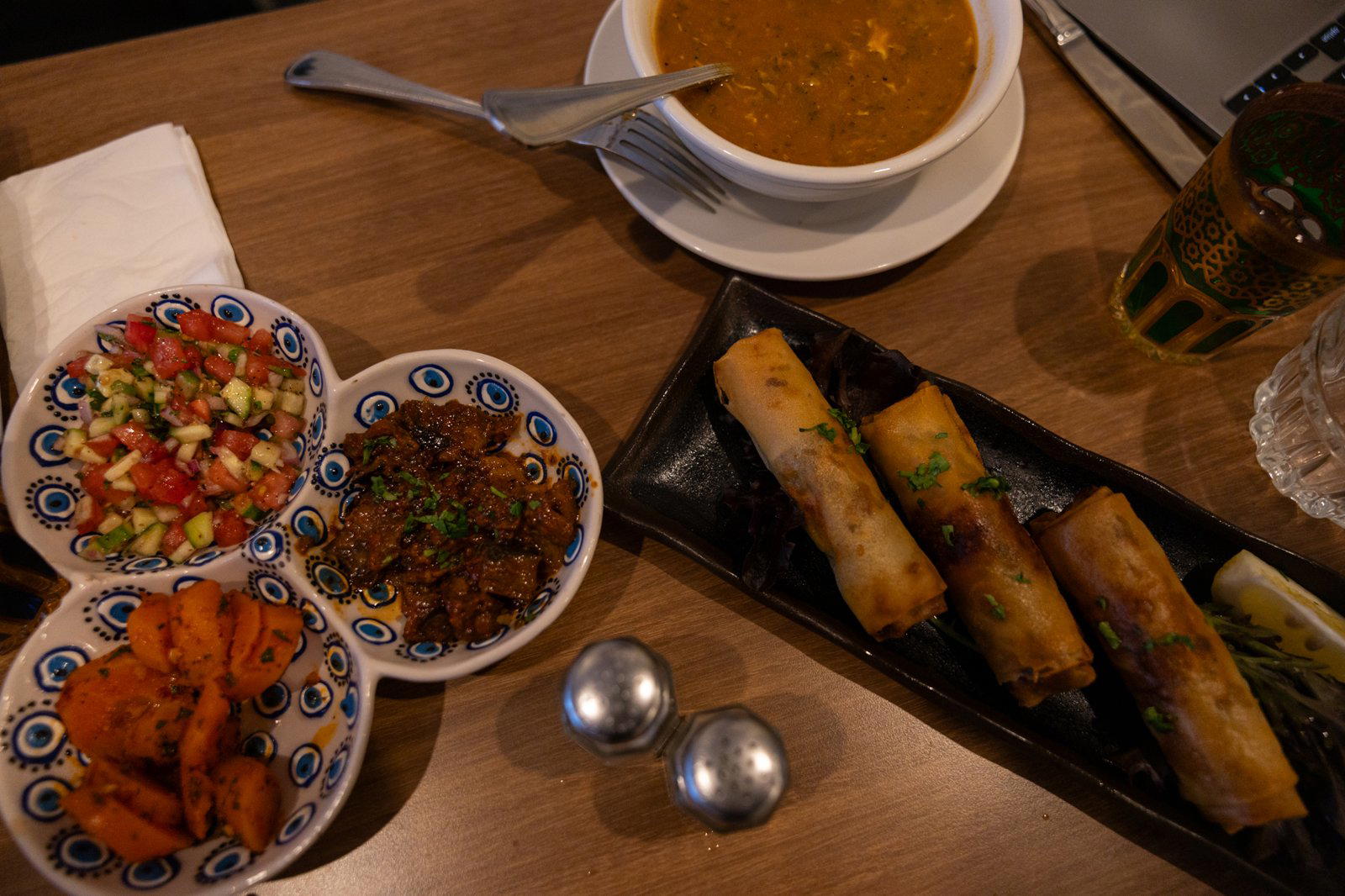
Dar Lbahja brings Moroccan home cooking into Astoria’s casual dining map, with the opening spread carrying much of the argument: mint tea, dips, salads, and pastry before the larger tagines arrive. The room is modest, the price tier is accessible, and chef Touria Lamtahaf’s cooking places preserved lemon, mint, rose, and slow-cooked meat at the centre of the experience.

Pearl is the En Primeur Club membership app, where members save venues, book tables and use the concierge.
The menu
What to order
- Harira soup
- Chicken bastilla
- Lamb tagine
- Couscous
- Zaalouk
New York City’s restaurant streets reward close attention: small storefronts, family-scale kitchens, and menus that often say more about the city than any formal dining room. Dar Lbahja belongs to that register. Rather than treating the restaurant as a spectacle, the more useful reading is practical: a Moroccan table in New York City, built around shared plates, conversation, and the kind of casual rhythm that makes the city’s dining scene feel lived-in.
Moroccan cooking in New York City often has to compete for attention with louder categories: noodle counters, tasting menus, pizza, wine bars, and the city’s endless Italian-American grammar. In New York City, the argument changes. A modest room can carry more weight because the city already understands the value of food that arrives for sharing. Dar Lbahja fits that local rhythm without turning Moroccan food into a theme-room performance.
The opening spread is the real centre of gravity
The beginning of a Moroccan meal is where this kind of dinner finds its pace. Shared starters and table-setting dishes are not side business; they set the tempo. The point is contrast: soft against sharp, oil against acid, herbs against warmth, bread and sauces as part of the conversation rather than garnish. In a city where small plates often become a pricing strategy, this kind of spread keeps an older social function. It slows the first half-hour and makes everyone reach across the table.
That matters at Dar Lbahja because the larger idea of the meal asks for the same behaviour. Moroccan cooking often moves between savoury depth, aromatic seasoning, brightness, and slow-cooked comfort. The best way to understand the restaurant is not as a sequence of isolated plates, but as a table that encourages sharing. The pleasure is in balance, in passing dishes around, and in letting the meal gather momentum without the stiffness of a formal dining room.
New York has plenty of restaurants where the opening order is a formality before the serious dish arrives. Moroccan dining works better when the first plates are treated as the structure, not the preface. The early dishes decide how the meal will be shared; the pacing decides how long the table is likely to stay; the rest of the meal then makes sense as part of that same communal logic.
New York City makes the format feel natural
New York City’s advantage is density without uniformity. The city can absorb a Moroccan storefront because its dining culture is already fluent in bakeries, grills, cafés, and inexpensive tables where a meal is built from several small decisions rather than a chef’s tasting sequence. That is why Dar Lbahja reads differently here than it would in a polished luxury room. The setting does not need to translate every cue for the guest; New York has long been comfortable with restaurants that expect the table to participate.
The stronger story is the cooking tradition rather than biography. Moroccan food carries layered regional and historical influences, and its New York expression often depends on how confidently a restaurant handles balance. Too much sweetness can flatten a dish. Too much perfume can read as novelty. Too little acid can leave slow cooking heavy. Dar Lbahja’s appeal sits in a classic register rather than in the language of fusion theatre.
The accessible price tier also changes the stakes. When Moroccan food is presented as occasion dining, the meal can become decorative. At a $ price point, the stronger test is repetition: whether the restaurant works for a casual dinner, a family table, or a group that wants several dishes without turning the evening into a production. Dar Lbahja’s format is better understood through that lens than through the language of luxury.
How to read it within New York's wider dining map
For travellers using New York as a food city rather than a checklist, this is the kind of address that explains why the city remains essential. Some dining rooms supply polish and velocity; others supply concept; New York City also supplies range at street level. A Moroccan meal at Dar Lbahja belongs beside the city’s broader habit of everyday dining, where immigrant cooking is not a category to sample once but part of the weekly rotation.
That wider map can be useful. Readers comparing casual, character-led restaurants across the city might look at other New York City dining rooms for different expressions of small-plate culture, ingredient-led formats, or counter-driven meals. Dar Lbahja sits in its own register, where the grammar of the meal is set less by formality than by the shared spread and the slow rhythm of a table built for conversation.
Moroccan cooking takes different shapes in different dining markets, moving between polished rooms, regional interpretation, and city-specific expectations. Dar Lbahja’s New York City version is direct: Moroccan cooking, an accessible price point, and a room that does not need to over-explain itself.
For broader planning, use the New York City restaurants guide alongside the New York City bars guide, New York City hotels guide, New York City wineries guide, and New York City experiences guide. EP Club’s wider restaurant map also includes compact, category-specific addresses in other cities, but Dar Lbahja’s appeal is best understood through New York City’s own casual dining rhythm.
Frequently asked questions
Is Dar Lbahja a family-friendly restaurant?
Dar Lbahja is a Moroccan restaurant in New York City with a $ price range, which makes it read as an accessible option for relaxed meals.
What kind of setting is Dar Lbahja?
It is a New York City restaurant serving Moroccan cuisine at a $ price point.
Is Dar Lbahja award-winning?
Dar Lbahja is recognized on the 2026 New York Times Best Restaurants in New York City list, where it is ranked No. 78.
How would you describe the cuisine at Dar Lbahja?
Dar Lbahja serves Moroccan cuisine.
What does dinner at Dar Lbahja typically cost?
Pricing at Dar Lbahja is listed as $.
Where is Dar Lbahja in New York City?
New York City.
How hard is it to get a table at Dar Lbahja?
The provided listing identifies Dar Lbahja as a $ Moroccan restaurant in New York City; reservation difficulty is not specified.
In Context
Comparable venues nearby, for context on price, style, and recognition.
| Venue | Cuisine | Price | Notes |
|---|---|---|---|
| Dar LbahjaThis venue (the venue you are viewing) | Traditional Moroccan Homestyle | $30–50 | Not listed |
| Africa Kine | Senegalese | $20–30 | Harlem (North), Senegalese |
| Divine Flavored caterings | Authentic Nigerian & West African | $10–20 | Crown Heights (North), Authentic Nigerian & West African |
| L’Industrie | New York-Style Thin-Crust Pizza | $10–20 | Williamsburg, Modern New York-Style Pizza |
| Vezzo | NYC Thin Crust Pizza | $20–30 | Murray Hill-Kips Bay, NYC Thin Crust Pizza |
| Ginger Ristoranti NY | Modern Italian Pizzeria & Ristorante | $30–50 | Midtown-Times Square, Modern Italian Pizzeria & Ristorante |
Recognition history
Dated appearances from independent guides and award organizations, with the underlying list record or original source where available.
New York Times Best Restaurants in New York City #78
New York Times
Continue exploring
More in New York City
Restaurants in New York City
All restaurants in New York City →
Bars in New York City
All bars in New York City →




Details
- Cozy
- Lively
- Intimate
- Date Night
- Group Dining
- Family
- Casual Hangout
- After Work
- Late Night
- Standalone
- Design Destination
- Byob
- A La Carte
- Family Style
- Tea
- Byob
- Halal
Current opening hours
- Monday
- Closed
- Tuesday
- Closed
- Wednesday
- 1–10 PM
- Thursday
- 1–10 PM
- Friday
- 12–10 PM
- Saturday
- 12–10 PM
- Sunday
- 12–10 PM
Hours can change for holidays and private events. Hours as of .
Warm and homey with the feel of eating in a Moroccan living room, Dar Lbahja emphasizes hospitality and family-style sharing; the small dining room can get lively during peak hours but remains welcoming and relaxed rather than formal.