A-ba's Taro Ball
A-ba's Taro Ball occupies a narrow lane address in Yonghe District, one of New Taipei City's most concentrated pockets of traditional Taiwanese street food. The shop deals in taro balls, a staple of Taiwanese dessert culture built around ingredient quality and regional sourcing. For anyone tracing the district's food character beyond its more prominent restaurant facades, this is a useful stop.
 Discover on Pearl
Pearl is the En Primeur Club membership app — saves, bookings, and concierge access live there. Same editors, same standards.
- Address
- No. 1, Lane 18, Baoping Rd, Yonghe District, New Taipei City, Taiwan 234
- Phone
- +886229247461
- Website
- facebook.com
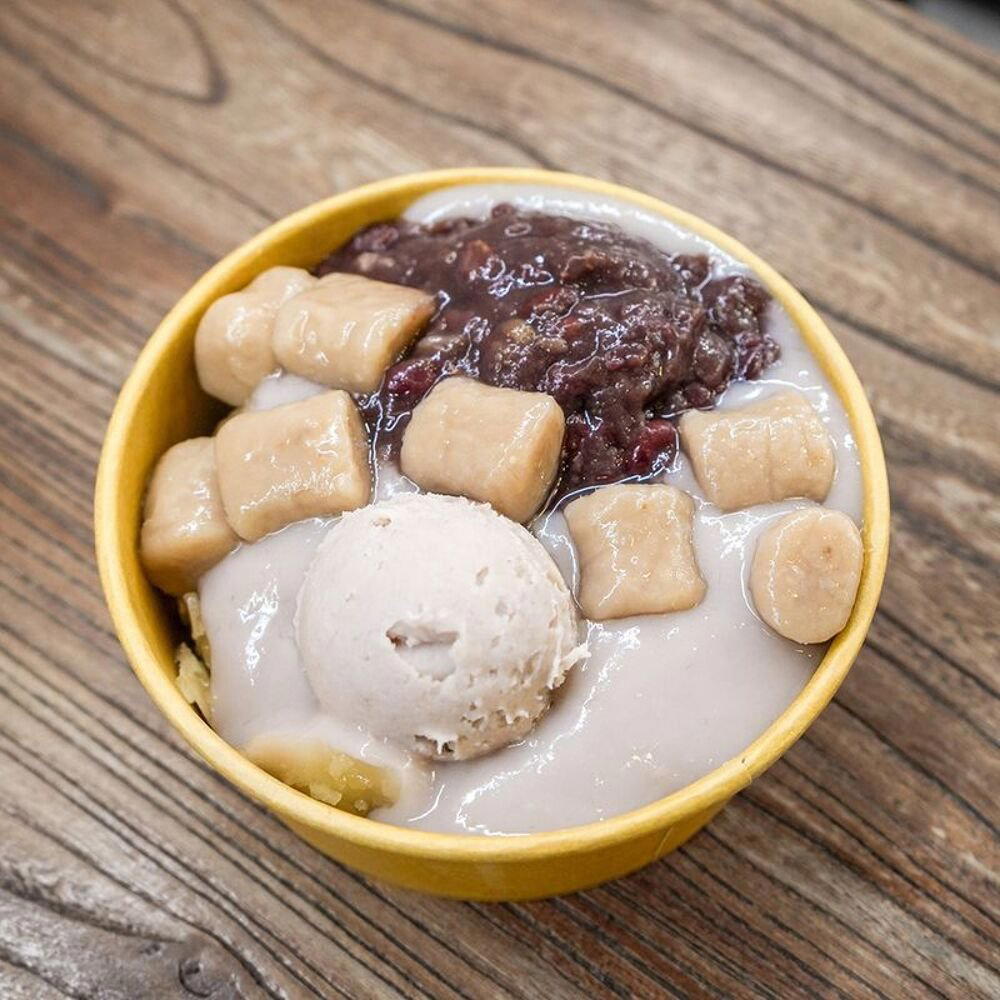
Where Yonghe's Street Food Logic Begins
A-ba's Taro Ball is a Taiwanese dessert shop in Yonghe District, New Taipei City, serving taro ball desserts at a casual, walk-in-friendly counter. Lane addresses like No. 1, Lane 18 on Baoping Road fit that pattern precisely. These are not spaces designed for passing trade. They require a degree of intent to find, which means the customers who arrive tend to know what they are looking for. A-ba's Taro Ball operates in that register, anchored in a district where the competitive pressure comes not from ambition but from the sheer number of alternatives within walking distance.
The Ingredient Logic Behind Taro Ball Culture
Taro balls, known in Mandarin as 芋圓 (yù yuán), represent one of the cleaner expressions of Taiwanese dessert craft: a form in which the quality of a single agricultural ingredient determines almost everything about the outcome. The dish is built around taro root, sweet potato, or tapioca, shaped into small rounds and served over shaved ice or warm sweetened broth depending on season. There is nowhere for technique to hide poor sourcing. Taro grown in Taiwan's mountainous interior, particularly from Dajia in Taichung County or from the slopes of Jiufen in New Taipei, carries a different density and sweetness than commodity-farmed alternatives. Shops that source deliberately from these growing areas produce a firmer, more fragrant ball with a texture that holds across the temperature contrast of ice service.
This sourcing distinction matters because the dessert format itself is deceptively simple. The production steps, mixing, steaming, shaping, and chilling, are not complex enough to compensate for ingredient gaps. In this sense taro ball shops function more like produce stalls than restaurants: the ingredient is the product, and the maker's role is largely to not ruin it. That logic places ingredient sourcing at the centre of any honest assessment, and it is the lens through which regulars in Yonghe evaluate their local options.
Taiwan's dessert tradition draws from Hokkien and Hakka foodways, where root vegetables formed a significant part of daily diet, and where sweetened preparations served both as snacks and as practical energy food. The taro ball's persistence as a street food format, from night markets to lane shops, reflects its structural role in that tradition rather than any recent trend cycle. It has not been reinterpreted or modernised in the way that, say, Taiwanese beef noodle soup has attracted fine-dining attention. It remains close to its origin form, which is part of its appeal to the demographic that seeks it out.
Yonghe as a Food District: Context for Visitors
Visitors approaching Yonghe from Taipei often arrive via the MRT Yonghe line and find a district that does not announce itself the way Da'an or Xinyi do. The streets are residential-commercial, the signage is functional, and the food operations are embedded in the neighbourhood rather than staged for tourism. That character means discovery requires a different navigation approach: following addresses rather than visual cues, and cross-referencing with local knowledge rather than tourist indexes.
The presence of specialty dessert shops alongside these formats reflects Yonghe's layered food identity, one that runs from quick street-format snacks to sit-down dining without a clean hierarchy between them.
JL Studio in Taichung and logy in Taipei represent the formal end of that spectrum, while operations like A-ba's sit at the tradition-preserving end. Both ends are worth understanding as part of the same food culture. Further south, GEN in Kaohsiung and A Xia in Tainan offer additional reference points across the island's regional dining character.
Other traditional format operations across Taiwan that offer useful comparison include Chenggong Douhua in Chenggong, which applies similar ingredient-first logic to tofu pudding, and Ah Zhen Rou Bao in Lukang, a steamed bun operation built on comparable lane-shop principles. Golden Formosa Taiwanese Cuisine 金蓬萊遵古台菜餐廳 in 士林 extends that traditional lineage into a more formal sit-down setting.
Operations like Atomix in New York City demonstrate how Korean culinary traditions translate into formal dining contexts, while Le Bernardin in New York City shows what ingredient-obsessive sourcing looks like at the highest formal tier. The principle is the same across formats, even when the price point and setting differ by an order of magnitude.
Each of these operations maps to a different node in Taiwan's traditional food network.
Planning Your Visit
A-ba's Taro Ball is located at No. 1, Lane 18, Baoping Road, Yonghe District, New Taipei City. The lane address means GPS navigation is more reliable than landmark orientation. Yonghe is well connected to Taipei via bus and the Zhonghe-Xinlu MRT line. No booking is required or available for a street-format operation of this type. Hours are Monday through Sunday, 3:30 to 11 PM, and the counter is walk-in friendly. Seasonal variation in the taro ball menu is standard across the format in Taiwan, with warm broth service more common in winter months and shaved ice presentation dominant in summer.
Comparable Spots, Quickly
Comparable venues nearby, for context on price, style, and recognition.
| Venue | Cuisine | Price | Awards | Notes |
|---|---|---|---|---|
| A-ba's Taro BallThis venue — the venue you are viewing | Taiwanese Taro Desserts | $ | , | |
| GARDENh | Hakka and Shanghai-style | $$ | , | Yonghe District |
| 永和佳香豆漿 | Traditional Taiwanese Breakfast & Dim Sum | $$ | , | Yonghe District |
| 三分俗氣餐廳 | Traditional Taiwanese Breakfast | $$ | , | Yonghe District |
| Chan Kee Mochi | Traditional Taiwanese Mochi | $ | , | Taitung City |
| 越南小吃 鹿港民族路 | Traditional Taiwanese Mienxian Hu (Mie Line Paste) | $ | , | Lukang Old Street area |
Continue exploring
More in Yonghe District
Restaurants in Yonghe District
Browse all →
Bars in Yonghe District
Browse all →
Hotels in Yonghe District
Browse all →

Wineries in Yonghe District
Browse all →
At a Glance
- Cozy
- Trendy
- Casual Hangout
Casual dessert shop atmosphere suitable for relaxed indulgence in traditional Taiwanese sweets.