





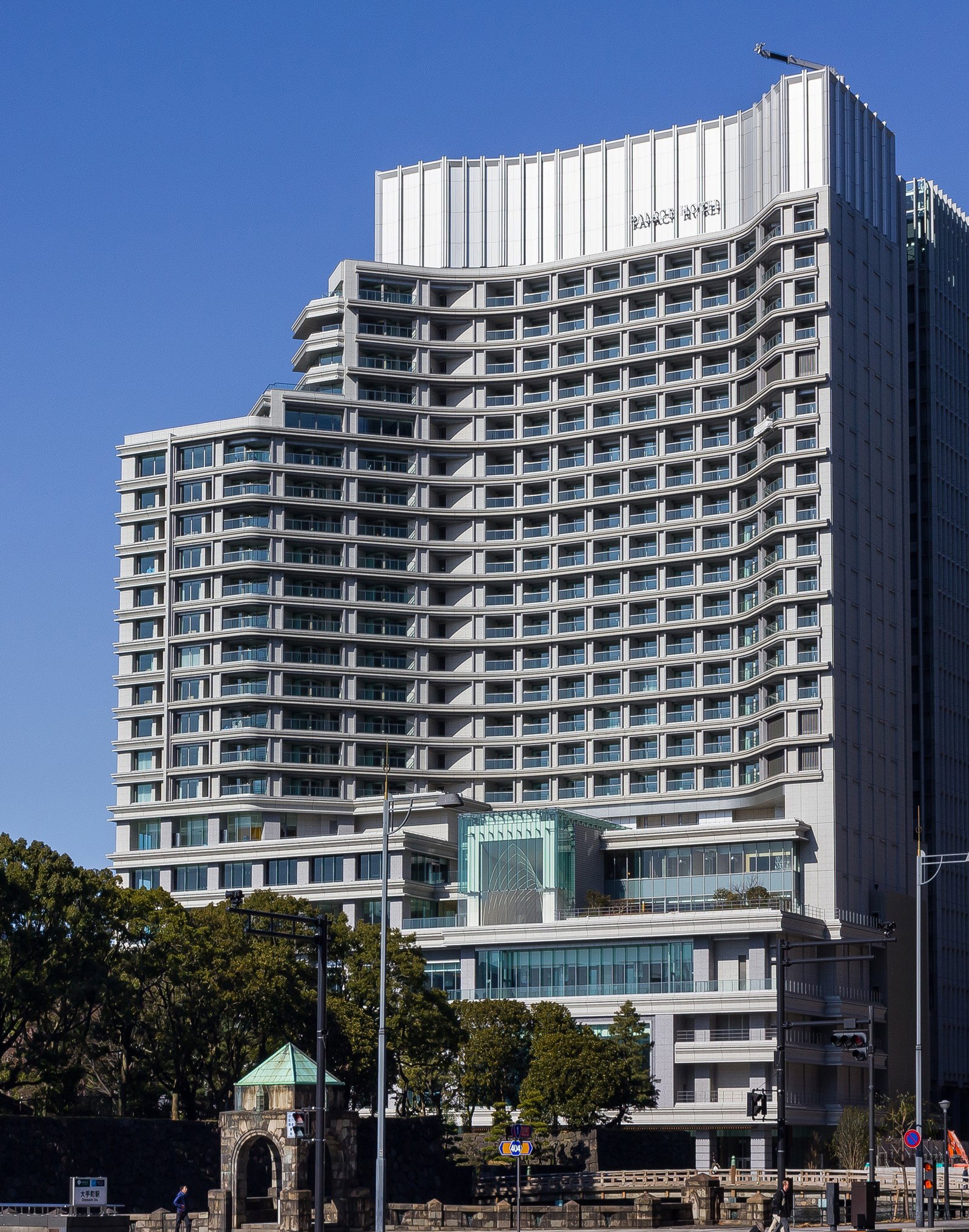
Positioned at the edge of the Imperial Palace moat in Marunouchi, Palace Hotel Tokyo holds a Forbes Travel Guide Five Star rating, 2024 Michelin 3 Keys, and a La Liste Top Hotels score of 98.5 points. Its 284 rooms combine contemporary Japanese design with views across the Imperial gardens, while the Royal Bar, Palace Lounge, and Evian Spa place it firmly in Tokyo's highest tier of urban luxury stays.
A Address That Earns Its Weight
In a city where luxury hotels cluster around Shinjuku's vertical ambitions or Roppongi's after-dark energy, Marunouchi occupies a different register entirely. The district sits between Tokyo Station and the Imperial Palace grounds, a corridor of low-slung government buildings, financial institutions, and open sky that is, by Tokyo standards, almost startlingly unhurried. It is this context that frames a stay at Palace Hotel Tokyo before a guest even reaches the lobby. The approach along the moat, with manicured maple trees lining the embankment and the palace walls rising on the far bank, establishes a spatial calm that few urban properties can claim with any honesty. That view is not borrowed scenery — it is the address.
Tokyo's luxury hotel tier has expanded considerably since 2012, with international brands staking positions in Toranomon, Otemachi, and Azabudai. Bvlgari Hotel Tokyo, Aman Tokyo, Four Seasons Hotel Tokyo at Otemachi, and JANU Tokyo have all entered the conversation in that period. Palace Hotel Tokyo's proposition within this peer set rests less on brand lineage than on its singular site: 284 rooms in a building that faces the Imperial Palace grounds directly, at a location that cannot be replicated elsewhere in the city.
Design Rooted in Japanese Material Culture
The decision to rebuild rather than refurbish — the current hotel opened in 2012 after a three-year ground-up reconstruction , produced interiors that read as considered rather than fashionable. Double-height ceilings in the main lobby, walls of glass, and a natural palette of whites, greens, and woods draw the eye outward toward the moat rather than inward toward décor. This is a Japanese spatial instinct translated into a large hotel context: the view is the room's primary feature, and the furnishings are calibrated not to compete with it.
This approach mirrors a broader design philosophy visible across Tokyo's more disciplined luxury properties. Where some of its competitors , Andaz Tokyo and Bellustar Tokyo among them , lean into height and panoramic city sprawl as their visual argument, Palace Hotel Tokyo works with horizontal depth: the still water of the moat, the resident swans, the silhouette of the emperor's palace roof against the city's skyline. A different kind of Tokyo view, and arguably a more historically rooted one.
The rooms themselves carry this material intelligence through to the details. Glass-walled bathrooms arrive stocked with 300-thread-count Imabari towels , a provenance marker that signals craft rather than genericism, as Imabari is Japan's most rigorously certified textile region. Maruyama Nori green tea served in Mashiko ceramics adds a further layer of regional specificity: Mashiko pottery carries a craft tradition dating to the Edo period. These are not decorative gestures but a coherent design position, one that places the hotel in continuity with Japanese material culture rather than simply adjacent to it.
More than half of the 284 rooms include balconies, a rarity in Tokyo's hotel inventory at this tier. South-facing rooms deliver views across the Imperial gardens and, in the right light, the palace roofline with the city's financial towers arranged behind it. The contrast between the palace's low, natural silhouette and the vertical ambition of the surrounding skyline is one of Tokyo's more arresting urban compositions, and it is available from a private balcony here in a way it is not from most competitors.
Seasonal Tokyo, Framed Through a Window
The cultural weight of seasonal change in Japan runs deeper than aesthetics. The concept of mono no aware , an attentiveness to the transience of things , finds its most public expression in the rhythm of the natural year: cherry blossoms in late March, the dense green of summer, autumn's maple colouration, the spare geometry of winter. At Palace Hotel Tokyo, this cycle plays out directly in front of the building. The manicured maple at the lobby's centre-stage position is referenced in reviews precisely because it marks the seasons for guests in a way that a concrete courtyard cannot. Afternoon teas in the Palace Lounge are constructed around seasonal leaves and flavours, served in tiered jyubako lacquer boxes, a format that places the experience within the tradition of Japanese celebration dining rather than the conventions of Western afternoon tea.
The autumn months, when the maple trees around the Imperial Palace turn, represent one of Tokyo's most concentrated luxury travel windows. Bookings at hotels in this tier across Marunouchi and Otemachi tighten significantly in October and November. For comparable seasonal positioning, properties like The Capitol Hotel Tokyu, set near Hie Shrine, offer a different register of seasonal engagement, but none carry quite the same moat-and-palace frame.
Bars, Lounges, and the Art of the Tokyo Martini
Royal Bar's reputation for its martinis is specific enough to appear in independent editorial assessments as a named highlight, which in Tokyo's bar culture carries weight. The city's cocktail scene operates at a level of technical precision that sets a very high floor for any hotel bar that wants to be taken seriously. The Royal Bar , dark woods, leather, velvet, deliberately dim , fits the Japanese model of the intimate, craft-focused bar rather than the open lobby lounge format that international brands often default to. For guests who want to extend their exploration of Tokyo's broader bar culture, our full Tokyo bars guide maps the city's most considered programs.
The Evian Spa and Tokyo's Approach to Wellness
Hotel opened Japan's first Evian Spa in 2012 as part of its reconstruction, a European-inflected wellness program in a city that has its own deeply developed traditions of thermal bathing and bodily care. The spa runs five treatment rooms and a suite alongside cold plunge pools, reclining baths, and a cedar-scented marble sauna with LED light therapy calibrated to replicate the light cycle of the French Alps. Tokyo luxury properties routinely produce their wellness amenities at a standard that surprises visitors expecting something merely functional , this spa sits within that pattern, with the European reference point delivered through Japanese precision of execution.
For those considering properties where spa and natural setting are more central to the stay, Japan offers a compelling complement circuit: Amanemu in Mie draws on the onsen traditions of the Shima Peninsula, while Gora Kadan in Hakone places thermal baths against mountain scenery. For a base in Kyoto, HOTEL THE MITSUI KYOTO offers a comparable level of historical and material seriousness. Other regional options worth considering alongside a Tokyo base include Asaba in Izu, Benesse House in Naoshima, ENOWA Yufu in Yufu, Fufu Kawaguchiko in Fujikawaguchiko, Fufu Nikko in Nikko, and Halekulani Okinawa for those extending south.
Credentials and Competitive Standing
Palace Hotel Tokyo carries a Forbes Travel Guide Five Star rating, a 2024 Michelin 3 Keys designation (the Guide's highest hotel category, shared among Tokyo properties including Bvlgari and Four Seasons at Otemachi), and a La Liste Leading Hotels score of 98.5 points in 2026. It holds membership in Leading Hotels of the World. Room rates start at approximately USD 1,532 per night, positioning it at the upper bracket of Tokyo's luxury tier , consistent with the price range at comparable properties. Google reviews average 4.5 across nearly 6,000 responses, which for a property at this rate and standard is a signal of consistent delivery rather than selective excellence.
For those comparing Tokyo options at the same tier, Four Seasons Hotel Tokyo at Marunouchi offers a boutique counterpoint within the same district, while the Aman Tokyo holds a Michelin 2 Keys rating and positions itself differently through its Otemachi tower address. Our full Tokyo hotels guide covers the broader field across all tiers and neighbourhoods.
Planning a Stay
Palace Hotel Tokyo sits at 1-1-1 Marunouchi, Chiyoda-ku, a few minutes on foot from Tokyo Station's Marunouchi exit and directly adjacent to the Imperial Palace East Gardens. Booking at least two to three months ahead is advisable for the autumn viewing season and cherry blossom period. The fifth-floor fitness centre operates with Under Armour gym kit available on loan. The hotel's restaurants and lounges are accessible to non-resident guests for dining and bar visits, making the Royal Bar a viable standalone destination for those staying elsewhere. For dining beyond the property, our full Tokyo restaurants guide covers the city's most considered tables, and our Tokyo experiences guide maps cultural programming worth building a visit around. Those travelling to Japan from comparable international properties might also cross-reference Aman New York, The Fifth Avenue Hotel, or Aman Venice to calibrate service expectations across the same international tier.
Frequently Asked Questions
- How would you describe the overall feel of Palace Hotel Tokyo?
- The hotel reads as a grand residence rather than a luxury property in the conventional sense. Double-height ceilings, walls of glass, and views directly across the Imperial Palace moat produce a sense of civic calm unusual in a 284-room city hotel. The Forbes Five Star and Michelin 3 Keys ratings, alongside a La Liste score of 98.5 points, confirm that the experience delivers at the level the address implies. Room rates begin around USD 1,532 per night, placing it at the upper end of Tokyo's luxury tier.
- What room should I choose at Palace Hotel Tokyo?
- South-facing rooms with balconies , available in more than half the hotel's inventory , provide views across the Imperial gardens and the palace roofline. At a Michelin 3 Keys property where the setting is a primary asset, the balcony rooms make full use of what the address offers. The natural palette of whites, greens, and woods, combined with Imabari towels and Mashiko ceramics, gives even the entry-level Deluxe Rooms a material quality that holds up to the price point.
- What's the standout thing about Palace Hotel Tokyo?
- The address. In a city as dense as Tokyo, a hotel that faces the Imperial Palace moat directly, with resident swans and manicured maple trees visible from the main lobby, occupies a position that no amount of interior design can manufacture elsewhere. That location, validated by Forbes Five Star, Michelin 3 Keys, and a La Liste score of 98.5, makes this one of Tokyo's most credentialled urban stays for guests who prioritise setting over verticality.
Comparable Options
Comparable venues for orientation, based on our database fields.
| Venue | Cuisine | Price | Notes |
|---|---|---|---|
| Palace Hotel Tokyo | This venue | ||
| Bvlgari Hotel Tokyo | Michelin 3 Keys | ||
| Aman Tokyo | Michelin 2 Keys | ||
| Four Seasons Hotel Tokyo at Otemachi | Michelin 3 Keys | ||
| Andaz Tokyo | Michelin 1 Key | ||
| Four Seasons Hotel Tokyo at Marunouchi | Michelin 1 Key |
Preferential Rates?
Our members enjoy concierge-led booking support and priority upgrades at the world's finest hotels.
Access the Concierge