







Occupying the top floors of the Otemachi Tower, Aman Tokyo holds a 2025 World's 50 Best Hotels ranking of #25 and Michelin 2 Keys recognition. Its 84 rooms and suites channel ryokan residential principles at altitude, with panoramic views over the Imperial Palace gardens and Mount Fuji. Rates from $2,953 per night position it among Tokyo's highest-tier urban properties.
Thirty-Three Floors Above the City Grid
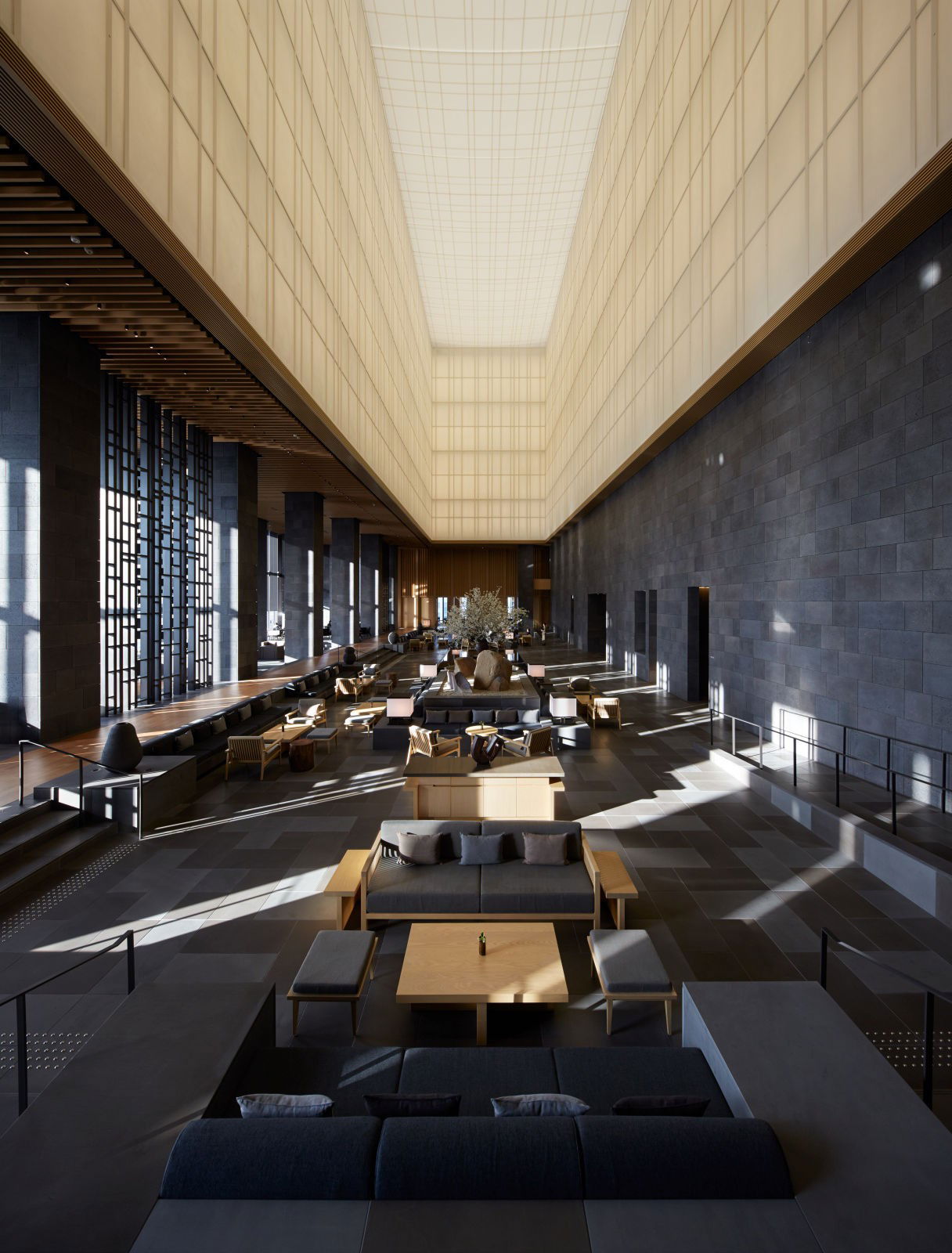
The elevator opens not onto a corridor but into a double-height atrium where pale washi paper, basalt stone, and cypress wood absorb the ambient noise of a city of fourteen million people. From street level, the Otemachi Tower reads as a standard-issue glass commercial block in Tokyo's financial district. By the 33rd floor, that reading no longer applies. The geometry of the space, designed by Australian architect Kerry Hill using locally sourced natural materials, produces something closer to a contemplative chamber than a hotel lobby — the kind of architectural restraint that defines the Aman brand's approach across its global portfolio, adapted here to a Japanese idiom it clearly suits.
Tokyo's luxury hotel tier is deep and competitive. Four Seasons Hotel Tokyo at Otemachi and Palace Hotel Tokyo both hold Michelin 3 Keys recognition; Bvlgari Hotel Tokyo operates at similar altitude with equal brand authority. Aman Tokyo, carrying Michelin 2 Keys and a 2025 World's 50 Best Hotels ranking of #25 (up from #7 in 2024 and #5 in 2023), occupies its own niche in that field — one defined less by scale or brand spectacle than by a particular quality of atmospheric removal from the city below. The question most luxury travellers ask in Tokyo is not whether the rooms are good (they are, across the top tier) but what kind of stillness a property can manufacture at this density of urban noise. Aman's answer, here as elsewhere in its portfolio, is architectural.
The Sequencing of a Stay
Arriving at Aman Tokyo follows a logic that resembles the progression of a well-structured meal: each stage is designed to reduce, to simplify, to redirect the senses. The lobby level introduces the material vocabulary , stone, wood, paper , that will repeat through every subsequent space. The rooms, 84 in total and arranged in what the property describes as Japanese residential style, build on that vocabulary with chestnut wood flooring, cypress paneling, and granite baths separated from the living space by sliding shoji screen doors. Heated stone floors in the bathrooms, remote-control blackout shades, and views across the Imperial Palace gardens, Mount Fuji, or Tokyo Skytree constitute the practical architecture of a room designed for sustained occupation rather than a one-night transit stop.
The analogy to a tasting progression holds through the dining sequence as well. The Aman Lounge functions as a first course: afternoon tea served daily on handmade bamboo stands, with sweets from executive pastry chef Yoshihisa Miyagawa paired with green, black, or herbal teas. Washi paper lanterns illuminate a bar positioned directly in front of floor-to-ceiling windows , a room that earns its view by not over-decorating it. Adjacent to the bar, the Fumoir cigar lounge operates as an optional interlude, a place to extend the evening with a glass of port before the transition to dinner. The dining program across the property spans Japanese cuisine from sushi and tempura to kaiseki, alongside Arva on the 33rd floor, which frames European technique around Japanese ingredients. In a city where Michelin stars accumulate at a rate that makes any single hotel's culinary offering look modest by comparison, the approach of grounding European cooking in local produce is a reasonable editorial choice. For a comprehensive map of where Tokyo's dining scene sits, see our full Tokyo restaurants guide.
The Spa as Destination
High-end Tokyo hotels increasingly treat the spa as a credentialing space rather than an amenity, and the Aman Spa on the 33rd and 34th floors represents the category at its most committed. Occupying a footprint described as the largest hotel spa in Tokyo, it incorporates a gym, yoga studio, onsen-style baths, and a black basalt swimming pool whose material language connects directly to the lobby's stone palette. The spa uses Aman Skincare products, a proprietary line drawing on traditional wellness formulations. The onsen component situates the property in a specifically Japanese hospitality lineage: the thermal bath as restorative ritual rather than decorative feature. For comparison, the ryokan tradition that informs this approach can be explored further at properties like Gora Kadan in Hakone and Asaba in Izu, where the onsen format operates in its natural rural context rather than transplanted to an urban tower.
Location as Competitive Advantage
The Otemachi district argument for luxury hotel placement is not obvious. Business districts in global cities tend to empty at weekends and carry none of the neighbourhood character that shapes a guest's sense of place. What redeems the Otemachi positioning here is proximity: Tokyo Station and its shinkansen connections are within walking distance, the Imperial Palace gardens provide a rare piece of open green space in the inner city, and the Nihonbashi district offers the kind of traditional Tokyo street-level texture that guests in Shinjuku or Shibuya have to seek out more deliberately. Five subway lines converge at Otemachi station, which connects directly to the tower. Haneda Airport sits roughly 40 minutes by road; Narita, the primary international hub, runs closer to 60 minutes. This transport density makes the location function as a genuine base rather than a quieter peripheral alternative.
The wider Aman network in Japan gives the property additional context for travellers building a Japan itinerary. Amanemu in Mie operates in onsen-resort format against the Ago Bay; HOTEL THE MITSUI KYOTO covers the Kyoto entry. For the nature-focused ryokan tier, Benesse House in Naoshima, ENOWA Yufu, and Fufu Kawaguchiko near Mount Fuji represent the more dispersed, regionally embedded tier. Aman Tokyo operates differently from all of them: it is the urban anchor of a brand that built its identity on resort seclusion, and it demonstrates that the seclusion proposition transfers to altitude as effectively as it does to geography.
Where It Sits in the Tokyo Tier
Rates from $2,953 per night position Aman Tokyo at the leading of the city's accommodation pricing, ahead of peers like Andaz Tokyo and Four Seasons Hotel Tokyo at Marunouchi, and broadly in line with JANU Tokyo and the Bvlgari property. The Google review aggregate of 4.4 across 1,847 reviews reflects consistent satisfaction at a price point where guest expectations are high and tolerance for operational inconsistency is low. Within the Aman global portfolio, the New York equivalent is Aman New York, which applies a similar urban-conversion logic in a different architectural register; Aman Venice operates the brand's palazzo format for European comparison. The Pearl Recommended designation from EP Club's 2025 assessment aligns with the World's 50 Best Hotels recognition and confirms that the property's standing has not eroded as the Tokyo luxury tier has grown more crowded.
The 186 Japanese trees planted at the tower's entrance function as both design statement and practical buffer: a vertical forest inserted between the financial district's concrete and the hotel's lower floors. It is a detail that reads as theatrical until you stand inside it, at which point it reads as necessary. That shift from scepticism to acknowledgment is, in many respects, the Aman Tokyo experience in miniature. See Bellustar Tokyo and The Capitol Hotel Tokyu for further reference points in Tokyo's upper mid-tier. For a full survey of the city's options, our full Tokyo hotels guide maps the field, and our guides to Tokyo bars and Tokyo experiences cover the surrounding programme. Additional Japanese properties worth considering alongside a Tokyo stay include Fufu Nikko and Halekulani Okinawa for those extending into the regions.
Frequently Asked Questions
What's the signature room at Aman Tokyo?
The suites facing the Imperial Palace gardens represent the clearest statement of the property's positioning: rooms where the cypress paneling, heated granite bath floors, and sliding shoji screens are matched by a view that no amount of interior design can substitute. At $2,953 per night as the entry rate, the allocation logic favours those who book well in advance, particularly for the higher categories. The Pearl Recommended designation and the 2025 World's 50 Best Hotels ranking at #25 reflect assessments made across the room tier, not just at the suite level.
What's the standout thing about Aman Tokyo?
In a city where the luxury hotel tier includes properties with Michelin 3 Keys recognition and long institutional histories, Aman Tokyo's case rests on atmospheric compression: the ability to manufacture genuine quiet on the 33rd floor of a commercial tower in one of the world's densest urban cores. The spa, at the largest hotel spa footprint in Tokyo, and the Kerry Hill-designed interiors are the structural pillars of that argument. The World's 50 Best Hotels tracked the property at #5 in 2023, #7 in 2024, and #25 in 2025 , a shift in ranking that reflects an expanding field rather than a declining property. Browse our Tokyo wineries guide for further context on Japan's premium hospitality ecosystem.
Price Lens
A compact comparison to help you place this venue among nearby peers.
| Venue | Price | Awards | Notes |
|---|---|---|---|
| Aman Tokyo | Hidden in Tokyo’s business district on top of a 40-story glass office tower, you’ll find an urban sanctuary in Aman Tokyo. Aman is the Sanskrit word for; (2026) La Liste Top Hotels: 93.5pts; Aman Tokyo represents the pinnacle of urban luxury hospitality, bringing Aman's signature tranquility to the heart of Japan's vibrant capital city. This urban sanctuary occupies the top floors of the Otemachi Tower, featuring 84 rooms and suites that showcase traditional Japanese design principles with contemporary luxury. The accommodations offer panoramic city views and feature natural materials like washi paper, stone, and wood, creating serene spaces above the bustling metropolis. The property includes multiple dining venues serving Japanese cuisine from sushi and tempura to kaiseki, while the bar offers premium sake and whisky selections. The comprehensive spa provides traditional Japanese treatments including onsen-style bathing and shiatsu massage in a serene setting. The hotel's location in the Otemachi business district provides easy access to the Imperial Palace gardens, traditional neighborhoods, and cultural attractions. The property serves as an ideal base for exploring Tokyo's diverse districts, from ancient temples to cutting-edge architecture, while providing a peaceful retreat from the city's energy.; **Our Inspector's Highlights Aman Tokyo’s prime location puts guests in the Otemachi district, with easy access to Tokyo Station and the exciting Nihonbashi district.Designed by architect Kerry Hill, Aman Tokyo’s interior is built in traditional Japanese style using natural, locally sourced materials: basalt stone, cypress wood and washi paper.The forest has been brought to the city — 186 Japanese trees planted at the entrance are a welcome break from the skyscrapers and concrete towers of the city.The Aman Lounge is a chic spot just off the lobby. When you’re looking for a cosmopolitan view, the bar is directly in front of windows offering a vista of the cityscape and is lit with washi paper lanterns.Try Fumoir, the cigar lounge next to the bar. It’s an ideal place to relax with a glass of port and a Habanera after dark.** **Things to Know The breathtaking Aman Spa on the 33rd and 34th floors is the biggest in Tokyo. A gym, a yoga studio, onsens (or hot baths) and a striking black basalt swimming pool are within the expansive spa.Japanese wood paneling and a terrace with a view of the city make it a one-of-a-kind experience. The spa uses products from Aman Skincare — an original line of all-natural formulas that draws on ancient wellness traditions and nature.Afternoon tea is served daily in the lounge (on handmade bamboo stands). Dishes include sweets by executive pastry chef Yoshihisa Miyagawa and are paired with traditional green, black or herbal teas.** **Treatments:** The Rooms The 84 rooms and suites of the luxury hotel are arranged in Japanese residential style — simple and luxurious.Each room is a nod to Japanese culture with local artwork, traditional ceramics and paper lanterns. Cypress paneling and chestnut wood flooring give the spaces an earthy, warm atmosphere.The granite baths with heated stone flooring are separated from the rooms by sliding shoji screen doors.Remote control blackout shades and state-of-the-art entertainment add comfortable touches to a stay at Aman Tokyo.Perhaps the best perk is that each room has a magical view over the Imperial Palace, Mount Fuji or Tokyo Skytree. **Amenities:** 1-5-6 Otemachi, Chiyoda-ku, Tokyo 100-0004, Japan; (2025) World's 50 Best Best Hotels #25; (2025) Pearl Recommended Hotel; Price: $2,953 Rooms: 84 Rooms We’ll admit it: our first thought when we heard whispers of an Aman Tokyo was that they might just have lost the plot. Why would these purveyors of resort perfection bother with the city? And why this particular city, whose high-end hotels are already as close to flawless as any we’ve seen? Well, we were fools to wonder. There might be no challenge that Aman resorts isn’t up to — certainly not Tokyo, where they’ve created something that the rest of the world’s luxury hoteliers will be chasing for a decade or more. Turns out the top of a Japanese skyscraper is tailor-made for the kind of quiet seclusion an Aman resort is tasked with providing. Once you’re on the 33rd floor of the Otemachi Tower, the city streets are a mere memory. The modernist spaces are calming to a degree that’s awe-inspiring, almost religious. The interiors throughout, in fact, were designed by Kerry Hill, the Australian architect who’s responsible for more than a few other Aman resorts, and who’s clearly quite comfortable remaining faithful to Japanese idiom. It’s not quite the full tatami experience, but it’s a fairly traditional one all the same. What’s to say about the nuts and bolts of the place? Everything’s perfect, is the short version. The rooms are a modern, urban interpretation of a classic ryokan, as is the stunning, massive spa, incidentally, with its baths clearly inspired by the traditional spring-fed onsen. The views, naturally, are phenomenal, and the tower’s location alongside the Imperial Gardens certainly doesn’t hurt in that department. And even Aman is inspired to step up its culinary game in this Michelin-star-studded city; Arva, on the 33rd floor, serves a local interpretation of European fare, made from exotic Japanese ingredients, to memorable results. How to get there: The Otemachi Tower is connected to five-line Otemachi subway station and close to Tokyo Station, which offers access to the nationwide bullet-train network. Haneda Airport is a 40-minute drive and handles domestic and international flights, while Narita Airport is a 60-minute drive and handles international flights.; (2024) World's 50 Best Best Hotels #7; (2024) Michelin 2 Keys; (2023) World's 50 Best Best Hotels #5 | This venue | |
| Bvlgari Hotel Tokyo | Michelin 3 Key, World's 50 Best | Michelin 3 Keys | |
| Four Seasons Hotel Tokyo at Otemachi | Michelin 3 Key | Michelin 3 Keys | |
| Palace Hotel Tokyo | Michelin 3 Key | Michelin 3 Keys | |
| Andaz Tokyo | Michelin 1 Key | Michelin 1 Key | |
| Four Seasons Hotel Tokyo at Marunouchi | Michelin 1 Key | Michelin 1 Key |
Preferential Rates?
Our members enjoy concierge-led booking support and priority upgrades at the world's finest hotels.
Access the Concierge