HUBERTUS Mountain Refugio Allgäu
A 66-room alpine lodge in Balderschwang, less than two miles from the Austrian border, HUBERTUS Mountain Refugio Allgäu sits at the intersection of serious mountain access and considered design. Solid wood interiors, direct cable car access to the Balderschwang ski area, and Slow Food-inspired terrace dining make a coherent case for a property where the Allgäu landscape is the primary architecture.
 Discover on Pearl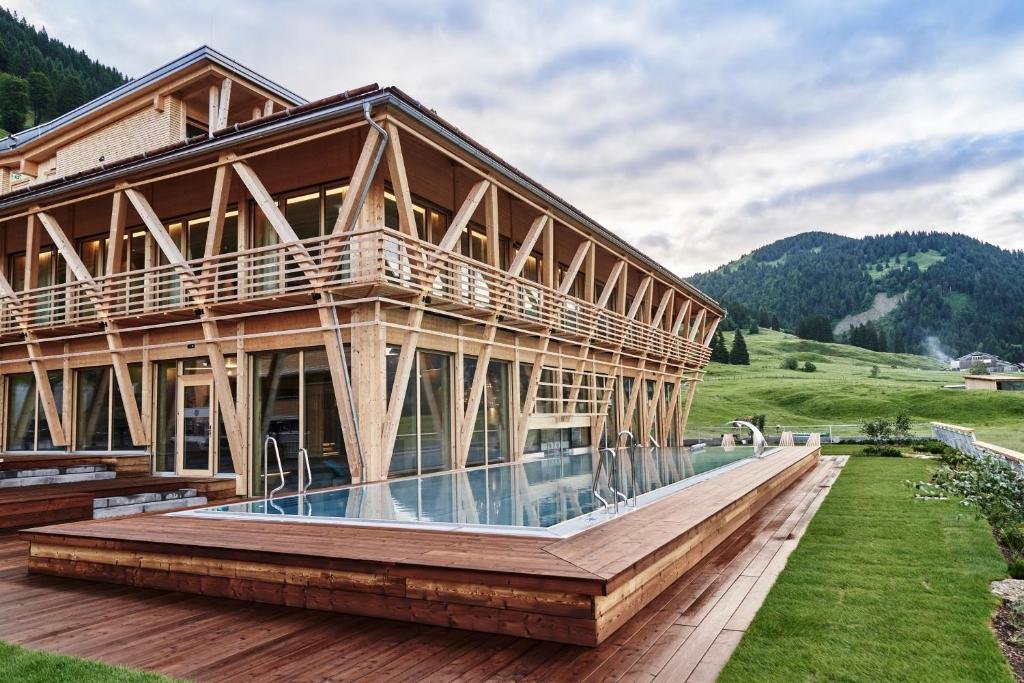
Where the Allgäu Alps Set the Terms
Balderschwang sits at the southern edge of Germany's Allgäu Alps, less than two miles from the Austrian border, at an elevation where the air carries the mineral sharpness of high pasture and the seasonal rhythm is defined by snowfall depths, not urban calendars. The village is small enough that arrivals notice the quiet before they notice anything else. It is into this setting that HUBERTUS Mountain Refugio Allgäu places itself: a 66-room lodge built on the premise that the mountains do the heavy lifting, and that the architecture's job is to get out of their way while still providing serious comfort.
That premise shapes every design decision in the building. Alpine-style rooms use solid wood construction and unpretentious materiality as a deliberate counterpoint to the glossy-surface luxury that characterises many European mountain hotels. The interiors are not austere — 66 rooms across a lodge of this scale allows for a range of configurations — but the aesthetic language is consistently grounded: natural textures, restrained colour, furniture that belongs to the mountains rather than to a mood board assembled in a city studio. It is a design position that places HUBERTUS in a specific peer set: properties that use regional material vocabulary as a primary architectural argument rather than as decorative garnish.
Design as Site Response
Among German alpine properties, the question of how a building relates to its landscape has produced two broad camps. One camp treats the mountain as backdrop , a visual amenity framed through floor-to-ceiling glass while the interiors remain generically international. The other camp treats the mountain as context , something that actively informs the materials, scale, and spatial logic of the building. HUBERTUS sits clearly in the second camp. Solid wood furniture is not a styling choice here; it is a structural honesty, a material that connects the building to the forests it occupies. The terrace, where Slow Food-inspired cuisine is served with panoramic mountain views, makes the connection between interior and exterior explicit rather than merely scenic.
That said, the lodge does not sacrifice function for philosophy. Direct cable car access from the property connects guests to the Balderschwang ski area without the shuttle logistics that complicate arrival at many comparable properties. The cable car station is effectively an extension of the building's circulation , a logistical precision that matters considerably when conditions outside are Arctic. For guests who want to travel further, Germany's longest year-round toboggan run is a short drive from the hotel, adding a non-skiing dimension to the winter offer. This combination of immediate ski access and secondary activity options places HUBERTUS in the category of alpine lodges that function as operational base camps rather than purely contemplative retreats.
The Slow Food Argument at Altitude
Alpine lodge dining has historically split between two approaches: the high-end tasting menu format that imports urban fine-dining conventions into the mountains, and the hearty regional formula that leans on tradition without much critical examination. A Slow Food-aligned kitchen represents a third position , one that takes regional ingredient sourcing as a serious discipline rather than a marketing footnote. At HUBERTUS, the terrace setting amplifies this: eating outside against panoramic Allgäu peaks changes the frame through which food is received. The mountains are not merely visible; they are the dominant sensory context, which places demands on a kitchen to match rather than compete with them.
For context on how this positions HUBERTUS within the broader German alpine luxury tier, consider the comparison set. Properties like the Kempinski Hotel Berchtesgaden (Michelin 2 Keys) and the Schloss Elmau Luxury Spa Retreat & Cultural Hideaway in Elmau occupy the high-specification end of Bavarian alpine hospitality, with polished international programming. HUBERTUS takes a different editorial position: smaller in its ambitions, more focused on the immediate landscape, and deliberately less glossy. That is a viable competitive posture in a market where a portion of the premium traveller base is specifically seeking retreat from the kind of luxury that replicates itself across continents.
For a sense of how the wider German luxury hotel market is structured, the Fairmont Hotel Vier Jahreszeiten in Hamburg (Michelin 3 Keys) and the Althoff Seehotel Überfahrt in Rottach-Egern define the urban and lakeside ends of the premium spectrum. Mountain lodges like HUBERTUS operate in a different register entirely , where the comparative advantage is geography and immediacy rather than service breadth or F&B prestige.
Wellbeing Without the Script
The property describes its approach as holistic wellbeing, a term that has been diluted by overuse across the European luxury hotel sector. What distinguishes the HUBERTUS version is its grounding in the physical environment rather than in a programme of treatments delivered in a sealed interior. The natural soundtrack , cowbells, wind, the specific silence of high-altitude snowfall , is not ambient; it is the point. Properties that make this kind of atmospheric argument depend on location in a way that cannot be replicated at sea level or in a city spa. The Balderschwang setting, at altitude and at the southern edge of the German Alps, provides the conditions. The design's restraint is what allows those conditions to register.
This positions HUBERTUS alongside other German wellness-oriented alpine properties that foreground environment over amenity lists. Das Kranzbach Hotel & Wellness Retreat in Kranzbach and Das Achental Resort in Grassau occupy similar positioning within the Bavarian alpine wellness tier, each making landscape integration a central part of the offer. Gut Steinbach Hotel Chalets Spa in Reit im Winkl provides a further regional comparison for guests calibrating their options across the broader Bavarian Alps.
Planning a Stay
HUBERTUS Mountain Refugio Allgäu is located at Dorf 5, 87538 Balderschwang, in the Allgäuer Alps. The property's 66 rooms across an alpine lodge format means it operates at a scale where direct booking enquiries are advisable rather than relying on third-party platforms. The Balderschwang ski area is accessible directly from the property via a cable car station, making winter the primary season, though the year-round toboggan run and summer hiking terrain extend the relevant calendar. For guests building a wider itinerary across the German alpine region, our full Balderschwang hotels guide provides additional context on the local accommodation market, and the Balderschwang experiences guide covers the activity range available in the surrounding area. Visitors interested in the dining dimension can consult our Balderschwang restaurants guide for the broader regional picture beyond the hotel's own kitchen.
Frequently Asked Questions
- What is the general vibe at HUBERTUS Mountain Refugio Allgäu?
- The property reads as a lodge designed for serious mountain use rather than as a luxury resort that happens to be near mountains. Solid wood interiors, direct cable car access to the ski area, and a Slow Food kitchen position it as a retreat where the Alpine environment is the primary experience. The 66-room scale keeps it intimate relative to larger Alpine resort hotels, and the Balderschwang location , a small village close to the Austrian border , keeps the setting genuinely remote.
- Which room offers the leading experience at HUBERTUS Mountain Refugio Allgäu?
- The venue data available to EP Club does not specify individual room categories or configurations, so a precise recommendation is not possible here. Generally at lodges of this type and scale, rooms with direct terrace access or unobstructed mountain-facing orientations tend to be the most sought-after. We recommend contacting the property directly to discuss which categories offer the most favourable aspect given the Allgäu panorama.
- What is the defining thing about HUBERTUS Mountain Refugio Allgäu?
- The combination of ski-to-door access via an on-property cable car station and a Slow Food-aligned kitchen served on a mountain-view terrace sets the property apart within the German alpine lodge category. It is less positioned as a full-service luxury resort and more as a purposeful mountain retreat where the design, the food philosophy, and the activity infrastructure are all oriented toward the same landscape.
- How hard is it to get in to HUBERTUS Mountain Refugio Allgäu?
- Balderschwang is a small, high-altitude village with limited accommodation capacity across the area. At peak winter season, when the Balderschwang ski area is at full operation, availability at lodges of this scale and positioning books out substantially in advance. Contacting the property directly at Dorf 5, 87538 Balderschwang is the most reliable route; third-party platforms may not reflect live availability accurately for smaller alpine properties.
- Is HUBERTUS Mountain Refugio Allgäu suitable for a non-skiing winter visit?
- The property's wellbeing focus and Slow Food-aligned terrace dining make it a plausible base for guests who are not primarily skiing. Germany's longest year-round toboggan run is a short drive from the hotel, providing a non-skiing outdoor activity. The Allgäu walking and snowshoe terrain around Balderschwang also offers winter access without requiring ski equipment, and the lodge's design and atmosphere are structured around mountain immersion rather than ski performance exclusively.
For broader hotel comparisons across the German luxury market, see our guides to Hotel Bareiss in Baiersbronn, Breidenbacher Hof Düsseldorf, Excelsior Hotel Ernst in Cologne, Hotel de Rome in Berlin, Bülow Palais in Dresden, Der Öschberghof in Donaueschingen, Esplanade Saarbrücken, LA MAISON in Saarlouis, Hotel Ketschauer Hof in Deidesheim, BUDERSAND Hotel in Hörnum, and Aman Venice for international reference points on how the mountain lodge format compares across tiers. Guests exploring New York-based luxury can also consult our profiles for The Fifth Avenue Hotel and Aman New York. Our Balderschwang bars guide and Balderschwang wineries guide cover additional local options for visitors spending time in the region.
In Context: Similar Options
These are the closest comparables we have in our database for quick context.
| Venue | Cuisine | Price | Awards | Notes |
|---|---|---|---|---|
| HUBERTUS Mountain Refugio Allgäu | Surrounded by the soaring peaks of the Allgäu, HUBERTUS Mountain Refugio Allgäu… | This venue | ||
| Fairmont Hotel Vier Jahreszeiten | Michelin 3 Key | Michelin 3 Keys | ||
| Kempinski Hotel Berchtesgaden | Michelin 2 Key | Michelin 2 Keys | ||
| Kempinski Hotel Taschenbergpalais | Michelin 2 Key | Michelin 2 Keys | ||
| Mandarin Oriental Munich | Michelin 2 Key | Michelin 2 Keys | ||
| Rocco Forte Charles Hotel | Michelin 2 Key | Michelin 2 Keys |
Preferential Rates?
Our members enjoy concierge-led booking support and priority upgrades at the world's finest hotels.
Get Exclusive Access