Set against Pokhara's lakeside ridgeline with the Annapurna range as backdrop, Himalayan Hideaway Resort is part of the Centara Collection, a brand tier that prioritises character-led properties over standardised luxury. Positioned where the Himalayan foothills meet Phewa Lake, the resort addresses a specific demand: considered accommodation in Nepal's most visited trekking gateway that does not read like a transit hotel.
Pearl is the En Primeur Club membership app — saves, bookings, and concierge access live there. Same editors, same standards.
- Address
- Pokhara, Nepal
- Directions
- Get directions
 Saves & bookings on Pearl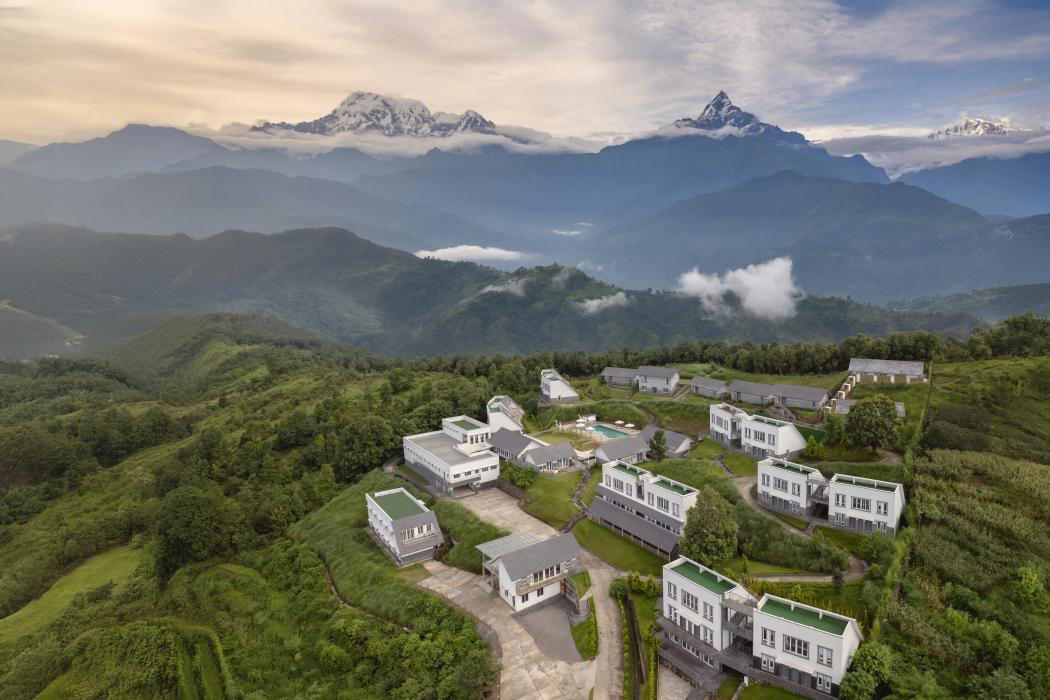
Where the Architecture Does the Heavy Lifting
Pokhara divides cleanly between the lakeside strip, with its trekker guesthouses and budget cafes, and a quieter tier of properties that sit above the noise, oriented toward the Annapurna massif. Himalayan Hideaway Resort Pokhara, part of the Centara Collection, occupies that upper register. In a city where the mountain view is one fought-over asset, the physical positioning of a property matters more than almost any other design decision. Approaches that frame Machhapuchhre (Fishtail Mountain) through a central corridor or terrace become the architecture. The landscape is not a backdrop; it is load-bearing.
The Centara Collection sits within the Thai-headquartered Centara Hotels group as a sub-brand reserved for properties with distinct local character, separated from the group's larger resort and city-hotel formats. That positioning matters for understanding what Himalayan Hideaway is doing in Pokhara. It is not a flag-planted international box; it belongs to a cohort of properties across Asia that trade on specificity of place rather than brand ubiquity. In Nepal's accommodation market, where the range runs from Kathmandu's heritage-led properties like Dwarika's Sanctuary in Dhulikhel to the stripped-back mountain lodges found along the Khumbu corridor at places such as Sherpa Lodge in Lobuche or Thukla Kalapathar Lodge, Himalayan Hideaway targets the gap in the middle: structured comfort with a genuine sense of arrival.
Design Tradition and Mountain Vernacular
Himalayan resort architecture has two dominant modes. The first borrows from Newari craftsmanship, the brickwork, carved timber lattice, and tiered pagoda rooflines that define Kathmandu Valley heritage hotels. The second draws on a more contemporary mountain idiom: stone, slate, dark wood, and open terraces calibrated for morning alpenglow. Properties in Pokhara largely follow the second school, partly because the city's architectural heritage is less codified than Kathmandu's, and partly because the view demands a certain horizontal openness that dense Newari construction does not easily allow.
Centara's Collection model, applied across its portfolio from Southeast Asia to the Indian subcontinent, tends to respect local material palettes rather than impose a corporate signature. In a Himalayan context, that means the quality of the stone cladding, the weight of the joinery, and the relationship between interior volumes and the external ridgeline all carry more critical weight than brand-standard furnishings. Travellers comparing this property to international comparators like Amangiri in Canyon Point will find a similar commitment to letting the surrounding geology do the aesthetic work, even if the operating scale and price tier differ considerably.
Pokhara as a Gateway, Not Just a Stopover
Most travellers arrive in Pokhara either from Kathmandu by a short domestic flight or after the approximately 200-kilometre road journey, with the latter taking six to eight hours depending on road conditions. Pokhara is the launch point for Annapurna Circuit and Annapurna Sanctuary trekking permits, and the city's hospitality market has split accordingly. Trekkers requiring only a bed before and after the trail gravitate toward the lakeside lodges. A growing number of visitors, including those who are not trekking but want the mountain experience at altitude, are staying longer and expecting a different kind of accommodation. For those readers, a broader map of where Nepal's considered hospitality operates is useful: Aloft Kathmandu Thamel addresses the capital's design-hotel demand; Shinta Mani Mustang in Jomsom pushes further into the restricted upper Mustang corridor. Himalayan Hideaway sits between those poles, in Nepal's most accessible mountain city.
Timing matters here: the post-monsoon window from October through November delivers the clearest Annapurna views and is the property's primary high season. The spring window in March and April runs close behind. Both periods see the city's better-positioned properties at or near capacity among international visitors.
The Nepal Premium Tier in Context
Nepal's premium accommodation market remains small by regional standards. The country lacks the resort infrastructure of, say, the Maldives or Sri Lanka, and Pokhara in particular has developed more slowly than Kathmandu on the higher-end hotel front. That relative underdevelopment means a Centara Collection property carries more weight here than the same brand tier would in Bangkok or Phuket, where the competitive set is considerably denser. It also means that expectations around food and beverage programming, spa services, and sustainability credentials are still being set, rather than benchmarked against a mature local peer group.
Travellers calibrated to properties like Castello di Reschio in Umbria or Hotel Esencia in Tulum, where design-led boutique identity has been refined over years of iteration, will find Pokhara's premium tier earlier in that process. That is not a criticism; it is a category difference. The draw here is the mountain environment itself, and particularly considered properties understand that their job is primarily to frame it, not compete with it.
For travellers building a broader Nepal itinerary, the logical structure typically runs Kathmandu for cultural depth, Pokhara for mountain access and recovery, and then onward into the trekking corridors. The lodge network along the Khumbu, including properties like Hikers Inn in Chaunrikharka, Dingboche Inn, Trekkers Holliday Inn in Pangboche, Zambala Lodge, and The Happy House in Phaplu, operates at a fundamentally different standard, and the transition from a resort like Himalayan Hideaway to that network is part of the journey's deliberate arc. See You Lodge in Dhampus Phedi sits at an intermediate point on the Annapurna foothills trail, useful for those who want to begin their acclimatisation walk directly from Pokhara.
Planning Your Stay
Given Pokhara's seasonal concentration, booking Himalayan Hideaway during the October-to-November and March-to-April windows in advance is advisable. Pokhara is served by domestic flights from Kathmandu. The longer road journey is used mainly by those who want to move through the middle hills at ground level, with the Prithvi Highway connecting the two cities. Reservations are recommended.
At-a-Glance Comparison
Comparable venues nearby, for context on price, style, and recognition.
| Venue | Cuisine | Price | Notes |
|---|---|---|---|
| Himalayan Hideaway Resort Pokhara, The Centara CollectionThis venue — the venue you are viewing | Secluded sanctuary blending modern comforts with authentic Nepali charm and Thai-inspired hospitality. | $$$$ | Not listed |
| The Beyul Hermitage Lodge And Farm | rustic hermitage with farm elements | $$$ | Chhuserma |
| See You Lodge And Restaurant | Eco-friendly mountainside lodge inspired by local designs | $$ | Dhampus Phedi |
| The Happy House | Traditional Nepali/Tibetan style luxury home with modern comforts | $$ | Phaplu |
| Trekker's Holliday Inn | rustic trekking lodge | $ | Pangboche |
| Zambala Lodge & Restaurant | Traditional Sherpa teahouse with stone and wood construction. | $$ | Khumbu Pasanglhamu Rural Municipality |
Continue exploring
More in Pokhara
Hotels in Pokhara
Browse all →
At a Glance
- Quiet
- Scenic
- Elegant
- Cozy
- Sophisticated
- Romantic Getaway
- Wellness Retreat
- Honeymoon
- Group Retreat
- Panoramic View
- Infinity Pool
- Pool
- Spa
- Fitness Center
- Wi Fi
- Room Service
- Concierge
- Mountain
- Pool
- Spa
- Fitness Center
- Wi Fi
- Room Service
- Concierge
Serene and sophisticated ambiance with soothing wooden tones, natural light, and mountain views.