
Grand Elysée Hamburg is one of the city's largest independent luxury hotels, with 510 rooms on Rothenbaumchaussee and a 94.5-point score in the 2026 La Liste Top Hotels ranking. Its scale places it in a different competitive tier from Hamburg's boutique properties, while its independent ownership gives it a character distinct from international chain flagships.
 Discover on Pearl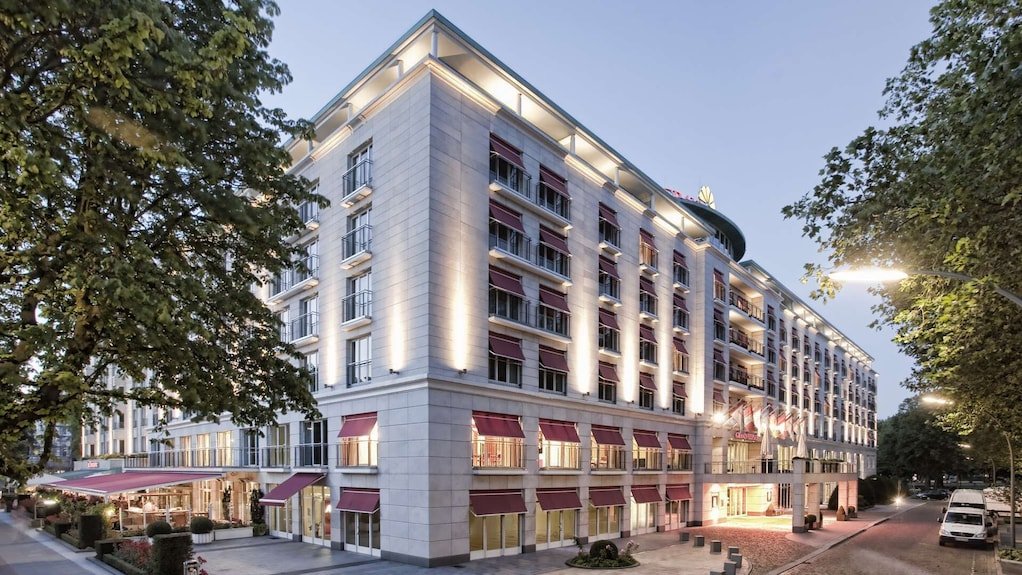
A Different Scale of Ambition on Rothenbaumchaussee
Rothenbaumchaussee is not Hamburg's flashiest address, but it is one of its most purposeful. The boulevard runs through the Harvestehude district, connecting the inner Alster to the university quarter, and the hotels that have established themselves here tend to favour permanence over trend. Grand Elysée Hamburg sits on this axis with 510 rooms, a footprint that immediately signals its position: this is not a boutique property optimising for intimacy, nor a chain flagship optimising for brand consistency. It occupies a third category, the large-format independent luxury hotel, a model that has largely disappeared from European city centres but remains alive in Hamburg through properties with the confidence to maintain their own identity at scale.
In the 2026 La Liste Leading Hotels ranking, Grand Elysée Hamburg scored 94.5 points, placing it inside a peer set that includes some of the most consistently recognised hotels in Germany. La Liste's methodology draws on hundreds of international sources, so a score at this level represents sustained performance across multiple dimensions rather than a single strong season. For Hamburg specifically, that ranking places Grand Elysée in direct conversation with Fairmont Hotel Vier Jahreszeiten and The Fontenay, two properties that anchor the upper tier of the city's hotel market from quite different positions.
The shortlist, unlocked.
Hard-to-book tables, cellar releases, and concierge-planned trips.
Get Exclusive Access →What Happens Inside 510 Rooms
At 510 rooms, Grand Elysée Hamburg is operating at a scale where consistency becomes the central discipline. Large luxury hotels face a specific challenge that smaller properties do not: the guest in room 412 and the guest in room 104 need to receive the same quality of experience, which requires operational infrastructure that boutique properties rarely need to build. The fact that the hotel maintains a 94.5-point La Liste score despite that volume suggests the infrastructure is holding.
The room experience at a hotel of this size typically stratifies across several categories, from standard configurations through to suites, and the gap between those tiers tends to be wider than at smaller properties where even the entry-level rooms receive careful individual attention. What distinguishes the better large-format luxury hotels is not just the quality of the premium rooms but the floor at which quality begins. Hamburg's upper hotel market has become more competitive in recent years, with design-led arrivals like The Fontenay and the repositioning of established names like Fairmont Hotel Vier Jahreszeiten raising expectations across the board.
For travellers assessing room categories at Grand Elysée specifically, the 510-room inventory means availability is rarely the constraint that it becomes at smaller Hamburg properties. Hotel Louis C. Jacob, with its Elbchaussee position and more limited key count, regularly books out further in advance. Grand Elysée's scale works in the guest's favour when planning flexibility matters, particularly for business travel or group stays where lead times are compressed.
Hamburg's Independent Luxury Tier
The independent luxury hotel is a specific product. Without a global brand's reservation network or loyalty programme infrastructure, these properties compete on reputation, repeat clientele, and the kind of accumulated character that takes decades to build. In Germany, that model has produced some of the country's most distinguished addresses: Excelsior Hotel Ernst in Cologne, Breidenbacher Hof in Düsseldorf, and Hotel de Rome in Berlin each occupy this independent or semi-independent niche. Grand Elysée Hamburg belongs in that lineage.
The comparison matters because it sets the right frame for what to expect. Guests arriving from a brand-affiliated property elsewhere in Europe will find fewer programmatic touchpoints, but potentially more operational focus on the physical stay itself: the room, the food and beverage, the service cadence. That trade-off suits certain travellers well, particularly those who find loyalty ecosystems more friction than benefit.
Within Hamburg, the contrast with chain-affiliated properties is instructive. Conrad Hamburg brings Hilton's infrastructure to the HafenCity, while Apotheke an der Elbphilharmonie takes a different approach entirely with its design-forward positioning near the concert hall. Grand Elysée's Rothenbaumchaussee address keeps it slightly removed from both the harbour-facing cluster and the city centre, in a residential-adjacent neighbourhood that has its own rhythm distinct from the tourist-heavy Altstadt.
Placing It in the Broader German Hotel Context
Germany's luxury hotel market has a strong regional character: properties like Schloss Elmau in Elmau, Hotel Bareiss in Baiersbronn, and Althoff Seehotel Überfahrt in Rottach-Egern draw international guests specifically for their setting and the depth of what surrounds them. Urban luxury in Hamburg operates differently: the pull is the city itself, the port culture, the Elbphilharmonie, the Speicherstadt, and the hotel's role is to serve access to that rather than to be the destination in itself.
Grand Elysée's 94.5 La Liste score positions it above many of Germany's well-regarded urban properties and within range of peers like Bülow Palais in Dresden and Esplanade Saarbrücken. At the northern end of the country, it also draws comparison with BUDERSAND Hotel in Hörnum on Sylt, though the market contexts are quite different: resort versus city, leisure versus mixed.
For a broader map of what Hamburg offers across different hotel styles, our full Hamburg guide covers properties ranging from the design-led east Hamburg and Gastwerk Hotel Hamburg to the converted-industrial Garner Hamburg East.
Planning a Stay
Grand Elysée Hamburg sits at Rothenbaumchaussee 10 in the 20148 postal district, within walking distance of the outer Alster and a short taxi or U-Bahn ride from the main station. The 510-room inventory means the hotel can absorb demand that would close out smaller properties, making it a practical choice for last-minute business travel into Hamburg's conference calendar. For comparison, travellers prioritising waterfront positioning might look at The Fontenay for Alster views or Hotel Louis C. Jacob for the Elbe. Those cross-referencing Hamburg against other European city-stay options may find useful context in properties like The Fifth Avenue Hotel in New York or Aman Venice, which occupy comparable luxury tiers in their respective markets.
The shortlist, unlocked.
Hard-to-book tables, cellar releases, and concierge-planned trips.
Get Exclusive Access →Frequently Asked Questions
Quick Comparison
A small peer set for context; details vary by what’s recorded in our database.
| Venue | Cuisine | Price | Awards | Notes |
|---|---|---|---|---|
| Grand Elysée Hamburg | This venue | |||
| Fairmont Hotel Vier Jahreszeiten | Michelin 3 Key | |||
| The Fontenay | Michelin 3 Key | |||
| Hotel Louis C. Jacob | Michelin 2 Key | |||
| Conrad Hamburg | ||||
| east Hamburg |
Preferential Rates?
Our members enjoy concierge-led booking support and priority upgrades at the world's finest hotels.
Get Exclusive AccessThe shortlist, unlocked.
Hard-to-book tables, cellar releases, and concierge-planned trips.
Get Exclusive Access →