Bab Al Shams, A Rare Finds Desert Resort, Dubai


1 Michelin Key · Tablet Hotels Top 40 New Hotels #4
Forty kilometres from Dubai's skyline, Bab Al Shams sits on Al Qudra Road where the desert opens into dune terrain that the city's coastal properties cannot replicate. The resort belongs to the Rare Finds collection, a positioning that signals deliberate distance from the international chain model. For guests seeking genuine arid landscape rather than a beach backdrop, it occupies a category of its own within the Dubai accommodation market.

Pearl is the En Primeur Club membership app, where members save venues, book tables and use the concierge.
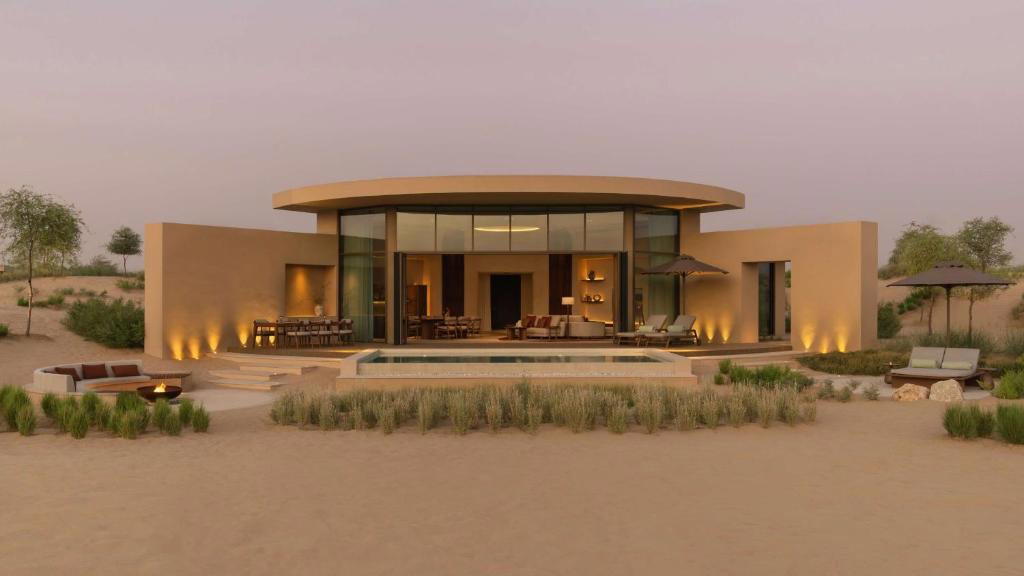
Where the City Ends and the Desert Begins
Dubai's hotel market divides cleanly along a geographic axis. The coastline from Palm Jumeirah through Jumeirah Beach to Dubai Creek carries the majority of the emirate's flagship properties: Atlantis The Royal, Jumeirah Marsa Al Arab, The Lana, and others that compete primarily on proximity to water and urban amenity. Bab Al Shams operates in an entirely different register. Positioned on Al Qudra Road opposite Endurance City, roughly forty kilometres from the city centre, it places the Arabian desert itself as the primary offering. The drive out is part of the experience: as the towers thin and eventually disappear, the flat scrubland transitions into rolling dune country, and the resort materialises as a low-rise sandstone silhouette against an open sky.
That approach sequence matters architecturally. Where coastal Dubai resorts compete on verticality and spectacle, towers, infinity pools cantilevered above the Gulf, panoramic sky bars, Bab Al Shams is deliberately horizontal. The built environment keeps a low profile against the dune line, and the design language draws from traditional Arabian fort architecture rather than contemporary glass-and-steel hotel norms. Thick walls, arched doorways, warm terracotta tones, and interior courtyards create a thermal and visual logic that belongs to this landscape rather than being placed upon it.
The Rare Finds Positioning
The resort carries the Rare Finds designation, a collection identity that signals a deliberate departure from the volume-driven international hotel model. In the UAE market, where the dominant players include large-footprint international brands operating across Address Beach Resort, Address Creek Harbour, Address Downtown, and Address Dubai Mall, a collection that actively foregrounds place-specificity occupies a narrower competitive tier. The Rare Finds model favours properties where the location cannot be replicated in a different city, where the setting is the product, not a backdrop to standard amenities.
Comparable concepts exist elsewhere in the Emirates and broader region: Arabian Nights Village in Abu Dhabi, Anantara Qasr Al Sarab Desert Resort in the Liwa Desert, and Desert Islands Resort and Spa by Anantara in Al Dhafra. What distinguishes the Bab Al Shams proposition is access: it remains the closest true desert resort to central Dubai, which removes the extended travel commitment that some of its more remote competitors require. Guests arriving at Dubai International can reach it in under an hour, whereas properties deeper into the Liwa or Rub' al Khali regions add two or more hours of road travel.
Architecture as the Editorial Argument
The design of Bab Al Shams makes an argument that most Dubai hotels do not: that the built environment should respond to climate and topography rather than override them. This is a meaningful distinction in a city whose hospitality architecture has historically tended toward maximalism. The resort's low-rise arrangement, grouped around courtyards and open-air passages, channels the logic of traditional Arabian settlements where built form created shade, directed airflow, and created intimate communal spaces rather than corridors connecting elevator banks to room doors.
This design philosophy puts Bab Al Shams in an international conversation that extends well beyond the UAE. The question of how luxury resort architecture should relate to desert terrain has produced some of the more interesting hospitality buildings of recent decades globally. Amangiri in Canyon Point resolves the same problem through a different formal language, pouring concrete around the Utah rock formations rather than referencing vernacular tradition. The Bab Al Shams approach is more contextually historicist, which suits its location: this is a landscape with deep cultural memory, and an architecture that references Arabian fort forms carries meaning that a purely contemporary aesthetic would not.
Interior spaces are organised around that same logic of enclosure and threshold. Guests move through a series of framed views and enclosed moments rather than through large open-plan lobbies. The sequence from arrival courtyard to room to pool area to desert edge is choreographed in a way that builds anticipation and maintains spatial intimacy, even at resort scale. This kind of sectional thinking is relatively rare in Dubai's hotel stock, which more commonly prioritises grand statement moments over the cumulative experience of moving through a property.
The Desert Activities Context
Desert resort programming in the region has become increasingly sophisticated, and Bab Al Shams sits within that shift. The camel riding, dune bashing, and falconry offering that characterises the category has expanded across the UAE market to include stargazing programmes, desert ecology briefings, and slower experiential formats that compete with the adrenaline-oriented excursion model. The Al Qudra location gives guests access to the Al Marmoom Desert Conservation Reserve, one of the largest such protected areas in the emirate, which adds ecological context to the landscape experience beyond pure recreation.
For travellers visiting Dubai primarily for its coastal and urban offers, the resort functions as an overnight or two-night counterpoint: a decompression from the pace and visual noise of the city rather than a destination in its own right. This two-track Dubai itinerary, combining a few nights on the coast at properties like Address Beach Resort Fujairah with a desert stay, has become a recognisable pattern among return visitors who have exhausted the standard coastal programme.
For those extending into wider Emirates territory, Bab Al Shams connects logically to a broader UAE desert circuit. Al Badayer Retreat by Sharjah Collection in Sharjah, Jebel Hafeet in Al Ain, and Anantara Mina Ras Al Khaimah Resort each offer a different facet of the Emirates' non-coastal geography. The full circuit, for guests with the time, covers mountain, desert dune, and salt flat terrain across a relatively compact driving radius. For a broader comparison of Dubai hotel options, our full Dubai guide maps the category against city, coastal, and desert variables.
Planning a Stay
The resort sits on Al Qudra Road, opposite Endurance City, a direct drive from central Dubai that avoids the traffic congestion associated with coastal routes during peak hours. Early morning and late afternoon represent the most rewarding times in desert terrain climatically, which shapes how the activity programme is structured; guests should factor this into their room selection and scheduling rather than treating the outdoor experience as an all-day option in summer months. The October-to-April window, when daytime temperatures sit in the low to mid-twenties Celsius, is when the desert property format operates at full advantage. Summer visits remain possible, with the experience shifting more heavily toward pool, spa, and evening activity formats as midday temperatures make outdoor desert time impractical.
How It Stacks Up
| Venue | Cuisine | Price | Awards |
|---|---|---|---|
| Bab Al Shams, A Rare Finds Desert Resort, DubaiThis venue (the venue you are viewing) | This venue | $300–500 | 1 Michelin Key · Tablet Hotels Top 40 New Hotels #4 |
| Anantara The Palm Dubai Resort | Not listed | $300–500 | Forbes 4-Star · World Travel Awards #1 |
| Conrad Dubai | Not listed | Not listed | La Liste Top Hotels · Forbes 4-Star |
| Fairmont The Palm | Not listed | Not listed | Forbes 4-Star |
| Four Seasons Hotel Dubai International Financial Centre | Not listed | Not listed | Michelin Guide New Hotels New Hotel · Michelin Selected |
| Four Seasons Resort Dubai at Jumeirah Beach | Not listed | $750–1,000 | 1 Michelin Key · Michelin Guide New Hotels New Hotel |
Recognition history
Dated appearances from independent guides and award organizations, with the underlying list record or original source where available.
Michelin 1 Key
Michelin
Tablet Hotels Top 40 New Hotels #4
Tablet Hotels
Full recognition history (3 entries)
Michelin 1 Key
Michelin
Continue exploring
More in Dubai
Hotels in Dubai
All hotels in Dubai →
Bars in Dubai
All bars in Dubai →
Details
- Scenic
- Romantic
- Elegant
- Rustic
- Family Vacation
- Romantic Getaway
- Wellness Retreat
- Destination Wedding
- Infinity Pool
- Private Villa
- Destination Spa
- Panoramic View
- Private Dining
- Garden
- Terrace
- Wi Fi
- Pool
- Spa
- Fitness Center
- Room Service
- Concierge
- Kids Club
- Bicycle Rental
- Garden
- Wheelchair Accessible
- Elevator
- Accessible Restroom
Sepia-toned serenity with warm desert lighting, whirling sufi dancers, and ancient spa rituals creating high-saturation snapshots of old-world Arabia against sun-baked landscapes.