Set inside a repurposed railway viaduct above the Kanda River, Hitachino Brewing Lab at Manseibashi puts one of Japan's most recognised craft beer lineages, the Ibaraki-based Kiuchi Brewery, into a setting that makes the industrial history of the space as present as the pour. The format leans into the brewery's range rather than a single flagship, making it a reference point for understanding how Japanese craft beer sits alongside the country's bar culture.

Pearl is the En Primeur Club membership app, where members save venues, book tables and use the concierge.
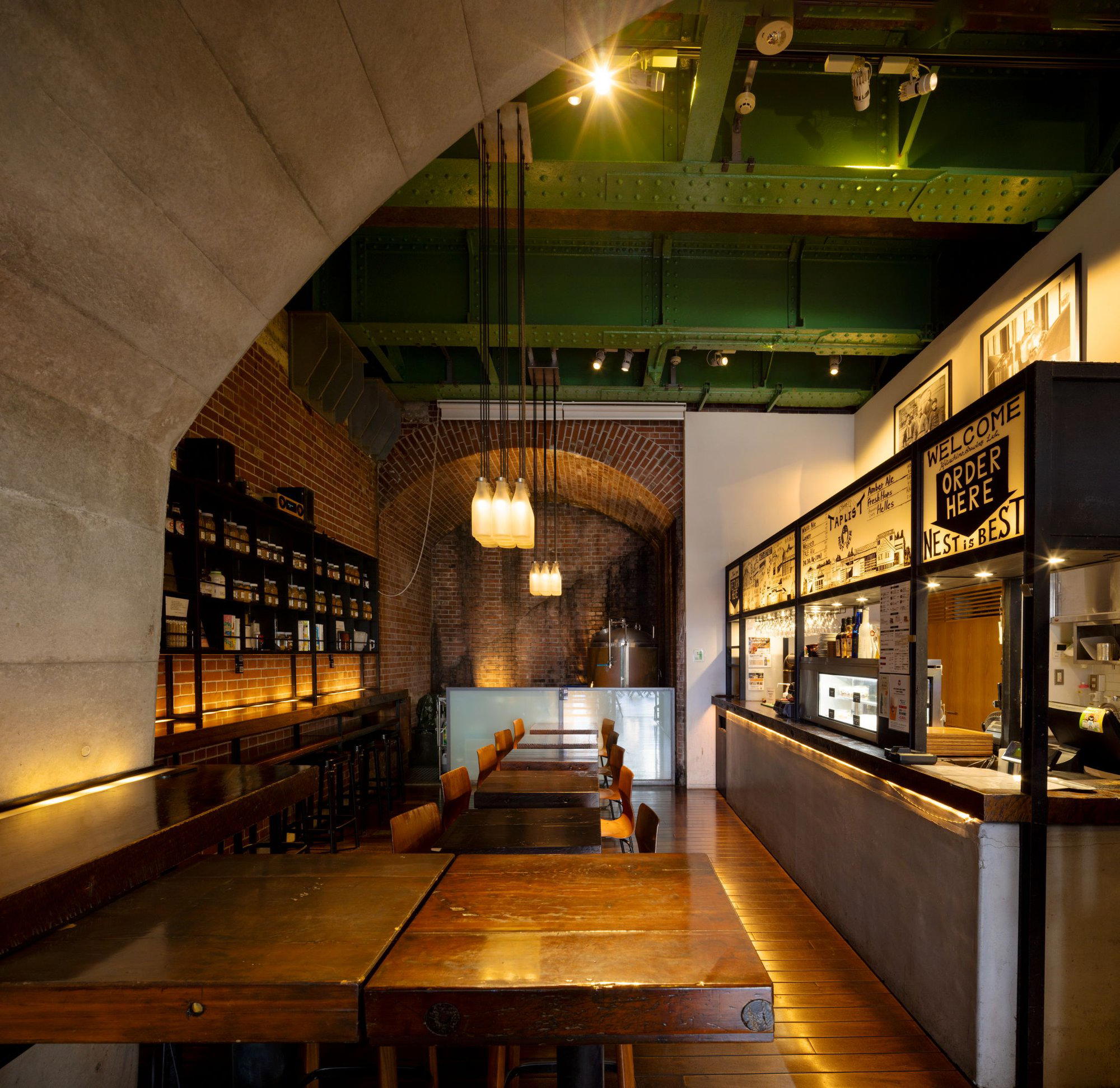
A Railway Arch, a River, and the Architecture of a Pour
Tokyo's drinking culture has long sorted itself by category: the whisky bars of Ginza and Shinjuku, the standing izakayas of Yurakucho, the craft beer taprooms of Shibuya and Shimokitazawa. What the mAAch ecute Kanda Manseibashi complex introduced was something harder to categorise, a hospitality corridor built inside the brick arches of a disused 1912 railway viaduct, positioned above the Kanda River where the old Manseibashi station once stood. The Hitachino Brewing Lab occupies one of those arches. Before the first glass arrives, the setting has already done significant work: exposed red brick, the low geometry of a vaulted ceiling, and the particular quiet that comes when you're inside a structure built to carry trains rather than people.
The mAAch ecute complex opened in 2013 as part of a broader Tokyo movement to convert industrial infrastructure into curated retail and dining destinations, a pattern visible in cities from London to Seoul, but executed here with the restraint characteristic of Japanese adaptive reuse. Hitachino's presence in the complex isn't incidental. The brewery, operated by Kiuchi Brewery out of Naka, Ibaraki Prefecture, had by that point built one of the more recognisable export identities in Japanese craft beer, with the owl logo appearing in specialist bottle shops across Europe and North America. Placing a dedicated brewing lab inside a heritage rail structure in central Tokyo was a logical extension of a brand that had already moved well beyond its regional origins.
The Hitachino Range as a Curatorial Argument
Japanese craft beer developed differently from its American and European counterparts. Where the American craft movement prioritised volume and regional independence, and where British real ale culture grew around pub ownership and tied estates, the Japanese iteration was shaped by the 1994 deregulation of small-scale brewing licences. That change opened the door to a wave of small producers, but it also meant the most credible names had to build recognition against a domestic market still dominated by the major lager producers. Kiuchi Brewery, which traces its sake and shochu production back to 1823, entered brewing from an unusual position of existing credibility and distribution infrastructure. That background is legible in how the Hitachino range is constructed: it reads less like a taproom experiment sheet and more like a considered lineup with distinct registers, wheat ales, aged variants, Japanese-ingredient-inflected styles that position the range against international craft peers rather than domestic macro lager.
At Manseibashi, the lab format means the tap selection goes deeper into the range than you'd encounter in a hotel bar or airport lounge stocking a single Hitachino White. For visitors already familiar with the core wheat ale, the lab is where the comparative tasting logic becomes available. The editorial angle here is less about any single bottle and more about what a brewery's full range reveals about its decision-making: which styles it extends, which it restricts, and how limited or seasonal releases are positioned relative to the anchor products. That kind of range depth is what separates a brewing lab from a brand showcase.
Where Manseibashi Sits in Tokyo's Bar Scene
Tokyo's bar culture is usefully understood as a set of parallel tracks that rarely intersect. The precision cocktail bars, Bar High Five in Ginza, Bar Benfiddich in Shinjuku, Bar Libre, Bar Orchard Ginza, operate on a model where technique, sourcing, and the bartender's accumulated knowledge are the product. Craft beer venues operate on a different premise: the production facility and its choices are the expertise on offer, and the bar is the transmission mechanism. Manseibashi sits closer to the latter, but the setting and the quality of what's on tap put it above the utilitarian taproom tier. It occupies a middle register, accessible enough for someone working through Tokyo's bar and restaurant scene without specialist knowledge, specific enough to hold the attention of someone who comes prepared.
That positioning has an analogue elsewhere in Japan. Bar Nayuta in Osaka, Bee's Knees in Kyoto, and Lamp Bar in Nara each represent the kind of craft-focused, setting-conscious drinking experience that has grown in Japanese cities over the past decade. What they share is an understanding that the glass is inseparable from the room it's served in. Yakoboku in Kumamoto, anchovy butter in Osaka, and Kyoto Tower Sando extend that pattern into different cities and formats. Even internationally, that ethos carries: Bar Leather Apron in Honolulu operates on a similar principle, that curation and context do as much work as the liquid itself.
Getting There and Planning Your Visit
The mAAch ecute Kanda Manseibashi complex sits between Akihabara and Ochanomizu stations, accessible from either JR line stop in under five minutes on foot. The Kanda River walkway approach is the more atmospheric route, with the viaduct arches visible from the riverside path before you enter. The complex is a genuine mixed-use space with retail and multiple food and drink operators, so the Hitachino Brewing Lab is leading treated as part of a longer evening in the area rather than a standalone destination requiring significant advance planning. Tokyo's Kanda district has a dense enough concentration of eating and drinking options, izakayas, standing bars, specialist coffee shops, that the surrounding streets reward time spent above and beyond the lab itself. Given the open, walk-in character of the space, early evenings on weekdays tend to offer the leading combination of atmosphere and space to drink at a pace that allows the range to be explored properly.
Quick Comparison
| Venue | Cuisine | Price | Awards |
|---|---|---|---|
| Hitachino Brewing Lab Kanda ManseibashiThis venue (the venue you are viewing) | This venue | $10–20 | Not listed |
| Bar Benfiddich | World's 50 Best | $20–30 | World's 50 Best #62 · Tatler Listed in Best Bars Asia-Pacific |
| Bulgari Ginza Bar | World's 50 Best | $50–100 | World's 50 Best #86 · Forbes Travel Guide Hotel Star Bar |
| Star Bar Ginza | World's 50 Best | Not listed | Not listed |
| The Bellwood | Sushi | $50–100 | World's 50 Best #79 · Tatler Listed in Best Bars Asia-Pacific |
| Tender Bar | Not listed | $50–100 | Not listed |
Continue exploring
More in Tokyo
Bars in Tokyo
All bars in Tokyo →

Restaurants in Tokyo
All restaurants in Tokyo →


Hitachino Brewing Lab Marche ecute Kanda Manseibashi
The drinks
- Craft beer
Details
- Cozy
- Modern
- Trendy
- After Work
- Casual Hangout
- Historic Building
- Outdoor Terrace
- Seated Bar
- Craft Beer
- Street Scene
Current opening hours
- Monday
- 11 AM–10 PM
- Tuesday
- 11 AM–10 PM
- Wednesday
- 11 AM–10 PM
- Thursday
- 11 AM–10 PM
- Friday
- 11 AM–10 PM
- Saturday
- 11 AM–10 PM
- Sunday
- 11 AM–9 PM
Hours can change for holidays and private events. Hours as of .
Cozy atmosphere with good music, good lighting, and a relaxed vibe.