Birra + sits on Via del Pigneto in Rome's most argued-about neighbourhood for casual drinking culture, where the gap between a craft beer list and a serious bar program has been collapsing for years. The address puts it squarely in Pigneto's after-dark circuit, a stretch that draws a younger, locally-rooted crowd with little patience for tourist-facing theatrics. What it reveals about how Rome drinks casually is worth paying attention to.

Pearl is the En Primeur Club membership app, where members save venues, book tables and use the concierge.
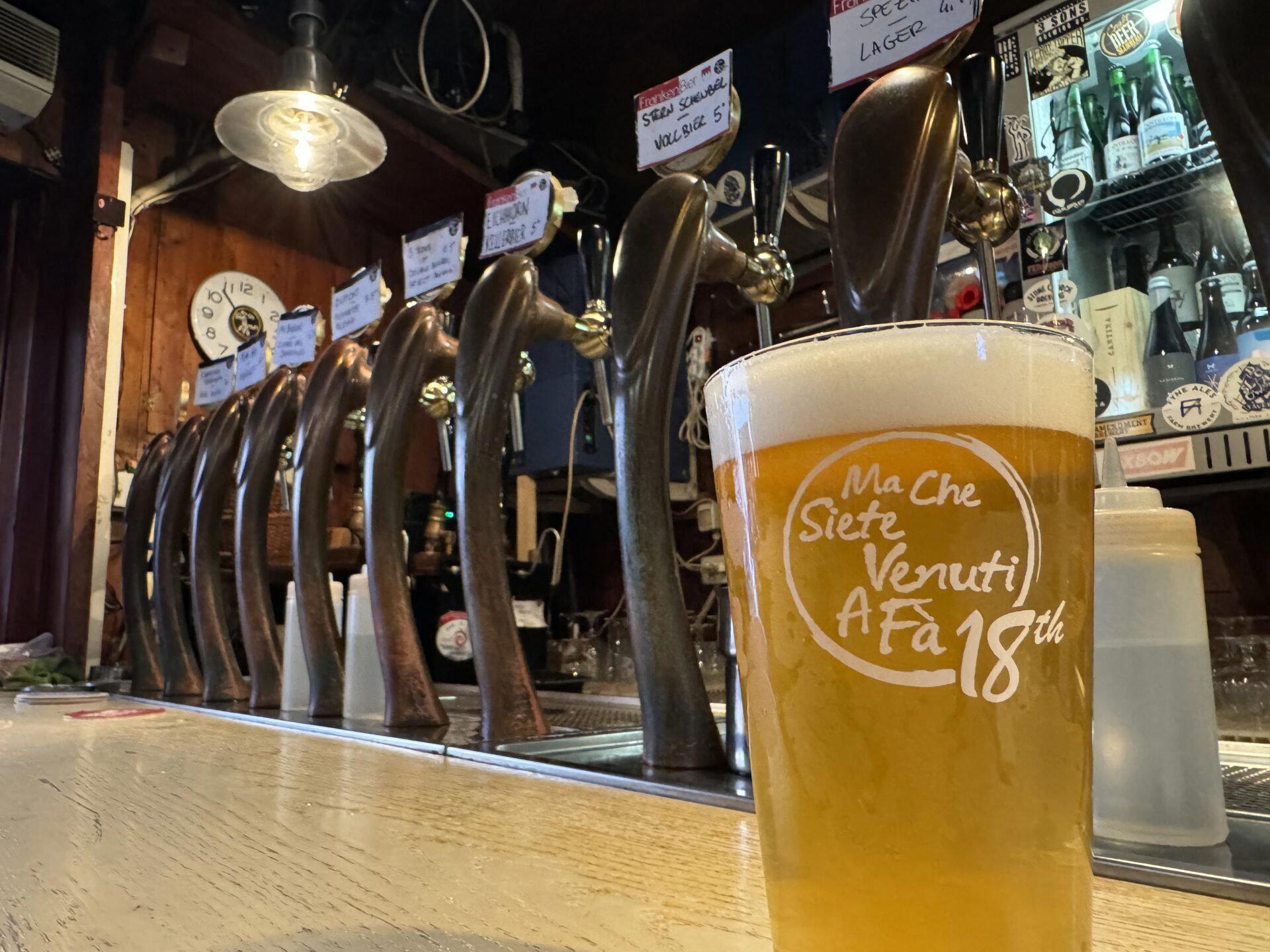
Pigneto and the Grammar of the Roman Beer Bar
Via del Pigneto has spent the better part of two decades resisting the kind of gentrification that flattened Trastevere's drinking scene into a parade of identical aperitivo terraces. The neighbourhood runs east of the centre, past Porta Maggiore, and the crowd that fills its bar stools on a Thursday night is not looking for a curated experience in the contemporary hospitality sense. They are looking for something cold, something considered, and a counter where nobody is performing. Birra + sits at number 105 on that street, and the address alone functions as a positioning statement: this is a neighbourhood bar operating inside a neighbourhood with specific expectations about what a neighbourhood bar should be.
Rome's craft beer scene developed later and less loudly than Milan's, partly because the city's identity was so thoroughly tied to wine and aperitivo culture that beer had to find its own register rather than borrow one. What emerged in pockets like Pigneto was a format that looked casual but asked more of its list than most bars twice its apparent ambition. The menu architecture at venues in this mould tends to be the tell: a broad, undifferentiated list of domestic and imported lagers signals a different operation than one that sequences offerings by fermentation style, origin, or food pairing logic.
What the Menu Structure Reveals
The editorial angle on a place like Birra + runs directly through how its offering is organised, because in Rome's more serious beer bars, the list is the argument. Where a casual bar treats the tap selection as a logistical convenience, a bar with genuine programme ambition arranges its beers around a point of view: regional Italian craft production alongside specific international references, or a rotation that changes with season and availability rather than sitting static across months. That kind of menu structure tells a visitor something concrete about the operation before a single glass arrives.
Pigneto bars of this type also tend to structure their food offer around the beer rather than treating it as an afterthought. The Italian tradition of pairing bar snacks with drinks is old and well-established, but in the craft beer context, that pairing logic gets more deliberate. A well-run beer bar in this part of Rome is not competing with the city's enoteca culture on wine's terms; it is making a case that fermentation literacy extends across categories, and that the counter between a draught handle and a guest is a place where that case gets made one pour at a time.
Where Birra + Sits in Rome's Drinking Circuit
Rome's serious bar scene concentrates in several distinct clusters, and understanding where Birra + fits requires knowing what the rest of the circuit looks like. The cocktail programmes drawing international attention operate in a different register entirely: Drink Kong has built a reputation on technical precision and a format that sits closer to Tokyo bar culture than anything traditionally Roman, while Jerry Thomas Speakeasy occupies the theatrical end of the spectrum, with a reservation-only model and a focus on historical cocktail research. Freni e Frizioni built its following on aperitivo volume and Trastevere foot traffic. Boeme operates in a more intimate, wine-leaning mode.
None of these are direct peers to a Pigneto beer bar, which is precisely the point. The craft beer format in Rome fills a gap between the enoteca, the aperitivo terrace, and the cocktail bar: it is lower on ceremony, higher on product specificity, and structurally dependent on a clientele that returns regularly rather than one that visits once on a recommendation. That regularity is what shapes the menu over time, as a bar with returning locals develops a shorthand about what the crowd will support and what will sit untapped.
For broader context on how Italian bar culture varies by city, the gap between Rome and the northern drinking scenes is instructive. 1930 in Milan operates at the opposite end of the formality spectrum, with a speakeasy format and a cocktail list that reads like a research document. Gucci Giardino in Florence folds hospitality into a retail and cultural context that has no equivalent in Rome. L'Antiquario in Naples anchors its identity in historical cocktail formats. These are all bars with a strong editorial thesis, and comparing them to a Pigneto beer bar is less useful than understanding that the category itself operates on different criteria.
Further afield, bars like Al Covino in Venice, Enoteca Historical Faccioli in Bologna, and Lost & Found in Nicosia each demonstrate how bar identity in Mediterranean cities is shaped as much by local drinking customs as by any international trend. The comparison is useful not because these venues are equivalent but because it shows how craft beer bars in Rome operate inside a specifically Roman cultural logic rather than importing a format wholesale from northern Europe or the United States. Bar Leather Apron in Honolulu represents yet another register, one where the category ambition is cocktail-focused and the regional context is entirely different.
Planning a Visit
Via del Pigneto is accessible by tram from the city centre, with the neighbourhood sitting roughly fifteen to twenty minutes from Termini depending on connection. The strip along Via del Pigneto itself concentrates several bars within walking distance of each other, which means an evening in this part of Rome tends to move between addresses rather than anchoring at one. Birra + at number 105 falls within the active stretch of the street. Given the neighbourhood's character, the expectation is informal: no reservation architecture, no dress code framing, no tasting menu pacing. The rhythm is determined by the bar, the list, and whoever happens to be working the counter that evening. For a fuller picture of where this address sits within the city's broader eating and drinking options, the EP Club Rome guide maps the scene across neighbourhoods and categories.
Awards and Standing
| Venue | Price | Awards |
|---|---|---|
| Birra +This venue (the venue you are viewing) | $20–30 | Not listed |
| Drink Kong | $50–100 | World's 50 Best #32 · Falstaff Bar - 96 Falstaff Points |
| Freni e Frizioni | $10–20 | World's 50 Best #31 · Falstaff Bar - 94 Falstaff Points |
| Jerry Thomas Speakeasy | Not listed | World's 50 Best #98 · Top 500 Bars Best Bars #174 |
| Salotto 42 | Not listed | World's 50 Best |
| Boeme | $10–20 | World's 50 Best #47 |
Continue exploring
More in Rome
Bars in Rome
All bars in Rome →
Restaurants in Rome
All restaurants in Rome →
Details
- Lively
- Trendy
- Energetic
- After Work
- Casual Hangout
- Group Outing
- Late Night
- Standalone
- Seated Bar
- Standing Room
- Craft Beer
- Craft Cocktails
Current opening hours
- Monday
- 5 PM–1 AM
- Tuesday
- 5 PM–1 AM
- Wednesday
- 5 PM–1 AM
- Thursday
- 5 PM–1 AM
- Friday
- 5 PM–2 AM
- Saturday
- 5 PM–2 AM
- Sunday
- 6 PM–1 AM
Hours can change for holidays and private events. Hours as of .
Cool, energetic atmosphere with stoner rock music that complements the craft beer and cocktail offerings.