
Yagenbori Hassho sits in Hiroshima’s late-evening okonomiyaki belt, where griddles, counter seats, and neighborhood drinking rooms matter as much as formal dining rooms. Its repeated Tabelog Okonomiyaki 100 selections, including 2025, place it in the city’s serious everyday-food tier rather than the polished tasting-menu circuit.
Pearl is the En Primeur Club membership app — saves, bookings, and concierge access live there. Same editors, same standards.
- Address
- 10-6 Yagenbori, Naka Ward, Hiroshima, 730-0027, Japan
- Phone
- +81 82-248-1776
- Website
- y792200.gorp.jp
 Saves & bookings on Pearl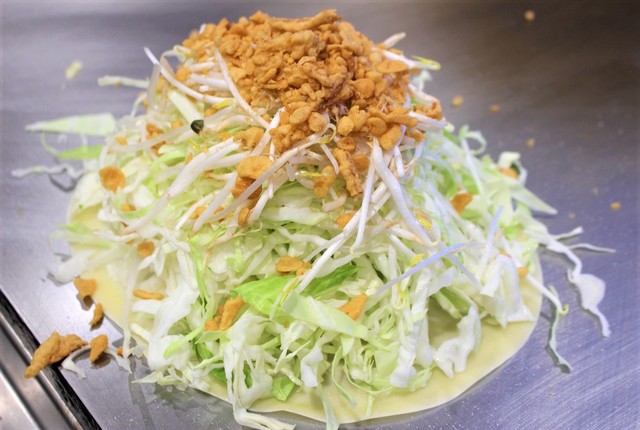
Yagenbori after dark has a different rhythm from Hiroshima’s museum-and-boulevard daytime circuit. The streets tighten, the signs get lower, and dinner moves toward counters, griddles, small drinks, and food that takes shape in front of the room rather than arriving from a hidden pass. In that setting, Hiroshima okonomiyaki is not a snack category. It is a civic grammar: layered batter, cabbage, noodles, egg, sauce, and the patience of a hot plate doing work over time.
Yagenbori Hassho belongs to that grammar. The draw is not ceremony in the Tokyo kaiseki sense, nor the chef-driven performance that defines much of Japan’s reservation economy. The point is a Hiroshima format with enough discipline to earn repeat Tabelog Okonomiyaki 100 selections, including 2025, and enough neighborhood utility to remain readable as dinner with friends rather than a trophy booking. That distinction matters. Hiroshima has fine dining rooms such as Akai (Creative Cuisine), wine-led and ingredient-led counters such as Bishu Bikou Hamai, and broader city institutions such as ANDERSEN. Okonomiyaki operates on a separate axis: speed is visible, but not rushed; price is accessible, but the good rooms are judged with precision.
Yagenbori puts Hiroshima okonomiyaki back in its natural habitat
Hiroshima-style okonomiyaki differs from Osaka’s mixed-batter model because construction matters. Layers are built rather than stirred together, and noodles are central rather than optional garnish. That changes the tempo of the room. Diners watch the cooking surface become a staging area: batter set thin, cabbage compressed by heat, noodles worked into the stack, egg used as structure. The format rewards cooks who can control moisture, heat, timing, and turnover without turning the meal into theatre.
The Yagenbori neighborhood sharpens that experience. This is not a dining-room district designed solely around destination restaurants; it sits in the city’s night-eating pattern, where teppanyaki, drinks, noodles, and okonomiyaki overlap. The restaurant’s listed categories, okonomiyaki, stir-fried noodles, and teppanyaki, reflect that local mix. Sake and shochu fit the same register: this is food built for a griddle and a glass, not a hushed room.
Among Hiroshima peers, the positioning is revealing. Okonomiyaki Koshida Honten sits in a similar everyday price band, while Seichan moves slightly higher. Hiroshima Marukajiri Naka-chan and Bishu Bikou Hamai occupy a more expensive dinner category, and Tonkatsu 16 sits in a different comfort-food lane. Yagenbori Hassho’s significance is that it keeps the city’s defining dish inside an accessible neighborhood format while carrying recognition that separates it from casual convenience eating.
The griddle format demands patience, not polish
Okonomiyaki is sometimes misread by visitors as quick street food because the ingredients are familiar and the room can feel informal. Hiroshima’s stronger counters prove the opposite. The cooking time is part of the format, and the restaurant notes that okonomiyaki takes about 20 to 30 minutes to prepare properly. That single detail says more about the category than any adjective could. The dish depends on heat management and compression, not assembly-line speed.
There is a useful lesson here for travelers planning a Hiroshima eating day. A meal like this should not be squeezed between tightly timed cultural stops. It works better as an early evening anchor before the city’s bar circuit or as the center of a casual dinner night in Naka Ward. For broader planning, Our full Hiroshima restaurants guide maps the city’s dining range, while Our full Hiroshima bars guide is the more natural companion for a Yagenbori night. Visitors building a longer stay can pair those with Our full Hiroshima hotels guide, Our full Hiroshima wineries guide, and Our full Hiroshima experiences guide.
The room format also matters. Counter seating and tatami seating point to two different readings of the same meal: solo or pair dining with the griddle in view, or a more social table rhythm. Private use is listed for smaller groups, which fits okonomiyaki’s role in Hiroshima as group food as much as solitary counter food. The practical note is simple: this is a cash-first, local-style environment rather than a hotel-concierge dining room, and that is part of the category’s honesty.
Where it fits in a serious Hiroshima itinerary
Hiroshima’s dining identity has expanded well beyond okonomiyaki, but the dish remains the city’s most legible food tradition for good reason. A serious itinerary should not reduce Hiroshima to a single plate, yet it should make room for a version that shows why the plate has endured. Yagenbori Hassho’s Tabelog score of 3.69 and repeated Okonomiyaki 100 recognition place it in that conversation: not an abstract local recommendation, but a documented selection within Japan’s granular user-review culture.
The smarter comparison is not with luxury restaurants, but with other ways of eating the city. CHILAN offers a different register of restaurant ambition. Butter Cake no Nagasaki Do shows the city through confectionery rather than the griddle. Across Japan, casual formats carry equal seriousness in other forms: -Grilled beef Sukiyaki- KAMAKURA TANUKIAN 鎌倉 たぬき庵 in Kamakura. 鮪と炭火焼き うお炭 秋葉原店 in Tokyo.cafe in Osaka.know in Kumamoto, (Shoku) Vietnam in Kawasaki, and [Curry Senmon Ten] Maruyama Kyoju. in Sapporo all underline the same point: Japan’s everyday categories often carry the sharpest local information.
For international context, the lesson translates beyond Japan. A sake bar such as Jōdo Saké Bar in Los Angeles or a compact rice-focused shop such as Onigiri Time in Pasadena can introduce a format abroad, but Hiroshima okonomiyaki reads differently in its home city. The neighborhood supplies the cues: the after-work timing, the low-lit streets, the expectation that a griddle meal can be casual and exacting at once. That is the reason to put the restaurant on a Hiroshima list, not because it turns local food into luxury, but because it leaves the local structure intact.
At a Glance
Comparable venues to calibrate price, style, and recognition.
| Venue | Cuisine | Price | Notes |
|---|---|---|---|
| Yagenbori HasshoThis venue — the venue you are viewing | Naka, Hiroshima-style okonomiyaki | $ | Not listed |
| Tatsu | Higashi, Japanese restaurant | $ | Not listed |
| Okonomiyaki Koshida Honten | Not listed | $ | Naka, Hiroshima-style okonomiyaki & teppanyaki |
| Stand Loki | Naka, Japanese Standing Bar | $ | Not listed |
| Nukazuke Kobo nipote Misasa honten | Not listed | $$ | Nishi, Nukazuke-focused Yoshoku (Japanese-style Western) |
| Jidan | Higashi, Hiroshima-style okonomiyaki | $ | Not listed |
Recognition history
Dated appearances from independent guides and award organizations, with the underlying list record or original source where available.
Tabelog 100 #84 · No. 84
Tabelog · Tabelog 100 - Okonomiyaki - 2025
Continue exploring
More in Hiroshima
Restaurants in Hiroshima
Browse all →
Bars in Hiroshima
Browse all →
At a Glance
- Lively
- Cozy
- Well Known
- Solo
- Family
- Group Dining
- Casual Hangout
- After Work
- Late Night
- Chefs Counter
- Open Kitchen
- Standalone
Current opening hours
- Monday
- Closed
- Tuesday
- 4–10:30 PM
- Wednesday
- 4–10:30 PM
- Thursday
- 4–10:30 PM
- Friday
- 4–10:30 PM
- Saturday
- 4–10:30 PM
- Sunday
- 4–9 PM
Hours can change for holidays and private events. Last verified .