The Würstelstand at Zieglergasse 2 in Vienna's 7th district represents one of the city's most enduring street food formats: the sausage stand. A fixture in a neighbourhood that has shifted considerably around it, this address offers a lens into how Vienna's casual eating culture persists alongside an increasingly formal fine dining scene. No booking required, no dress code, no reservation window to track.
Pearl is the En Primeur Club membership app — saves, bookings, and concierge access live there. Same editors, same standards.
- Address
- Zieglergasse 2, 1070 Wien, Austria
- Phone
- +434318772216
- Website
- steinmetz-gastro.at
- Directions
- Get directions
 Saves & bookings on Pearl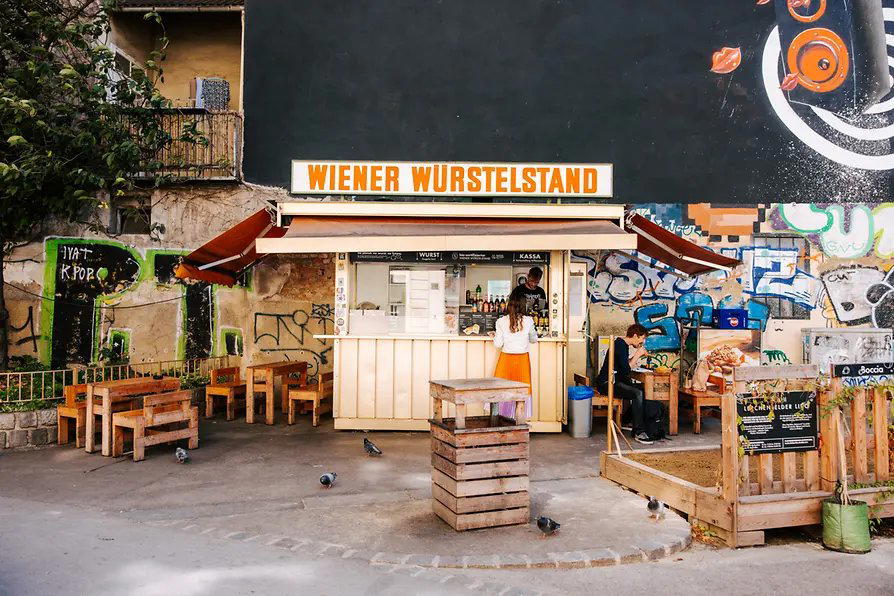
A Stand in the Seventh: Vienna's Sausage Culture in Context
On Zieglergasse, one of the Neubau district's busier pedestrian corridors, a Würstelstand occupies the kind of position that has defined Viennese street eating for well over a century. These stands are not a niche novelty or a retro affectation. They are a functional institution, present at the edges of U-Bahn exits, along market perimeters, and on corner plots throughout the city, operating according to a format that has changed far less than almost anything else in Vienna's food culture. The Würstelstand at Zieglergasse 2 sits in that tradition, in a district whose identity has shifted considerably over the past two decades.
Vienna's 7th district, Neubau, has gone through the kind of demographic and commercial evolution that tends to complicate traditional food formats. What was once a working-class residential quarter is now one of the city's denser concentrations of independent retail, design studios, and mid-range restaurants. The Würstelstand does not pivot with these trends. It holds its position, which is precisely its relevance to anyone trying to understand how the city actually eats, as opposed to how it presents itself to visitors booking tasting menus.
The Würstelstand Format: What Has and Has Not Changed
The editorial angle that makes Vienna's sausage stands worth examining is the tension between a format in its current form and the forces that have reshaped nearly every other category of Viennese eating around it. In the same city where Steirereck im Stadtpark has established itself among Europe's most discussed creative kitchens, and where Konstantin Filippou and Mraz & Sohn represent the serious end of modern Austrian cooking, the Würstelstand operates at the complete opposite end of the format spectrum, with no tasting menus, no reservations, no chef narrative.
Historically, the stands evolved from 19th-century street vending that served the city's working population. The format was licensed and regulated by the municipality, which gave it a semi-official character that distinguished it from informal street food in other European cities. Over time, that regulatory structure became part of what preserved it. Würstelstand operators hold municipal licenses that are not easily transferred, which has kept the market from flooding with imitations and maintained a degree of consistency in what the format delivers.
What has changed is the surrounding context. The stands that once competed primarily with cheap sit-down lunch options now exist in a city where fast-casual dining, international street food formats, and delivery platforms have all expanded. Some stands have adapted by extending hours into early morning, serving the post-club crowd that Neubau and neighbouring Mariahilf generate on weekends. Others have held to their traditional midday and early evening rhythm. The Zieglergasse location sits in territory that would see both patterns of demand.
Where This Fits in Vienna's Eating Hierarchy
Vienna operates with a fairly clear stratification in its food culture. At the summit of the formal tier, restaurants like Amador and Doubek represent serious investment in tasting-format dining. A tier below, neighbourhood bistros and Beisl-style restaurants handle the midweek dinner trade. Below that, the Würstelstand occupies a category that functions less as a dining destination and more as a utility: fast, specific, affordable, and available at hours when sit-down options are either closed or inconvenient.
That utility framing is not a dismissal. Within the Austrian dining tradition, the Würstelstand has a cultural legitimacy that no amount of fine dining can replicate or replace. It is where Viennese people eat at 2am, at noon between meetings, and while walking home from the market. The format's staying power in a city that has otherwise modernised its food scene considerably is itself a data point worth noting. Comparable street food institutions in other European capitals have either been displaced by rising rents or repositioned as premium experiences. In Vienna, the Würstelstand has largely remained what it is.
Austria's serious restaurant scene extends well beyond Vienna: Döllerer in Golling an der Salzach, Ikarus in Salzburg, Obauer in Werfen, and Landhaus Bacher in Mautern an der Donau each represent a distinct regional approach to Austrian produce and cooking tradition. In the Alpine west, Griggeler Stuba in Lech, Gourmetrestaurant Tannenhof in Sankt Anton am Arlberg, and Schwarzer Adler in Hall in Tirol anchor a different set of dining priorities shaped by the skiing and hiking economy of the region. And for those exploring beyond the established names, Kräuterreich by Vitus Winkler in Sankt Veit im Pongau, Ois in Neufelden, and Restaurant 141 by Joachim Jaud in Mieming each occupy specific niches in the Austrian countryside dining circuit.
The Würstelstand sits at the opposite pole from all of these, and that contrast is the point. Understanding a city's food culture requires both ends of the spectrum. Vienna's fine dining scene is internationally visible; its street food infrastructure is less discussed in travel media but no less central to how the city functions day-to-day.
Internationally, the contrast with formats like Le Bernardin in New York City or Atomix in New York City illustrates how differently cities at comparable levels of dining sophistication handle the relationship between high-end and everyday eating.
Know Before You Go
Booking and Cost Snapshot
Comparable venues nearby, for context on price, style, and recognition.
| Venue | Cuisine | Price | Notes |
|---|---|---|---|
| Wiener WürstelstandThis venue — the venue you are viewing | Mariahilf, Austrian Sausage Stand | $ | Not listed |
| Zum Goldenen Würstel II | Innere Stadt, Viennese Sausage Stand | $ | Not listed |
| Heisse am Gürtel | Josefstadt, Viennese Sausage Stand | $ | Not listed |
| Zum Goldenen Würstel | Not listed | $ | Innere Stadt, Traditional Austrian Sausages |
| Hermann's Würstelstand | Hofburg, Viennese Sausage Stand | $ | Not listed |
| Bier & Bierli | Not listed | $ | Staatsoper, Traditional Austrian Beer Hall |
Continue exploring
More in Vienna
Restaurants in Vienna
Browse all →![[aend] restaurant in Vienna](https://cdn.enprimeurclub.com/storage/v1/object/public/images/locations/recsVyRkMfzCxPmp0/hero2.jpg?width=3840&quality=75)
Bars in Vienna
Browse all →

Hotels in Vienna
Browse all →
At a Glance
- Well Known
- Lively
- Casual
- Casual Hangout
- Late Night
- Standalone
- Beer Program
Current opening hours
- Monday
- 9 AM–5 AM
- Tuesday
- 9 AM–5 AM
- Wednesday
- 9 AM–5 AM
- Thursday
- 9 AM–5 AM
- Friday
- 9 AM–5 AM
- Saturday
- 9 AM–5 AM
- Sunday
- 11 AM–5 AM
Hours can change for holidays and private events. Last verified .
Casual street-side atmosphere well-suited for a quick, well-known Viennese snack with tasty beers amid the city's lively energy.