Valentine’s Pizza
On Bedford Avenue in the heart of Bed-Stuy, Valentine's Pizza occupies the kind of neighborhood slot that Brooklyn pizza joints have filled for generations: a regular's spot first, a destination second. The draw is straightforward New York-style pizza in a borough that takes the category seriously, sitting at a price point well below the tasting-menu circuit that defines the city's fine-dining tier.
- Address
- 1063 Bedford Ave, Brooklyn, NY 11216
- Phone
- +1 347 627 2767
- Website
- valentinesbk.com
 Saves & bookings on Pearl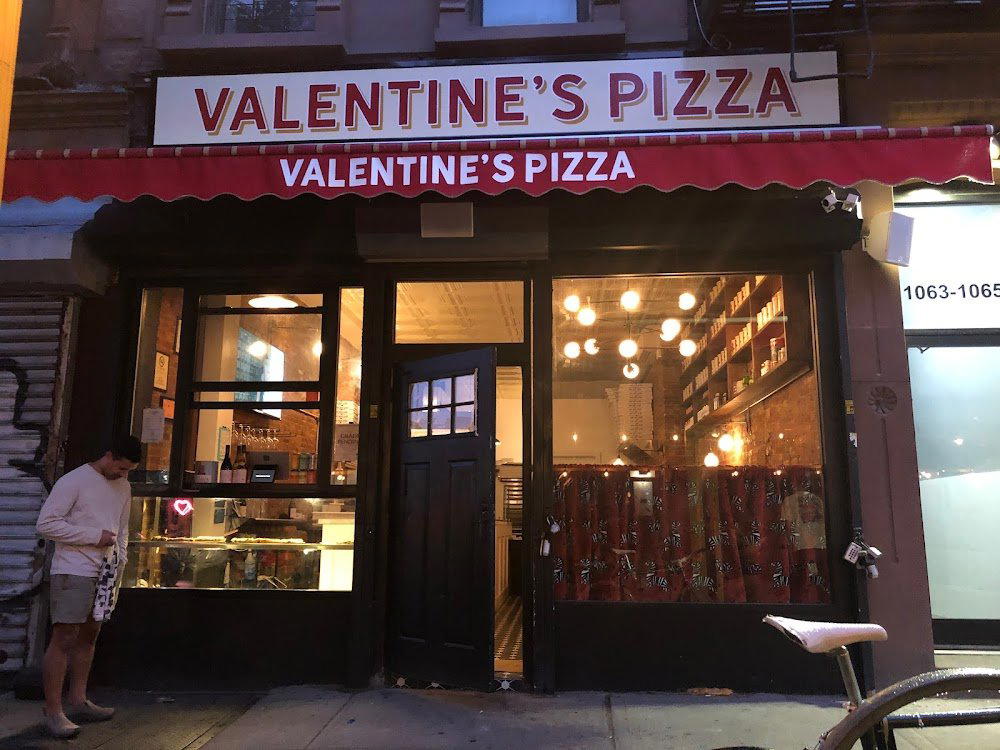
Bedford Avenue and the Neighborhood Pizza Tradition
Brooklyn's pizza culture operates on a different logic than Manhattan's. Where Midtown and the Upper West Side have largely ceded the category to delivery aggregators and fast-casual chains, neighborhoods like Bed-Stuy and Crown Heights have maintained a denser network of walk-in, counter-service spots that function as social infrastructure as much as restaurants. Valentine's Pizza is a New York-Style Pizza restaurant at 1063 Bedford Avenue in Brooklyn, with a price tier around $15 per person. It sits inside that tradition. Its address places it on a busy Brooklyn corridor, where the foot traffic skews local and the expectation is a reliable slice rather than an event.
This is a different tier of New York dining than the one occupied by Le Bernardin, Atomix, or Eleven Madison Park in Manhattan, where tasting menus can run well into three figures and reservations often require advance planning. It also sits at a remove from the multi-course counter formats you find at Masa or Per Se. Valentine's competes in the category that feeds the borough on a Tuesday evening, and that category has its own rigorous standards.
What Keeps the Regulars Coming Back
In neighborhoods like Bed-Stuy, the regulars' test is the only one that matters. A pizza place that draws the same faces week after week, year after year, earns that loyalty through consistency and familiarity rather than novelty. The unwritten menu at spots like this tends to be short: the slices that regulars order without looking at the board. That kind of shorthand between a place and its clientele takes time to develop.
The broader Bedford Avenue corridor has seen considerable turnover in its retail and food-and-beverage stock over the past decade. Pizza joints have been among the more durable fixtures in that environment, partly because of their price accessibility and partly because the format is inherently communal. A neighborhood slice shop that survives in that context does so because it maintains a clear identity for the people who live nearby, not because it courts press coverage or out-of-borough visitors.
Compare that dynamic to what you find at destination-driven formats elsewhere in the country. Lazy Bear in San Francisco, Smyth in Chicago, or Blue Hill at Stone Barns in Tarrytown build their audience from across a region or internationally, and their relationship with repeat visitors is structured around infrequent, occasion-driven visits. A neighborhood pizza counter builds its audience from a radius of a few blocks and earns repeat visits on a weekly or even daily basis. Neither model is superior; they solve different problems for different audiences.
The Brooklyn Pizza Context
New York's pizza identity is built almost entirely on the neighborhood slice shop. The form has roots in early twentieth-century Italian-American immigration, and Brooklyn was one of its primary incubators. The thin crust, the wide slice format, the foldability that allows eating while standing or walking: these are not arbitrary choices but adaptations to the pace and density of urban life. The boroughs maintained this culture more intact than Manhattan, where real estate pressure pushed many legacy operators out.
Within Brooklyn, there is now a second tier of more destination-oriented pizza operations: wood-fired Neapolitan spots, Roman-style al taglio counters, and chef-driven operations with longer menus and higher prices. That tier has drawn national attention and attracted visitors who treat a pizza meal as a planned outing rather than a daily routine. Valentine's on Bedford Avenue operates in the original model, the one that predates the pizza-as-destination trend and will likely outlast it.
For travelers coming to New York with itineraries anchored in fine dining, whether at Le Bernardin or the kind of ambitious American cooking you find at Emeril's in New Orleans, The French Laundry in Napa, or Providence in Los Angeles, a walk-in Brooklyn pizza stop represents a genuine tonal shift. That contrast is part of what makes New York's dining range worth exploring. The same city that contains Addison in San Diego's equivalent in formal ambition also contains blocks of Bedford Avenue where a cardboard box and a paper plate are the expected delivery mechanism.
Bed-Stuy as a Dining Neighborhood
Bedford-Stuyvesant has become one of Brooklyn's more watched dining neighborhoods, with a range of operations opening along and around Bedford Avenue and Fulton Street over the past several years. The neighborhood's dining character is still shaped primarily by its residential base rather than by tourism, which means that value, accessibility, and consistency matter more than press-readiness. Pizza, Caribbean, West African, and soul food operations tend to have stronger roots in the neighborhood than newer wine bars and tasting-menu formats.
For visitors to New York, Bed-Stuy offers a different register of the city than Midtown or the West Village. The blocks around Bedford Avenue offer a more residential, less curated version of Brooklyn's food scene than Williamsburg immediately to the north.
Neighborhood-rooted formats can sit alongside ambitious tasting-menu operations in the same city. Frasca Food & Wine in Boulder, Single Thread Farm in Healdsburg, and The Inn at Little Washington occupy the destination end of their respective markets; the everyday neighborhood formats that surround them are what make those markets legible as food cities rather than just collections of notable restaurants. The same logic applies to Brooklyn: Valentine's and places like it are load-bearing elements of what makes the borough's food culture function.
The gap between a neighborhood slice counter and a formal dining institution is not unlike the distance between a Milanese neighborhood trattoria and destination cooking at Atelier Moessmer Norbert Niederkofler in Brunico or Dal Pescatore in Runate. Both categories are part of the same food culture; they simply operate at different scales of ambition and serve different social functions.
Know Before You Go
- Address: 1063 Bedford Ave, Brooklyn, NY 11216
- Neighborhood: Bedford-Stuyvesant, Brooklyn
- Format: Neighborhood pizza counter; walk-in format expected
- Price tier: Accessible; well below the fine-dining tier
- Reservations: No reservation infrastructure indicated; walk-in
- Getting there: Bedford Avenue is served by multiple Brooklyn subway lines; the A/C and G trains provide access from Manhattan and surrounding neighborhoods
- Leading for: Casual meals, local atmosphere, Brooklyn neighborhood dining
Side-by-Side Snapshot
Comparable venues nearby, for context on price, style, and recognition.
| Venue | Cuisine | Price | Awards | Notes |
|---|---|---|---|---|
| Valentine’s PizzaThis venue — the venue you are viewing | New York-Style Pizza | $ | , | |
| L'Arte del Gelato | Authentic Sicilian Gelato | $ | , | Chelsea-Hudson Yards |
| Sal's Pizza Store | Classic New York Pizza | $ | , | Carroll Gardens-Cobble Hill-Gowanus-Red Hook |
| Joe | Classic New York-Style Pizza | $ | , | West Village |
| Paulie Gee's Slice Shop | New York-Style Pizza Slices | $ | , | Greenpoint |
| Evelina | Modern Italian Mediterranean | $$ | , | Fort Greene |
Continue exploring
More in New York City
Restaurants in New York City
Browse all →
Bars in New York City
Browse all →
Hotels in New York City
Browse all →




At a Glance
- Lively
- Casual Hangout