Tabelog 100 #45
Our verdict
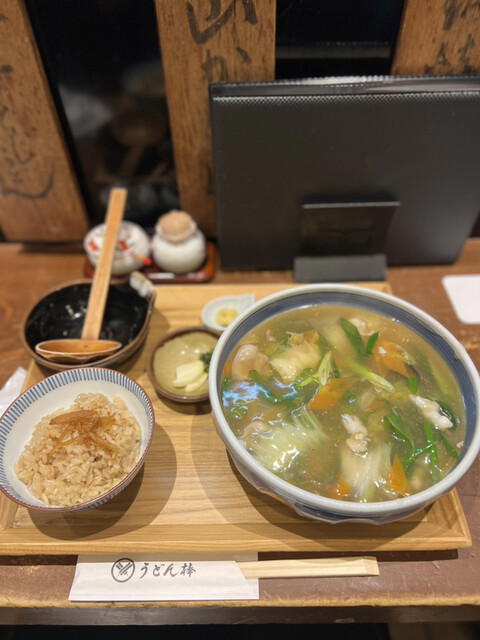
Udon Bo Oosaka honten brings Sanuki-style udon into the basement rhythm of Umeda, where station-building dining favors speed, precision, and repeat custom over ceremony. Selected for Tabelog 100 Udon WEST 2024, it is a compact 19-seat shop built around handmade noodles, tempura, udon-suki, sake, and shochu rather than luxury signals.

Pearl is the En Primeur Club membership app, where members save venues, book tables and use the concierge.
The menu
What to order
- Cold Tempura Udon
- Champon Udon
- Chicken Tempura & Tai Chikuwa Tempura Udon
Osaka has its own everyday dining rhythm: bright interiors, quick decisions, diners moving with purpose, and kitchens turning over meals at speed. In that setting, udon is not treated as a consolation prize between grander meals. It is part of the city’s daily food culture, a form with enough regional nuance to reward attention. Osaka’s casual dining scene compresses appetite into focused formats, and that compression suits a serious udon shop: wheat aroma, chew, broth discipline, and a pace that does not ask the meal to become ceremonial.
Udon Bo Oosaka honten belongs to the serious end of that casual category. Its selection for Tabelog Hyakumeiten Udon WEST 2024 places it among a curated group where noodle craft matters more than polish, and its listed Tabelog score of 3.78 gives the restaurant a clear public reputation marker. The experience reads as focused and everyday rather than ceremonial, with the directness of a noodle shop whose value sits in the bowl rather than in the performance around it.
Udon in Osaka's dining culture
Osaka’s reputation often leans toward sauce, griddle, and late-night excess, but the city’s noodle culture is more layered than that shorthand allows. Udon here sits between commuter practicality and regional argument. Diners tend to read broth, noodle texture, tempura timing, and value quickly; a bowl has little room to hide behind presentation. At a place like Udon Bo Oosaka honten, the focus stays on wheat noodles and the discipline of a category that can look simple while being judged in fine increments.
The menu categories frame the point clearly: udon, tempura, and udon-suki. That range is narrow enough to feel purposeful and broad enough to allow a meal to stay simple or expand slightly. The larger lesson is not one signature dish. It is the persistence of a low-cost, high-scrutiny format in a city better known to many visitors for transit, shopping, and larger food itineraries.
That value context is part of the appeal. Osaka casual addresses such as Sunshine and Odoru Udon Umeda ten also help define the city’s everyday dining logic, while restaurants such as Pineapple operate in a different Osaka price tier altogether. The comparison matters because udon at this level is not trying to imitate luxury dining. It competes on repetition: the practical lunch, the quick meal, the weekend stop, the bowl that has to justify itself without theatrical service.
A focused setting where the noodle leads
The atmosphere should be read through the format rather than through claims of spectacle. Udon works best when attention stays close to the bowl: the texture of the noodles, the clarity and balance of the broth, and the timing of any fried elements. In a focused udon meal, the sequence of ordering and eating becomes the experience. The attention stays on wheat, broth, and frying rather than on decoration.
There is no chef biography in the provided record to inflate into mythology here, and that is a strength editorially. Osaka has enough restaurants built on personality. This one reads through format: udon, tempura, udon-suki, accessible pricing, and a reputation recognized by Tabelog’s udon category rather than by international fine-dining awards. The audience implied by the genre also says something useful about the restaurant: it belongs to city life, not to a stage set for culinary tourism.
For travelers mapping Osaka through meals, this is the kind of stop that pairs well with broader exploration rather than replacing it. The city’s restaurant range runs from casual everyday dining to counters and regional Japanese specialists; compare the casual grammar here with other Osaka dining rooms across different formats. The broader city rails are useful too: Our full Osaka restaurants guide, Our full Osaka hotels guide, Our full Osaka bars guide, Our full Osaka wineries guide, and Our full Osaka experiences guide.
How to read the reputation
Tabelog’s Hyakumeiten selections are especially useful in categories such as udon because they highlight shops where craft and local approval overlap. A 2024 WEST udon selection and a Tabelog score of 3.78 give Udon Bo Oosaka honten more substance than a passing queue. The signal is not luxury; it is consistency inside a demanding everyday genre.
The decision is less about chasing ceremony and more about timing a focused meal intelligently. Lunch is a natural context for travelers already moving through Osaka, while an evening visit can work as a compact meal before other plans. The listed budget also supports that role: dinner is JPY 1,000 - JPY 1,999, while lunch is listed up to JPY 999, placing the restaurant firmly in the city’s accessible everyday dining band.
For readers building a Japan-wide food map, this Osaka udon stop sits in a useful contrast with other formats across the country and abroad: beef-focused restaurants, charcoal counters, regional dining rooms, curry specialists, Kyoto dining, and Japanese drinking culture overseas. The through-line is specialization. In Osaka, that specialization can be as compact as a focused meal and a bowl of udon.
Frequently asked questions
Is Udon Bo Oosaka honten a family-friendly restaurant?
Udon Bo Oosaka honten is an accessible Osaka udon restaurant rather than a formal fine-dining room. It is also a Tabelog Hyakumeiten Udon WEST 2024 selection. Check the venue's official channels for the latest details.
What is the atmosphere like at Udon Bo Oosaka honten?
It is an Osaka udon shop best understood through its focused categories: udon, tempura, and udon-suki. The emphasis is on a straightforward meal rather than ceremony.
How much does it cost to eat at Udon Bo Oosaka honten?
Pricing at Udon Bo Oosaka honten is listed as JPY 1,000 - JPY 1,999 - JPY 999. The listed budget is Dinner: JPY 1,000 - JPY 1,999; Lunch: - JPY 999.
What are the opening hours for Udon Bo Oosaka honten?
Check the venue's official channels for current opening hours before visiting Udon Bo Oosaka honten.
Where is Udon Bo Oosaka honten in Osaka?
Osaka.
What has Udon Bo Oosaka honten built its reputation on?
Its reputation rests on udon, tempura, and udon-suki, along with recognition in Tabelog’s Hyakumeiten Udon WEST 2024 list. The restaurant is listed with a Tabelog score of 3.78.
Budget and Context
Comparable venues for cuisine and category context.
| Venue | Cuisine | Price | Awards | Notes |
|---|---|---|---|---|
| Udon Bo Oosaka hontenThis venue (the venue you are viewing) | Traditional Sanuki Udon Noodle Shop | $10–20 | Tabelog 100 #45 | Not listed |
| Hakugin Tei | Japanese Curry | $10–20 | Tabelog 100 #31 | Chūō, Japanese Curry |
| Menya Tsumugu | Ramen shop | $10–20 | Tabelog 100 #75 | Ibaraki, Ramen shop |
| Umaiya Takoyaki | Traditional Osaka Takoyaki | $1–10 | Not listed | Tenma, Traditional Osaka Takoyaki |
| Okashi Tsukasa Takaoka Fukunobu | Traditional Japanese wagashi shop | $10–20 | Tabelog 100 #20 | Chūō, Traditional Japanese wagashi shop |
| Kama Hiro | Japanese Udon | $10–20 | Tabelog 100 #90 | Higashisumiyoshi, Japanese Udon |
Recognition history
Dated appearances from independent guides and award organizations, with the underlying list record or original source where available.
Tabelog 100 #45 · No. 45
Tabelog · Tabelog 100 - Udon - WEST - 2024