Our verdict
Trattoria Mario on Via Rosina has been feeding Florence's San Lorenzo market crowd since the 1950s, operating on communal tables and a no-reservations system that puts locals and visitors side by side. The format is deliberate: short daily menus, cash payment, and a pace set by the kitchen rather than the table. For a read on how central Florence still eats at midday, this is the reference point.

Pearl is the En Primeur Club membership app, where members save venues, book tables and use the concierge.

San Lorenzo's Dining Ritual, Uninterrupted
Via Rosina runs along the edge of the Mercato Centrale, Florence's covered market, and at midday the street operates at a particular pitch: vendors wrapping up their morning, tourists oriented toward the Basilica di San Lorenzo, and a queue forming outside a narrow doorway at number 2r. That queue is for Trattoria Mario, and it is the first signal that something different is happening here compared to the white-tablecloth rooms a few streets south. There is no maître d', no holding area with aperitivi, and no printed menu handed over with ceremony. You wait, a seat opens at a communal table, and the meal begins on the kitchen's terms.
This format, communal seating, rotating strangers sharing a bench, dishes arriving when they are ready, is not a design concept imported from Brooklyn or Copenhagen. It is the structure of the traditional Florentine trattoria at its most functional, and Mario has been running it since 1953. Across the city, that model has eroded. Most places that once operated this way have softened toward private tables, printed wine lists, and extended evening services. Mario has not moved in that direction, which is precisely why it reads as evidence of a specific dining tradition rather than a nostalgia project.
The Mechanics of the Meal
The ritual at Trattoria Mario follows a logic that rewards attention. Lunch is the operating window, the kitchen runs at midday and stops when the food runs out, which on busy market days can be earlier than the stated closing time suggests. The menu changes daily, built around what is available from the market immediately outside. Expect a short list of primi, ribollita, pasta e fagioli, a pasta of the day, followed by secondi that lean on braised meats and whatever the season allows. There is no tasting progression, no amuse-bouche, no cheese course with accompanying narrative. The meal moves from first to second course and then it is done.
Ordering operates through whoever is managing your section of the table, often verbally, with the day's options recited rather than presented in writing. Payment is cash, settled at the end, and the bill is calculated by memory or by a paper scrap rather than a printed receipt. For a reader accustomed to the digital booking flows and itemized statements at places like Enoteca Pinchiorri or the formal service architecture at Santa Elisabetta, the contrast is not incidental, it is the point. Mario operates as a working trattoria, not as a curated interpretation of one.
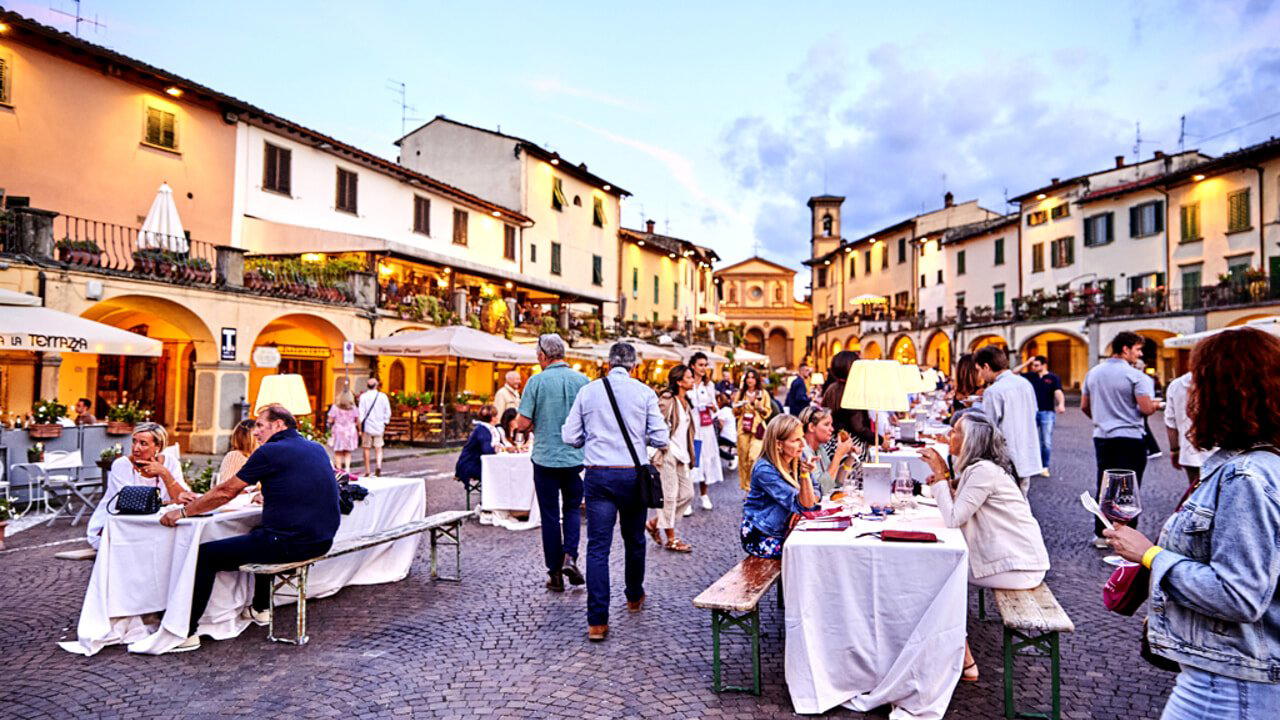
Communal seating means you will share a table with whoever is next in the queue. On a given Tuesday in November, that might be a market stallholder finishing a shift, a group of architecture students, and two visitors from Japan who found the address in a guidebook published fifteen years ago. The table talk is optional, the proximity is not. This is Florence eating functionally, which has its own form of honesty that the €€€€ rooms along the Lungarno do not replicate, however accomplished their cooking.
Where Mario Sits in Florence's Dining Range
Florence's upper tier of restaurants has consolidated around a recognizable format: tasting menus, wine pairings, and kitchens that reference Italian tradition through a contemporary technical lens. Atto di Vito Mollica, Borgo San Jacopo, and Gucci Osteria da Massimo Bottura all occupy that register, competing on technique, sourcing credentials, and room design. That tier is well-served and well-documented. Mario occupies a different stratum entirely, one where the competitive comparison is not other restaurants but the rhythm of the market it adjoins.
Across Italy, the trattoria format has proven surprisingly durable in cities where it retains an actual function, feeding the people who work nearby at a price point and a pace that fits a working lunch. In Florence specifically, the proximity of the Mercato Centrale provides that function. The daytime-only service, the cash-only payment, and the no-reservations policy are not eccentricities; they are the operational structure of a place that serves a purpose beyond the dining experience as such. For context on how Italian regional cooking operates at different price points and formats across the country, Dal Pescatore in Runate, Quattro Passi in Marina del Cantone, and Uliassi in Senigallia each anchor different regional traditions. Mario anchors something older and less decorated: the Florentine midday meal as a civic institution.
The broader Italian fine dining circuit, from Osteria Francescana in Modena to Piazza Duomo in Alba and Le Calandre in Rubano, operates in a register defined by editorial attention, awards seasons, and advance booking windows that sometimes stretch to months. Mario requires none of that apparatus. You show up, you wait, you eat.
Planning the Visit
Trattoria Mario operates lunch service only, closing when the kitchen is done rather than at a fixed hour, arriving before 12:30 gives the widest choice from the daily menu and the shortest queue. The restaurant does not take reservations, so the queue on the pavement is the only mechanism for entry. Cash is required; there is no card payment. Dress code is nonexistent in any meaningful sense. The address, Via Rosina 2r, places the entrance on the eastern flank of the Mercato Centrale, a few minutes' walk from the San Lorenzo church and easily combined with a morning in the market before lunch. For readers building a broader Florence itinerary, our full Florence restaurants guide maps the city's dining options across formats and price tiers.
Frequently asked questions
Is Trattoria Mario good for families?
If your children are comfortable eating at communal tables alongside strangers and following a kitchen-led pace, the format works well. The San Lorenzo location keeps things informal, and the price point is among the most accessible in central Florence. Families who expect private tables or a la carte flexibility will find the format less accommodating.
What kind of setting is Trattoria Mario?
Mario is a no-frills, communal-table trattoria on Via Rosina, running along the edge of Florence's Mercato Centrale in the San Lorenzo district. There is no table service in the conventional sense, no reservations, and no pretension, it sits at the opposite end of the city's dining range from the tasting-menu restaurants of the centre. Dress accordingly: this is a working lunch counter, not a dining room.
How does Trattoria Mario compare to Florence's trattorias that have modernised their format?
Many trattorias in central Florence that once operated on communal or shared principles have shifted toward private tables, card payment, and evening service. Mario on Via Rosina still runs lunch only, still seats strangers together, and still closes when the kitchen is done rather than at a fixed hour. For visitors specifically looking for an unreconstructed Florentine trattoria experience in the San Lorenzo market district, that distinction is the point of the visit.
What's the best thing to order at Trattoria Mario?
The menu changes daily based on market availability from the adjacent Mercato Centrale, so there is no fixed dish to anchor an order around. The primi, particularly any ribollita or pasta available that day, reflect the kitchen's Tuscan cucina povera approach most directly. Ask what came in from the market that morning and order accordingly.
What's Trattoria Mario's location?
Trattoria Mario is located at Via Rosina, 2r, 50123 Firenze FI, Italy, Florence.
Can I walk in to Trattoria Mario?
Walk-in is the only option: Mario does not accept reservations. The queue on Via Rosina self-organises before service begins, and staff seat parties as space becomes available at shared tables. Arriving before 12:30 gives the widest choice of dishes and the shortest wait.
What's Trattoria Mario best at?
Mario's consistent quality lies in Tuscan cucina povera, daily-changing menus built around produce from the Mercato Centrale, prepared simply and served without ceremony at communal tables. The format has remained largely unchanged while much of central Florence's trattoria scene has moved toward private tables and fixed menus. That consistency, more than any single dish, is what keeps it relevant.
Cost and Credentials
Comparable venues nearby, for context on price, style, and recognition.
| Venue | Cuisine | Price | Awards | Notes |
|---|---|---|---|---|
| Trattoria MarioThis venue (the venue you are viewing) | Traditional Tuscan Trattoria | $20–30 | Not listed | Not listed |
| Ristorante Ricchi | Traditional Tuscan Italian | $20–30 | Not listed | Santo Spirito, Traditional Tuscan Italian |
| Pitti Gola e Cantina | Tuscan Wine Bar | $50–100 | Star Wine List | Santo Spirito, Tuscan Wine Bar |
| Il Vecchio e il Mare | Neapolitan Pizza and Seafood | $20–30 | 50 Top Pizza Italia #46 | Ricorboli, Neapolitan Pizza and Seafood |
| Gustapizza | Neapolitan Pizza | $10–20 | Diners, Drive-Ins and Dives Featured Restaurant | Santo Spirito, Neapolitan Pizza |
| Coquinarius Fiesole | Refined Tuscan Bistro | $50–100 | Not listed | San Niccolo, Refined Tuscan Bistro |