The Patio at Cafe Brauer
Our verdict
Set within one of Lincoln Park's most historically significant structures, The Patio at Cafe Brauer occupies an outdoor space tied to early twentieth-century Chicago park culture. The setting draws on the Prairie School architecture of the 1908 Cafe Brauer building, placing guests in a context that few outdoor dining spots in the city can match for architectural and historical weight.

Pearl is the En Primeur Club membership app — saves, bookings, and concierge access live there. Same editors, same standards.
- Address
- 2021 N Stockton Dr, Chicago, IL 60614
- Phone
- (312) 507-9053
- Hours
- Daily 11 AM–5 PM
- Website
- lpzoopatio.org
- Directions
- Get directions
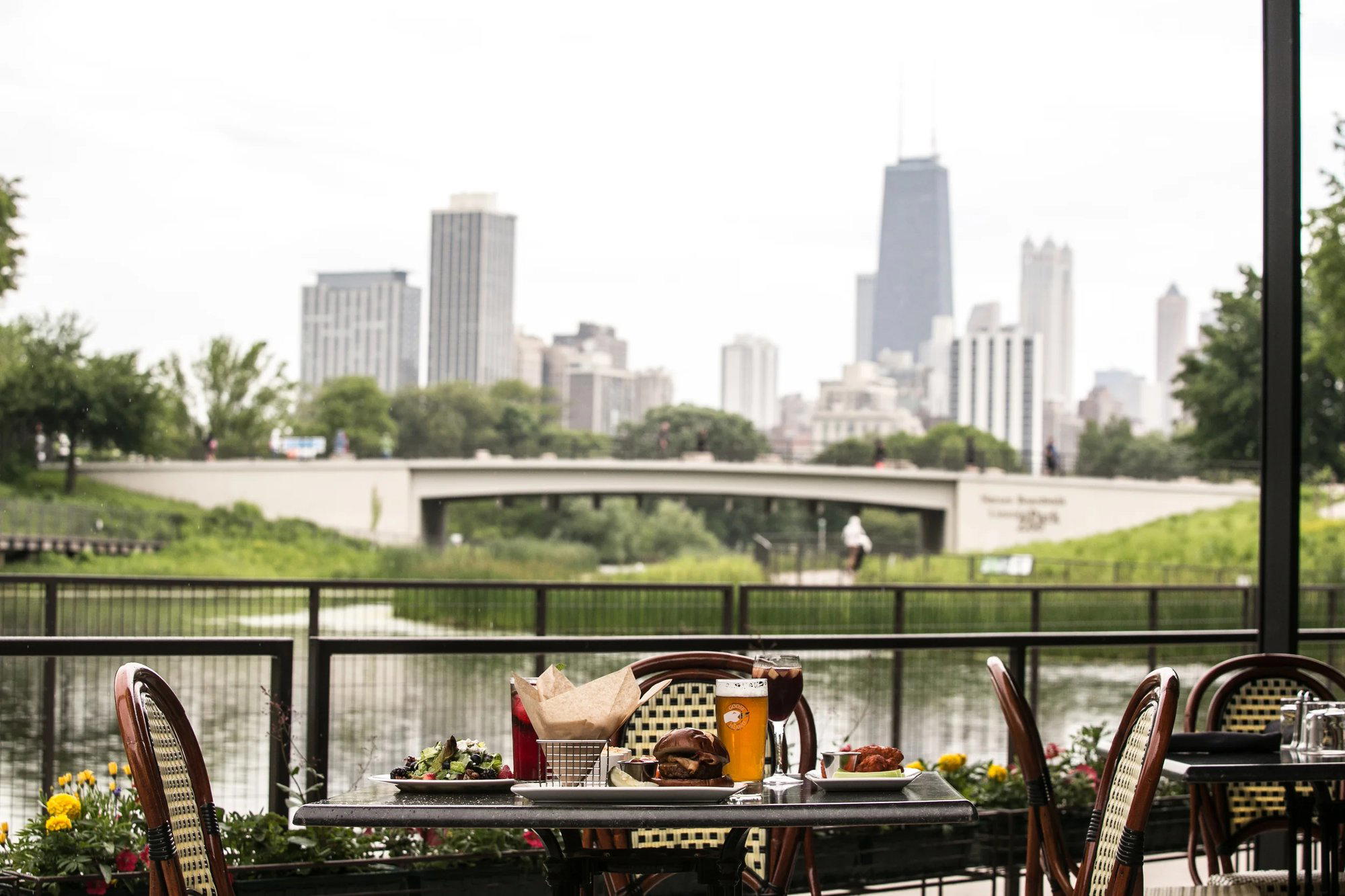
The menu
What to order
- Patio Burger
- Summer Berry Salad
- Texas French Toast
A Building That Predates the Dining Scene Around It
Outdoor dining in Chicago has expanded considerably over the past decade, with patios, rooftops, and parklets multiplying across nearly every neighbourhood. What separates The Patio at Cafe Brauer from the bulk of that growth is temporal: the structure behind it dates to 1908, designed by Dwight Perkins in the Prairie School tradition that would later define Chicago's architectural identity. When the city's dining culture shifts — and it shifts quickly — this patio remains anchored to something that precedes it by more than a century.
Lincoln Park as a dining district tends to cluster around Armitage, Halsted, and Clark. The stretch along Stockton Drive near the zoo occupies a different register, one where the park itself is the primary draw and the food operation exists within a public amenity context rather than a competitive restaurant corridor. That positioning shapes expectations and, more usefully, shapes how the space functions for the people who choose it.
The Architectural Frame
Prairie School buildings were designed around a philosophy of horizontal integration with landscape, and Cafe Brauer, a Chicago landmark listed on the National Register of Historic Places, reflects that intent in its low rooflines, wide eaves, and integration with the South Pond. The patio extends that relationship between structure and outdoor space. Dining here puts guests physically adjacent to one of the city's better-preserved examples of early twentieth-century civic architecture, which is a different kind of context than sitting beside a contemporary glass facade on Randolph Street.
Chicago has a handful of settings where architecture and food share genuine equal weight. Alinea operates within a Lincoln Park townhouse that carries its own spatial identity. Smyth works within an industrial West Loop frame. The Patio at Cafe Brauer sits in a category of its own: a landmarked public building inside a public park, where the dining experience is inseparable from the civic history around it.
What the Setting Implies About the Food
The editorial angle that matters most here concerns sourcing, not in the farm-to-table marketing sense, but in the structural sense. Venues operating within park conservancies and municipal frameworks often draw from institutional food service contracts, which means the ingredient sourcing model differs substantially from what you'd find at a chef-driven room like Oriole or Kasama. The food at The Patio at Cafe Brauer operates in service of the setting, not the reverse. That is neither a criticism nor a recommendation in isolation, it is a structural reality that should calibrate expectations before arrival.
For comparison, consider how farm-to-table sourcing defines the identity at places like Blue Hill at Stone Barns in Tarrytown, where the kitchen and the source farm occupy the same property, or Single Thread Farm in Healdsburg, where the farming operation dictates the menu. At the opposite end of that spectrum, park-embedded venues like this one prioritise accessibility and volume in ways that specialist dining rooms do not. Knowing where a venue sits in that spectrum is more useful than pretending the spectrum doesn't exist.
Chicago's most rigorous sourcing-led rooms, Next Restaurant and others operating in the $$$$ tier, run purchasing programs that are incompatible with the kind of open-access, high-traffic setting Cafe Brauer represents. The Patio functions in a civic hospitality model, closer in spirit to a well-run museum restaurant than to a tasting menu counter. That model has its own legitimacy and its own audience.
Lincoln Park Context and Who This Is For
Lincoln Park draws a broad cross-section of visitors: zoo visitors with families, joggers, cyclists, and people who come specifically to spend an afternoon near the South Pond. The patio at Cafe Brauer sits within that flow. The architectural setting provides a genuine reason to pause rather than simply pass through, and for visitors already spending time in the park, it represents a grounded, historically resonant place to eat.
For visitors whose primary interest is Chicago's fine dining culture, the city offers a deep roster that extends well beyond the park. Our full Chicago restaurants guide covers that range in detail, from the Michelin-decorated rooms to the neighbourhood spots that don't carry stars but carry significant culinary weight. The Patio at Cafe Brauer doesn't compete in that conversation, and doesn't need to.
For travellers building a broader American dining itinerary, Chicago anchors the Midwest end of a national circuit that includes sourcing-obsessed rooms like Lazy Bear in San Francisco, The French Laundry in Napa, Providence in Los Angeles, Addison in San Diego, Bacchanalia in Atlanta, Le Bernardin in New York City, Atomix in New York City, The Inn at Little Washington, Emeril's in New Orleans, and 8½ Otto e Mezzo Bombana in Hong Kong. The Patio at Cafe Brauer serves a different function in the itinerary: a setting break, a historical moment, a place to eat within one of America's great urban parks.
Planning Your Visit
The venue sits at 2021 N Stockton Drive, inside Lincoln Park, accessible on foot from the Armitage or Fullerton CTA stops on the Brown and Purple lines. The park itself operates as a public space, which means access to the building and its surrounds is open without a reservation or fee. For specific hours, current menus, pricing, and any booking requirements for the patio, checking directly with the Chicago Park District or the Cafe Brauer operator is advisable, as seasonal programming and event bookings can affect availability. The building is frequently used for private events, which can close the patio to general visitors on certain dates, making advance confirmation worthwhile before a planned visit.
The South Pond view is leading in the late afternoon, when the building's Prairie School horizontals read clearly against the skyline to the south and the park's mature tree canopy frames the water. That timing aligns well with a post-zoo or post-conservatory visit for anyone spending a full afternoon in the northern section of Lincoln Park.
Frequently asked questions
What should I expect atmosphere-wise at The Patio at Cafe Brauer?
The setting is defined by the 1908 Prairie School building behind it — a Chicago landmark — and the open green space of Lincoln Park directly around it. The patio places you within the park proper at 2021 N Stockton Drive, with zoo grounds nearby and a consistently active outdoor scene of families, cyclists, and park regulars. It reads as relaxed and park-casual rather than formal.
What's the address for The Patio at Cafe Brauer?
The Patio at Cafe Brauer is located at 2021 N Stockton Dr, Chicago, IL 60614, Chicago.
Is The Patio at Cafe Brauer a good venue for an event or private gathering in Chicago's Lincoln Park?
Cafe Brauer has historically operated as an event-capable venue given the scale of the 1908 landmark building it occupies inside Lincoln Park. The address at 2021 N Stockton Drive, Chicago places it within the park's managed spaces, which tend to have structured booking processes for private use. Anyone planning a group visit or event should check the venue's official channels to confirm current availability and capacity terms.
What's the signature dish at The Patio at Cafe Brauer?
The food program is shaped by the outdoor, park-adjacent context at 2021 N Stockton Drive, Chicago.
Should I book The Patio at Cafe Brauer in advance?
Given the patio's position inside Lincoln Park and its proximity to one of Chicago's most visited green spaces, demand on warm-weather weekends is predictably high. Booking ahead is a sensible precaution, particularly from late spring through early fall. Current reservation details are best confirmed directly with the venue.
What is The Patio at Cafe Brauer known for?
Cafe Brauer itself is a Chicago landmark building, constructed in 1908 and designed in the Prairie School tradition by Dwight Perkins. The patio draws on that architectural context and its location inside Lincoln Park at 2021 N Stockton Drive, making it one of the few Chicago dining spots set within a major public green space rather than adjacent to one.
The Minimal Set
Comparable venues nearby, for context on price, style, and recognition.
| Venue | Cuisine | Price | Notes |
|---|---|---|---|
| The Patio at Cafe BrauerThis venue — the venue you are viewing | American Cafe | $20–30 | Not listed |
| Chicago Chefs Cook | Midwest Seasonal Cuisine | Not listed | Chicago, Midwest Seasonal Cuisine |
| Toast It IZ | Elevated American Brunch | $20–30 | River North, Polished American Brunch |
| Harry Caray's Tavern, Navy Pier | American and Italian Comfort Food | $20–30 | Navy Pier, American and Italian Comfort Food |
| Soule To Soule | Soul Food Tapas | Not listed | West Town, Soul Food Tapas |
| BRGRBELLY | Gourmet American Burgers | $20–30 | Portage Park, Gourmet American Burgers |
Continue exploring
More in Chicago
Restaurants in Chicago
Browse all →

Details
- Scenic
- Casual
- Cozy
- Casual Hangout
- Brunch
- Family
- Terrace
- Historic Building
- Courtyard
- Craft Cocktails
- Beer Program
- Skyline
- A La Carte
- Cocktails
- Beer
- Wine
- Vegetarian Friendly
Current opening hours
- Monday
- 11 AM–5 PM
- Tuesday
- 11 AM–5 PM
- Wednesday
- 11 AM–5 PM
- Thursday
- 11 AM–5 PM
- Friday
- 11 AM–5 PM
- Saturday
- 11 AM–5 PM
- Sunday
- 11 AM–5 PM
Hours can change for holidays and private events. Last verified .
Relaxed outdoor atmosphere with natural light, waterside views, and a casual park-like setting amid historic Prairie School architecture.