Teske's Germania
One of downtown San Jose's most enduring dining addresses, Teske's Germania has anchored the corner of North First Street for decades, serving the kind of German-American food that has largely disappeared from California's restaurant scene. The menu reads as a document of mid-century immigrant cooking traditions, making it a counterpoint to the tech-era dining that surrounds it.
 Discover on Pearl
Pearl is the En Primeur Club membership app — saves, bookings, and concierge access live there. Same editors, same standards.
- Address
- 255 N First St, San Jose, CA 95113
- Phone
- +14082920291
- Website
- teskes-germania.com
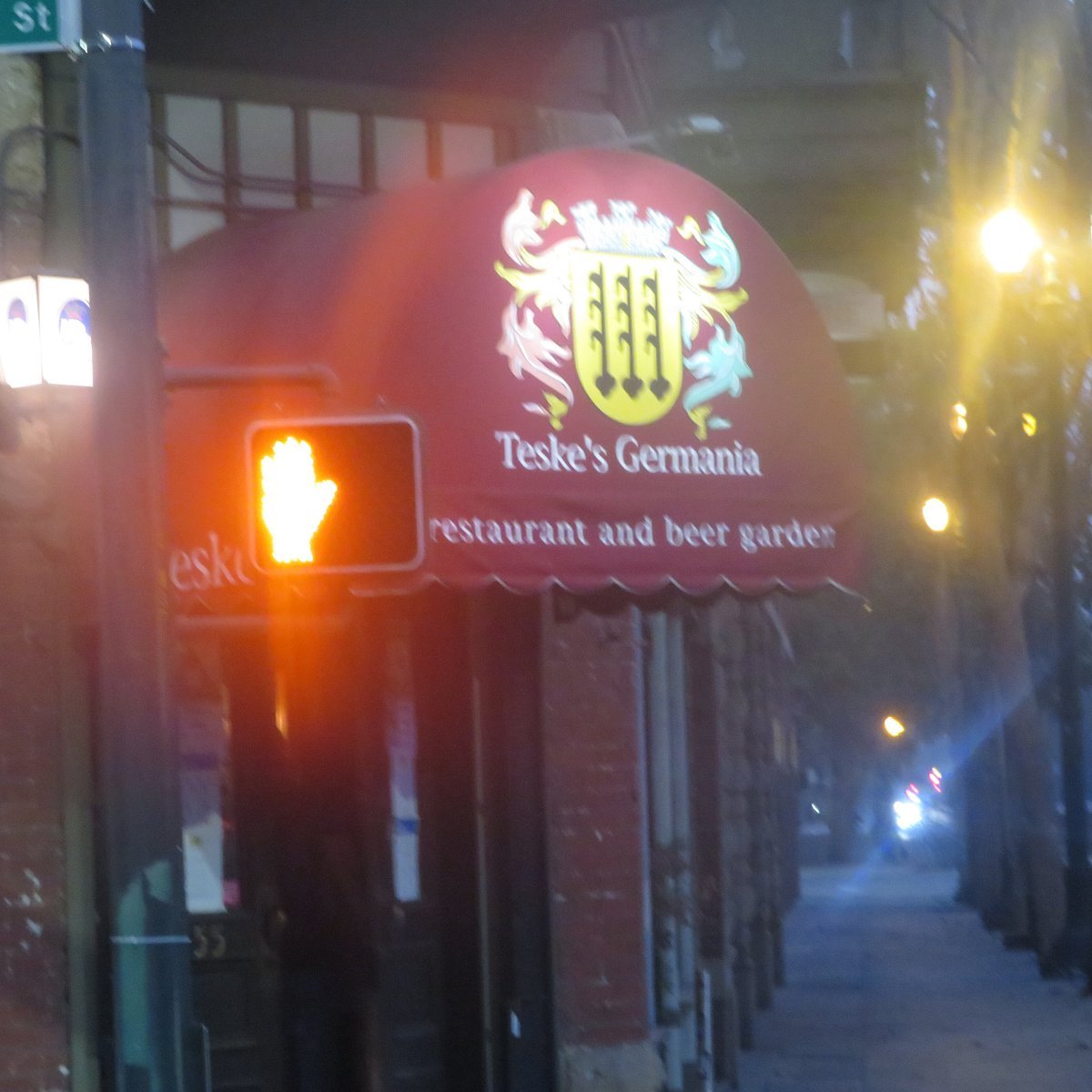
A Corner of Old San Jose That Refuses to Update Itself
Approach 255 North First Street on a weekday evening and the building reads as a deliberate act of resistance. Downtown San Jose has reorganized itself repeatedly around tech campuses, arena-district bars, and fast-casual formats, yet this address has held its ground with a dining room that signals another era entirely. Dark wood, Germanic decorative detail, and a room scaled for a different kind of hospitality than the open-plan, noise-forward spaces that now dominate the blocks around it. That physical continuity is not incidental. It is the argument the restaurant makes before a single plate arrives.
German cuisine has nearly no footprint in California's current restaurant conversation. The Bay Area's dining attention clusters around Japanese precision, updated California-Mediterranean, and a growing South and Southeast Asian presence. Within that context, a full-service German-American kitchen in downtown San Jose occupies a genuinely unusual position, not because it is exotic, but because the cooking tradition it represents has effectively retired from the region's restaurant scene. Venues like Adega (Portuguese) and Alma de Amón represent other immigrant culinary lineages that have found modern form in San Jose; Teske's Germania represents one that has stayed largely fixed.
What the Menu Reveals About Its Own Logic
The editorial angle that matters here is menu architecture, specifically what the structure of a German-American menu communicates about the cooking tradition it carries. Classical German restaurant menus in the United States were designed around the logic of the German beer hall and the central European Gasthaus: protein-anchored plates, starch foundations, preservation techniques (pickling, curing, smoking) applied as flavor rather than garnish, and portion sizes calibrated for a culture that treated dining out as a sustaining rather than a grazing act.
That logic produces a menu that looks unlike almost anything else operating in San Jose's current dining scene. Where restaurants like Back A Yard Caribbean Grill or Antipastos by DeRose structure around shareable formats and smaller plates, the German-American template runs in the opposite direction: discrete courses, individual portions, a clear hierarchy between starter, main, and accompaniment. The sauerbraten, the schnitzel, the braised red cabbage as a side rather than a salad component, the soup course treated with genuine seriousness rather than as an afterthought. Each element signals a set of assumptions about how a meal should unfold.
Beer list architecture follows the same logic. German and German-influenced lagers, wheat beers, and dark beers function not as a craft-bar selection but as the primary beverage pairing for the food, which is how the menu was originally conceived. This is a narrower and more coherent approach than the broad tap lists that now characterize most casual dining in the South Bay.
The Downtown San Jose Context
San Jose's dining scene has consolidated around a handful of identifiable clusters. The Japantown corridor carries its own distinct character. The Willow Glen strip runs toward neighborhood bistro formats. Downtown proper has fragmented between arena-adjacent sports bars, newer fast-casual entrants, and a small tier of serious independent restaurants. Augustine represents one end of that independent tier; Teske's Germania represents something orthogonal to the whole framework.
Nationally, the restaurants that attract the most editorial attention operate in a very different register. Lazy Bear in San Francisco, Alinea in Chicago, The French Laundry in Napa, and Single Thread Farm in Healdsburg all work in formats defined by tasting menus, chef-driven conceptual frameworks, and high-control dining environments. At the same price tier and format tier occupied by venues like Le Bernardin in New York City, Providence in Los Angeles, or Addison in San Diego, the conversation is about innovation, sourcing philosophy, and technique signaling. Teske's Germania is not in that conversation, and does not position itself to be. Its value proposition is the opposite: continuity, a known quantity, a menu that has not been reimagined to reflect current trends.
That positioning is more coherent than it sounds. Farm-to-concept restaurants like Blue Hill at Stone Barns in Tarrytown or tightly controlled tasting formats like Atomix in New York City require a certain kind of engagement from the diner: curiosity about process, willingness to be guided, openness to the unfamiliar. A long-standing German-American kitchen requires almost the opposite: familiarity is the point. You come knowing roughly what you will eat, and the measure of success is how well the kitchen executes a set of established preparations.
Who Eats Here and Why
The dining room at a venue like this tells you something about the city's demographic layers. Downtown San Jose has a pre-tech resident history that is easy to overlook when the surrounding development pulls focus. A German-American restaurant that has operated for decades has customer relationships that run across generations, and those relationships are not replicated by newer entrants to the market regardless of their quality. Emeril's in New Orleans and The Inn at Little Washington in Washington have built similar multi-decade loyalty loops in their respective cities; the mechanism is the same even if the price tier and format differ considerably. Longevity in a specific location accrues a kind of social capital that newer restaurants cannot shortcut.
For a visitor to San Jose arriving from a city with a more developed restaurant scene, the interest is less about comparing Teske's Germania against 8 1/2 Otto e Mezzo Bombana in Hong Kong or other globally recognized names than about reading what its continued existence says about the city. A restaurant that has held a downtown corner through multiple economic cycles and through the near-complete transformation of Silicon Valley's culinary identity is making a statement about the community it serves, whether or not that was ever a conscious intention. See our full San Jose restaurants guide for broader context on where Teske's Germania sits within the city's dining geography.
Planning Your Visit
Teske's Germania sits at 255 North First Street, within walking distance of the downtown SAP Center and the main transit corridor. The location makes it accessible without a car from central San Jose, and its proximity to the arena means it draws pre-event traffic on game and concert nights, so timing matters. The format is full-service dining room rather than counter or bar-first, and the room size and character suggest reservations are the more reliable approach on weekends.
- Schweinshaxe mit Kartoffelsalat
- Jäger Schnitzel
- Wiener Schnitzel
- Kassler Rippchen
- Rinderpaprikagulasch
- Bratwurst
- Apple Strudel
Style and Standing
Comparable venues nearby, for context on price, style, and recognition.
| Venue | Cuisine | Price | Awards | Notes |
|---|---|---|---|---|
| Teske's GermaniaThis venue — the venue you are viewing | Authentic German Bavarian | $$ | , | |
| Momosan Santana Row | Modern Japanese Izakaya and Ramen | $$ | , | Santana Row |
| Taiwan Restaurant | Szechwan, Cantonese & Chinese | $$ | , | Willow Glen |
| Milan | Modern Portuguese | , | Willow Glen | |
| Blowfish Sushi to Die For | Fusion Japanese Sushi | $$ | , | Santana Row |
| Tomo Sushi | Traditional Japanese Sushi | $$ | , | Willow Glen |
Continue exploring
More in San Jose
Restaurants in San Jose
Browse all →
Bars in San Jose
Browse all →
Hotels in San Jose
Browse all →
At a Glance
- Cozy
- Lively
- Classic
- Rustic
- Group Dining
- Casual Hangout
- Celebration
- After Work
- Special Occasion
- Live Music
- Beer Garden
- Historic Building
- Standalone
- Beer Program
- Craft Cocktails
Old-world cozy interior with warm gemütlichkeit (German warmth and good cheer), lively beer-garden energy during live-music nights and Oktoberfest events, long wooden bar stretching along the entryway.
- Schweinshaxe mit Kartoffelsalat
- Jäger Schnitzel
- Wiener Schnitzel
- Kassler Rippchen
- Rinderpaprikagulasch
- Bratwurst
- Apple Strudel