
Teshigoto Sanuki Udon Sansan gives Kawanishi a serious udon address outside Japan’s larger dining circuits, with handmade Sanuki-style noodles and recognition on Tabelog’s Udon WEST 100 for 2024. The appeal is rooted less in ceremony than in craft: wheat noodles, curry udon, cafeteria ease, and a suburban Hyogo setting that makes the cooking feel local rather than staged.
Pearl is the En Primeur Club membership app — saves, bookings, and concierge access live there. Same editors, same standards.
- Address
- 2 Chome-2-121 Midoridai, Kawanishi, Hyogo 666-0129, Japan
- Phone
- +81 72-792-8887
 Saves & bookings on Pearl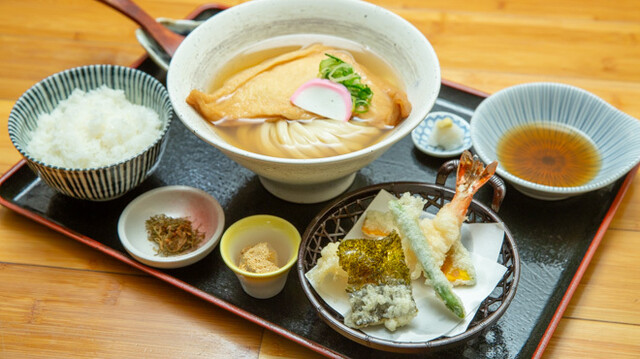
Approaching a udon shop in a Kawanishi shopping arcade changes the temperature of the meal before a bowl arrives. The setting is domestic rather than theatrical: counters, tables, raised seating, families, regulars, and the low rhythm of a noodle house built for repeat use. In Hyogo, where Osaka and Kobe often absorb attention, this kind of suburban address is where wheat-noodle culture can feel least mediated. Teshigoto Sanuki Udon Sansan belongs to that register: small-scale, practical, and judged on the elasticity of the noodle rather than the performance around it.
Sanuki udon carries a particular burden in Japan because its reputation rests on texture. The style, associated with Kagawa, prizes chew, snap, and smoothness over ornament. That makes sourcing and handling matter: flour, hydration, resting, and seasonal adjustment become the core of the kitchen’s argument. The restaurant’s own positioning is clear enough, handmade noodles whose aging changes with the season. That detail matters because udon is not a static product; humidity and temperature affect dough behavior, and serious shops treat those variables as part of the craft rather than an inconvenience.
Handmade Sanuki udon in a Hyogo suburb, judged by texture rather than spectacle
Japan’s noodle hierarchy is often distorted by travel writing. Ramen gets the queues and regional taxonomy, soba gets the language of purity, and udon can be misread as casual ballast. The better udon shops prove otherwise. They operate with fewer moving parts, which leaves less room to hide weak technique. Broth, noodle, tempura, curry, and condiment choices all matter, but the noodle carries the meal. Teshigoto Sanuki Udon Sansan sits in that demanding lane, with udon, cafeteria cooking, and curry udon listed as its categories.
The Tabelog Udon WEST 100 selection in 2024 places it within a wider western Japan conversation rather than a purely local Kawanishi one. Tabelog’s score of 3.62 is not a Michelin-style verdict, but for everyday Japanese dining categories it signals a shop that has attracted attention beyond neighborhood convenience. That distinction is useful for travelers: this is not the luxury-counter end of Japan dining, nor the anonymous station-front bowl. It occupies the middle ground where craft and accessibility overlap.
The ingredient angle is also the right way to read the menu. Sanuki-style udon depends on wheat structure, and curry udon tests a different side of the same kitchen: sauce weight can smother inferior noodles, while better noodles keep their shape and chew under a heavier preparation. Sake and shochu are listed, which nudges the format closer to a casual meal than a pure lunch stop, especially on evenings when the dining room opens beyond the weekday daytime pattern.
A 30-seat room that keeps udon close to daily life
Room reinforces the point. Thirty seats, divided among counter seating, table seating, and raised seating, create a format that can absorb solo diners, pairs, and family groups without turning into a destination dining stage. Private rooms are not part of the setup, but private use is available, which tells a different story about community function. In suburban Japan, a noodle shop can sit between lunch counter, family restaurant, and local gathering place; that mixed role is part of its cultural value.
Family friendliness is not an afterthought here. Children are welcomed, a kids’ menu is listed, and children’s udon is free for up to two per group. That matters editorially because it marks the shop as part of everyday Kawanishi eating rather than a specialist address sealed off for enthusiasts. Serious noodle craft in Japan often lives in places that do not ask diners to dress for seriousness.
Compared with nearby out-of-metro casual dining references, the positioning is clear. Takara Kasho Sugaya Yamamoto ten sits in a lower spend bracket, while Soba Kappou Soba Fuji moves into a higher noodle-adjacent tier. FRANK Ride and Eat and Clutch Hitter occupy casual price territory but speak to different categories. The useful comparison is not cuisine-for-cuisine, but function: Kawanishi-area dining rewards places that give residents a reason to return rather than visitors a single dramatic photo.
How to place it in a Kawanishi dining day
For travelers using Kawanishi as a quieter Hyogo base, this is a sharp example of why the city’s dining should not be treated as spillover from Osaka or Kobe. The address sits by Hirano on the Nose Electric Railway Myoken Line, putting it outside the frictionless tourist grid. That location is part of the appeal: noodle shops gain credibility when they survive on local habits, not only itinerary traffic.
The practical reading is simple. This is a low-pressure udon meal with enough recognition to justify a detour for diners who care about Japanese noodle technique. It is better suited to a focused lunch or casual dinner than a celebratory tasting-menu evening. The absence of chef mythology is not a weakness; udon culture does not need a personality cult when the dough work is the story.
Readers building a broader Kawanishi itinerary can place it alongside Our full Kawanishi restaurants guide, then branch into Our full Kawanishi hotels guide, Our full Kawanishi bars guide, Our full Kawanishi wineries guide, and Our full Kawanishi experiences guide. For contrast across Japan’s casual and specialist dining spectrum, see -Grilled beef Sukiyaki- KAMAKURA TANUKIAN 鎌倉 たぬき庵 in Kamakura, . 鮪と炭火焼き うお炭 秋葉原店 in Tokyo, .cafe in Osaka, .know in Kumamoto, (Shoku) Vietnam in Kawasaki, [Curry Senmon Ten] Maruyama Kyoju. in Sapporo, [ki:] in Kyoto, #肉といえば松田 奈良本店 in Kashihara, 1/3 HAMBURGER FACTORY in Kanazawa, 1000 in Yokohama, 1000mヒュッテ 1000m Hut in Kutchan, Jōdo Saké Bar in Los Angeles, and Onigiri Time in Pasadena.
Side-by-Side Snapshot
Comparable venues by cuisine and price in the same metro.
| Venue | Cuisine | Price | Notes |
|---|---|---|---|
| Teshigoto Sanuki Udon SansanThis venue — the venue you are viewing | Handmade Sanuki Udon & Udon Izakaya | $ | Not listed |
| らーめん かねかつ | Authentic Japanese Ramen | $ | Iizuka |
| Gyoza Hohei (ぎょうざ 歩兵) | Japanese Gyoza Specialist | $ | Gion |
| Tsurukamedo Zenzai | Okinawan Shaved Ice (Zenzai) | $ | Yomitan Village |
| Sukesama (ぎょうざ処 亮昌) | Kyoto Gyoza Specialist | $ | Gion |
| Mori no Ohagi | Creative Japanese ohagi & wagashi shop | $ | Osaka |
Recognition history
Dated appearances from independent guides and award organizations, with the underlying list record or original source where available.
Tabelog 100 #29 · No. 29
Tabelog · Tabelog 100 - Udon - WEST - 2024
Continue exploring
More in Kawanishi
Restaurants in Kawanishi
Browse all →




Bars in Kawanishi
Browse all →



Hotels in Kawanishi
Browse all →


Wineries in Kawanishi
Browse all →
At a Glance
- Cozy
- Lively
- Classic
- Family
- Solo
- Group Dining
- Casual Hangout
- After Work
- Standalone
- Local Sourcing
Current opening hours
- Monday
- 11 AM–3 PM
- Tuesday
- 11 AM–3 PM
- Wednesday
- 11 AM–3 PM
- Thursday
- 11 AM–3 PM
- Friday
- 11 AM–3 PM, 5–9:30 PM
- Saturday
- 11 AM–3 PM, 5–9:30 PM
- Sunday
- 11 AM–3 PM, 5–9:30 PM
Hours can change for holidays and private events. Last verified .
Casual and homely udon shop with a warm wood-accented interior, designed for families and solo diners alike, becoming more lively and izakaya-like on weekend evenings.