


Tempura Naruse holds a Tabelog score of 4.65 and consecutive Gold awards from 2023 through 2026, placing it among Japan's most decorated tempura counters outside Tokyo. The eight-seat room in Shizuoka's Aoi Ward operates by reservation only, with dinner running into the JPY 40,000–49,999 range. Chef Takeo Shimura's counter draws serious diners who make the journey specifically for it, not as an afterthought to the city.
 Discover on Pearl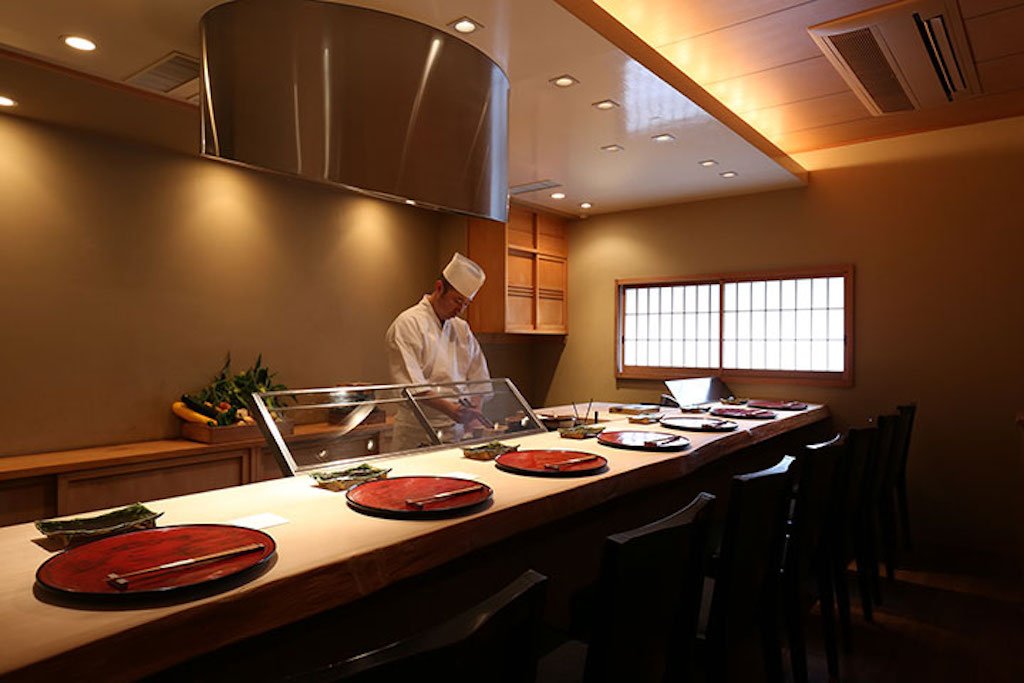
Where Precision Tempura Finds Its Quietest Address
The neighbourhood around Maruyamacho sits well clear of Shizuoka's transit hubs, and the walk from the nearest bus stop at Akatori Shrine Entrance takes around seven minutes through streets that don't announce themselves as a dining destination. That spatial remove is part of the point. Japan's most focused specialist counters — particularly in tempura — have increasingly settled outside metropolitan cores, where the physical conditions for concentration are easier to maintain and where the absence of tourist foot traffic filters the clientele before a single reservation is made. Tempura Naruse, at eight seats and reservation-only, belongs firmly to that tier.
The Counter Tradition Tempura Naruse Operates Inside
High-end tempura in Japan follows a specific logic: a single chef, a small counter, ingredients fried in sequence and served immediately, no holding. The format demands that a diner's full attention track with the cook's rhythm, which is why counter capacity rarely exceeds ten seats at this level. The economics are correspondingly steep. Naruse's Tabelog-listed dinner price sits in the JPY 40,000–49,999 range, with actual reviewer spending patterns placing many meals in the JPY 50,000–79,999 band once drinks and supplementary courses are counted. That positions the counter alongside Tokyo's most serious tempura rooms rather than the mid-tier tasting menus that occupy the same price bracket in provincial cities. The comparison to Tokyo is worth holding: while the capital's premium tempura scene clusters around Ginza and Minami-Aoyama, where restaurants price partly against real estate costs and partly against each other, Naruse prices against quality benchmarks alone.
The shortlist, unlocked.
Hard-to-book tables, cellar releases, and concierge-planned trips.
Get Exclusive Access →This is where the Tokyo–Shizuoka contrast becomes editorially productive. Metropolitan dining culture in Tokyo operates at speed: new openings generate instant attention, reservation systems fill within hours of a listing going live, and reputation compounds through social media cycles that can outpace actual quality assessment. Shizuoka, as a mid-sized prefectural city with a serious food culture anchored in proximity to Suruga Bay seafood, Izu peninsula produce, and the tea-growing highlands of the Okabe region, works on a different timescale. Counters here build reputation through sustained performance rather than launch heat. Naruse's trajectory , a Tabelog Silver in 2022, then Gold consecutively from 2023 through 2026, plus placement in the Tabelog Tempura 100 list for 2022, 2023, and 2025 , reflects that slower, more durable accumulation.
What the Awards Record Actually Signals
Tabelog Gold is awarded to restaurants that sustain scores above a high threshold across a large enough review sample to be statistically significant. A score of 4.65, which Naruse holds for 2026, places it well above the 3.5–4.0 range that already marks a very good restaurant in Japan's most demanding review ecosystem. Ranked 7th in Tabelog's broader Chef's Gold designation for 2026 and 17th in the Gold category overall, Naruse sits in the top tier of a national competition that includes every cuisine type across every city.
The Opinionated About Dining rankings, which aggregate expert assessments rather than crowd-sourced reviews, place Naruse even higher: ranked first in Japan in 2024 and fourth in both 2023 and 2025, with a La Liste score of 97 points in 2026 (up from 96.5 in 2025). These are not regional accolades. They measure Naruse against the full field of Japanese fine dining, including the concentrations of three-Michelin-starred kaiseki houses in Kyoto, the dense omakase scene in Tokyo's upmarket wards, and the French-Japanese fusion restaurants that dominate the La Liste methodology's upper reaches. For a tempura specialist operating an eight-seat counter in Shizuoka to rank among Japan's leading five restaurants by any serious methodology requires a level of sustained technical output that no single good review cycle can manufacture.
For comparison against regional peers, the Shizuoka dining scene includes kaiseki at Asaba, innovative French-Japanese approaches at LAT.34°N by Ao, and tempura at Tempura Nakamura. Outside the prefecture, the tempura format finds its closest national parallels at Numata in Osaka and internationally at Mudan Tempura in Taipei. Within the broader Japan fine dining field that Naruse is ranked against, the peer set includes counters like Harutaka in Tokyo, Gion Sasaki in Kyoto, and HAJIME in Osaka , restaurants operating in cities with far deeper tourist infrastructure and international name recognition than Shizuoka commands.
The Format and What It Requires of the Diner
Naruse operates under Chef Takeo Shimura and seats eight guests at the counter. The room has private dining available and can be taken for exclusive use, which makes it viable for small group occasions where that conversation privacy matters. Sunday is the only closed day, and the kitchen runs two services daily, Monday through Saturday, with lunch from 12:30 and dinner from 18:00. The schedule closes on alternating Tuesdays or Saturdays, a rotation worth confirming before booking. No parking is available on site.
Reservations are mandatory and accessible through four channels: the OMAKASE platform, AMEX KIWAMI Dining, TABLEALL, and Shokuoku. Phone reservations for the following month open on a specified date each month, which Naruse announces via Instagram. The AMEX channel signals something about the guest profile the counter attracts: KIWAMI Dining prioritises high-spend cardholders, and being listed there places Naruse in company with Tokyo's most sought-after omakase rooms. Payment accepts VISA and AMEX credit cards; electronic money and QR code payments are not accepted. Children are welcome only if they are able to eat the full adult course, which at this price level is a substantive condition.
The counter is approximately 1,447 metres from Shin-Shizuoka Station, accessible also via the Akatori Shrine Entrance bus stop. For travellers arriving from Tokyo by shinkansen, Shizuoka Station is the primary access point; Shin-Shizuoka is served by the Shizutetsu Justline, a local railway that connects to the city centre from the Shinkansen hub in under ten minutes.
Shizuoka as a Dining City Worth the Detour
Shizuoka's food credentials are frequently underestimated by travellers routing between Tokyo and Kyoto on the Tokaido Shinkansen. The prefecture sits between two of Japan's most ingredient-rich environments: the Pacific coastline provides tuna, seafood, and sakura ebi; the interior highlands supply wasabi from the Izu region, green tea from Shizuoka's plantations, and mountain vegetables that shift with the seasons. That ingredient proximity gives specialist counters in the city access to produce that Tokyo restaurants source from the same region but at one remove, through Tsukiji or Toyosu wholesale networks.
Beyond Naruse, the city supports a concentrated fine dining scene for its size. Unagi at Ichi Unagi, more formal kaiseki at Asaba, and the broader range covered in our full Shizuoka restaurants guide make the city a coherent two-day dining destination rather than a single-meal stop. The wider travel infrastructure , covered in our Shizuoka hotels guide, bars guide, wineries guide, and experiences guide , supports that case. For regional comparisons further afield, akordu in Nara, Goh in Fukuoka, and 1000 in Yokohama represent the same pattern: serious, award-tracked restaurants operating outside the Tokyo–Kyoto axis and rewarding travellers willing to adjust their routing.
At FUJI, the prefecture's positioning as a destination with its own culinary identity, independent of its proximity to Tokyo, continues to develop. Naruse is the clearest expression of what that identity can look like at the very leading of the quality spectrum.
Planning Your Visit
Naruse operates Tuesday through Sunday (closed Sundays, and on alternating Tuesdays or Saturdays , confirm the current schedule via Instagram before booking). Lunch service runs from 12:30, dinner from 18:00, at 12-2 Maruyamacho, Aoi Ward, Shizuoka 420-0861. The eight-seat counter is reservation-only; book through OMAKASE, TABLEALL, Shokuoku, AMEX KIWAMI Dining, or by phone to +81-54-295-7791 for the following month on the designated date. Budget JPY 40,000–49,999 per person at minimum, with total spend frequently running higher based on reviewer data. VISA and AMEX accepted; no electronic money or QR payments. Private room and full private hire are available for groups.
The shortlist, unlocked.
Hard-to-book tables, cellar releases, and concierge-planned trips.
Get Exclusive Access →Frequently Asked Questions
Cuisine Context
A fast peer set for context, pulled from similar venues in our database.
| Venue | Cuisine | Awards | Notes |
|---|---|---|---|
| Tempura Naruse | Tempura | {"Year":"2026","Award Source":"Tabelog",… | This venue |
| Unagi Shun | Eel | Eel | |
| Asaba | Kaiseki | Kaiseki | |
| Seirin | Kaiseki | Kaiseki | |
| Tempura Nakamura | Tempura | Tempura | |
| FUJI |
Need a table?
Our members enjoy priority alerts and concierge-led booking support for the world's most difficult tables.
Get Exclusive AccessThe shortlist, unlocked.
Hard-to-book tables, cellar releases, and concierge-planned trips.
Get Exclusive Access →