Taberna pirámide sits on Calle de la Torrecilla del Leal in the Centro district, where Madrid's traditional taberna format meets a contemporary sensibility. Positioned below the city's Michelin-starred tier but within the same neighbourhood gravity as the capital's most-discussed dining rooms, it offers a point of entry into Madrid's bar-and-table culture without the formality of tasting-menu-only rooms.
Pearl is the En Primeur Club membership app — saves, bookings, and concierge access live there. Same editors, same standards.
- Address
- C. de la Torrecilla del Leal, 15, Centro, 28012 Madrid, Spain
- Phone
- +34919355173
- Website
- sites.google.com
- Directions
- Get directions
 Saves & bookings on Pearl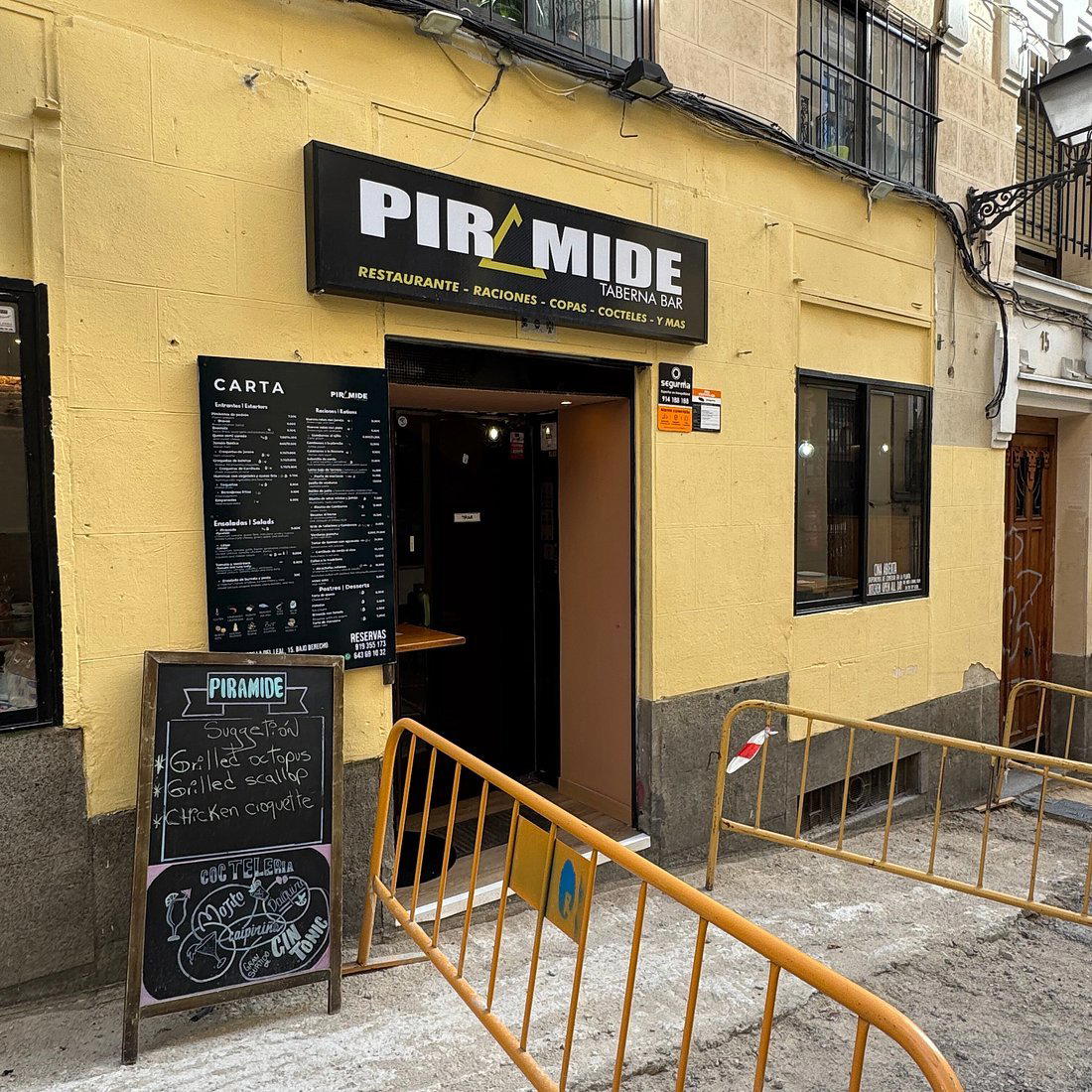
The Street, the Room, the Atmosphere
Calle de la Torrecilla del Leal runs through one of Centro's quieter residential folds, a few blocks south of the Lavapiés metro and east of the Rastro flea market zone. The streets here are narrower than the grand avenues further north, and the buildings carry the worn stucco and iron balconies that define working-class Madrid rather than the polished facades of Salamanca. It is the kind of neighbourhood where a taberna fits without effort, where the format has existed for generations and where the word itself still carries meaning rather than nostalgia.
In cities like Madrid, the taberna sits at the structural heart of how locals actually eat. It is not the tasting-menu room, not the grand hotel dining room, and not the terrace café aimed at tourists. It is the intermediate space where the cooking is serious but the setting is direct, where wine is poured without ceremony and where the noise level reflects the room's confidence rather than its ambition. The taberna format is, in many ways, more difficult to sustain than a fine-dining operation: it demands that quality hold without the scaffolding of elaborate service or high ticket prices to absorb kitchen costs.
Taberna pirámide occupies that format on a street where the rhythm is residential rather than commercial. The surrounding blocks are a mix of small grocery shops, neighbourhood bars, and apartment buildings whose ground floors have changed hands enough times to carry traces of several different eras. Approaching along Torrecilla del Leal, the sensory shift from the busier Lavapiés streets is immediate: less foot traffic, quieter, and with the particular acoustic quality of a street where buildings are close together and sound carries differently.
Madrid's Taberna Tradition and Where This Room Fits
Madrid's dining spectrum runs from the DiverXO-level tasting menu at one extreme to the neighbourhood bar at the other. The middle of that range, where serious kitchens operate in informal rooms, has expanded considerably over the past decade. Cities like Barcelona have seen a similar pattern, with places like Cocina Hermanos Torres demonstrating that ambition and accessibility are not mutually exclusive. In Madrid, the same tension plays out across the Centro and Lavapiés districts, where rents remain lower than in Salamanca or Chamberí, and where kitchens have more room to experiment without the pressure of a prime-location lease.
The taberna model in Spain traces a direct line through the country's culinary history. Before the fine-dining boom of the 1990s and 2000s that produced kitchens at the level of El Celler de Can Roca in Girona or Arzak in San Sebastián, the taberna was the dominant format for serious daily eating in Spanish cities. Wine came from the barrel or a short regional list, food was seasonal by necessity, and the cooking reflected the regional larder without self-consciousness about it. Some of those conventions have been revised in more recent taberna openings, where the kitchen might draw on technique borrowed from the haute cuisine generation, but the frame remains: no theatre, no courses designed for Instagram, no service designed to signal formality.
Those rooms belong to a different conversation, one indexed to international recognition and awards cycles. Spain's broader fine-dining circuit, which extends to Mugaritz in Errenteria, Quique Dacosta in Dénia, Azurmendi in Larrabetzu, Martin Berasategui in Lasarte-Oria, Aponiente in El Puerto de Santa María, Atrio in Cáceres, and Ricard Camarena in València, operates in a different register entirely. A neighbourhood taberna in Centro is not competing with that circuit. It competes on regularity, value in the broad sense, and the quality of a Tuesday lunch rather than a special-occasion dinner.
The Sensory Register of a Neighbourhood Taberna
The sounds that define a good taberna are specific: ceramic on tile, the low register of a room at comfortable capacity, wine being poured without the theatrical pause of fine-dining service. Lighting in these rooms tends toward the warm and functional rather than the designed darkness of a cocktail bar or the theatrical spot-lighting of a tasting-menu kitchen. The walls often carry more history than decoration. These are not accidental qualities. They are the result of a format that has been refined over generations, and any serious taberna understands them even if it never articulates them.
In the Lavapiés area, those sensory conventions meet a neighbourhood that has absorbed more demographic change than almost any other part of central Madrid. The result is a street-level texture that shifts from block to block, where a traditional taberna might sit between a Bangladeshi grocery and a gallery space operating on a shoestring. For a room like Taberna pirámide, this context is not incidental. The neighbourhood's character is part of the atmosphere, heard through the window and felt in the mix of the room itself. For visitors more familiar with the polished dining rooms of New York, where places like Le Bernardin or Atomix set a different register entirely, or with DSTAgE's more controlled Madrid environment, the taberna format requires a recalibration of expectations in a direction that most regulars consider an improvement.
Planning Your Visit
Taberna pirámide is located at Calle de la Torrecilla del Leal, 15, in the Centro district, Madrid 28012. The address puts it within walking distance of Lavapiés metro station on Line 3, and it is accessible from the Tirso de Molina and Antón Martín stations on Lines 1 and 3 respectively. The neighbourhood is leading approached on foot from the south end of the city centre; the walk from Sol takes roughly fifteen minutes and passes through the transition from tourist-heavy streets to residential blocks. For a fuller picture of where this fits within Madrid's dining options across price tiers and formats, see our full Madrid restaurants guide.
Given the taberna format and neighbourhood context, walk-in availability is plausible at off-peak hours, but confirming directly before visiting is advisable for weekend evenings when Centro's residential dining rooms tend to fill early.
How Taberna pirámide Madrid compares with similar nearby venues.
| Venue | Cuisine | Price |
|---|---|---|
| Doppelgänger Bar | Fusion | €€ |
| Ferretería | Contemporary | €€ |
Continue exploring
More in Madrid
Restaurants in Madrid
Browse all →
Bars in Madrid
Browse all →
Hotels in Madrid
Browse all →

At a Glance
- Classic
- Rustic
- Casual Hangout
- Standalone
Current opening hours
- Monday
- 12 PM–12 AM
- Tuesday
- Closed
- Wednesday
- 12 PM–12 AM
- Thursday
- 12 PM–12 AM
- Friday
- 12 PM–12 AM
- Saturday
- 12 PM–12 AM
- Sunday
- 12–11 PM
Hours can change for holidays and private events. Last verified .
Moderate noise level with a classic, rustic taberna atmosphere featuring hearty, lively seafood dishes.
Know Before You Go
- Getting there
- C. de la Torrecilla del Leal, 15, Centro, 28012 Madrid, Spain