1 Michelin Star
Our verdict
Sushiyoshi sits in Taipei's upper tier of omakase counters, where founder Hiroki Nakanoue draws on training in both Japanese and French culinary traditions to produce menus that move between Edomae nigiri and Western ingredients such as caviar and truffle. Ranked 227th in the OAD Top Restaurants in Asia 2024, it operates Tuesday through Saturday with separate lunch and dinner formats across Da'an District.

Pearl is the En Primeur Club membership app, where members save venues, book tables and use the concierge.
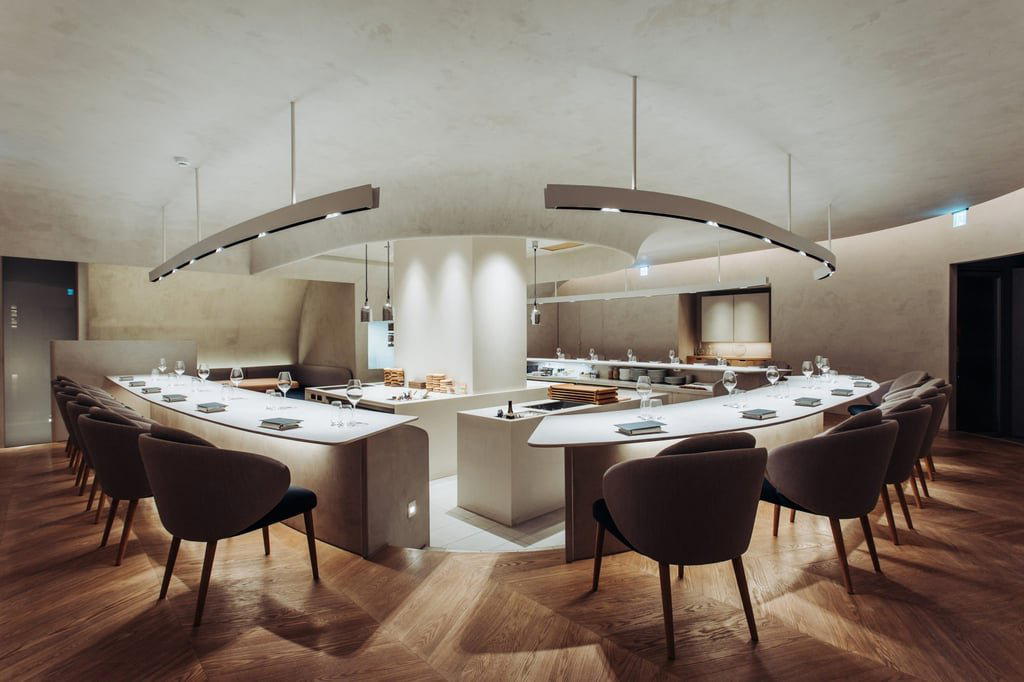
Where Edomae Discipline Meets a Cross-Cultural Kitchen
Da'an District has quietly become the address for Taipei's most serious omakase counters. The neighbourhood's density of high-spend residential blocks and its distance from the tourist circuits of Xinyi make it a natural home for the kind of restaurant that fills seats through word of mouth and waitlists rather than foot traffic. Sushiyoshi, on a lane off Section 4 of Zhongxiao East Road, operates exactly within that logic: the address takes a little effort to find, the format demands full commitment from a guest, and the rewards sit squarely at the upper end of what Taipei's Japanese dining scene can produce.
Taipei's relationship with Japanese cuisine runs deeper than proximity. Decades of cultural exchange, a generation of Taiwan-born chefs trained in Japan, and a market that has sustained serious omakase counters long before they became a global trend have produced a city where the format is genuinely competitive. At the $$$$ tier, Sushiyoshi sits alongside peers such as Logy and Taïrroir in terms of price positioning, though its culinary reference points are distinct: where those restaurants synthesise Taiwanese ingredients with European technique, Sushiyoshi pulls directly from the Edomae canon before bending it toward French vocabulary.
The Architecture of the Menu
Edomae sushi, the Tokyo-rooted tradition of curing, marinating, and applying controlled ageing to fish before it reaches the counter, is not a format that accommodates improvisation well. The techniques are specific, the rice temperature and seasoning matter enormously, and the pacing of a counter service shapes how a guest experiences each piece. What makes Sushiyoshi's position in this tradition notable is the deliberate extension of that framework to include ingredients that Edomae purists would not recognise: caviar, truffle, and Western preparations that draw on founder Hiroki Nakanoue's French culinary background.
The menu splits across two formats. Lunch leans heavily on nigiri, the classic sequence of rice and fish that tests a kitchen's command of the Edomae fundamentals. Dinner is where the kitchen's cross-disciplinary approach becomes most visible. The higher-priced evening omakase incorporates the Western elements more fully, and the OAD citation that placed Sushiyoshi at 227th in its 2024 Asia ranking explicitly identifies dinner as the format where the team's precision and inventiveness operate at their ceiling. That distinction between the two services is worth noting when booking: the lunch counter is not a shortcut to the same experience at a lower price, but a different set of priorities on the same stage.
The Team Dynamic at the Counter
The editorial angle on a serious omakase counter often defaults to the chef biography, but what actually produces a coherent experience at this level is the coordination between the person at the cutting board, whoever is managing the sake or wine programme, and the front-of-house team reading the pace of the service. At Sushiyoshi, the OAD citation frames the kitchen as an ensemble: it credits the team's collective creativity and precision rather than attributing the menu's direction to a single hand. Nakanoue's dual training in Japan and France provides the conceptual framework, but the execution of a menu that has to move credibly between Edomae tradition and caviar-driven Western courses requires a kitchen and floor that are working in close alignment.
This matters practically for the guest. A counter where the front-of-house is tracking which pieces arrived when, explaining the provenance of an unusual ingredient, or timing a sake pairing to the transition between nigiri and a more French-influenced course is a materially different experience from one where service is competent but disconnected from the kitchen's intentions. The format at this price point should deliver both, and the recognition Sushiyoshi has accumulated suggests it does.
For context on how the omakase counter format functions at comparable tiers elsewhere, the programmes at Masa in New York City, Sushi Masaki Saito in Toronto, and Sushi Noz in New York City each illustrate how counter-format Japanese restaurants in non-Japanese cities have built identity around a specific relationship between chef lineage, rice philosophy, and sourcing.
Taipei's Broader Fine Dining Context
Sushiyoshi does not exist in isolation. Taipei's high-end restaurant scene in 2024 encompasses French houses like L'Atelier de Joël Robuchon, Cantonese at the level of Le Palais, and boundary-crossing formats like Molino de Urdániz. The density of serious restaurants in a relatively compact dining district means that a $$$$ omakase counter has to earn its position against genuine alternatives, not just occupy a category by default.
Taiwan's dining scene extends well beyond Taipei, with JL Studio in Taichung and GEN in Kaohsiung representing the quality level that the island can sustain outside the capital. For those building a broader Taiwan itinerary, A Cun Beef Soup in Tainan, Akame in Wutai Township, and Volando Urai Spring Spa and Resort in Wulai each point toward a different register of the country's hospitality. Our full Taipei restaurants guide maps the city's dining at every price point, and we also cover hotels, bars, wineries, and experiences across the city.
Know Before You Go
- Address: No. 12, Alley 19, Lane 216, Section 4, Zhongxiao East Road, Da'an District, Taipei 106
- Price range: $$$$ (dinner omakase is priced above the lunch format)
- Hours: Tuesday to Saturday, lunch 12:00 PM–2:30 PM; dinner 6:00 PM–9:30 PM. Closed Sunday and Monday.
- Format: Omakase counter; lunch is nigiri-focused, dinner incorporates Western ingredients including caviar and truffle
- Recognition: OAD Leading Restaurants in Asia, ranked 227th (2024)
- Booking: Contact details not publicly listed; advance reservation is expected at this tier
What People Recommend at Sushiyoshi
The counter divides cleanly between its two services. Guests focused on classic Edomae technique tend to point toward lunch, where nigiri is the primary sequence and the kitchen's command of rice, seasoning, and fish preparation is the main event. The dinner omakase draws the most consistent commentary for its integration of French-trained sensibility with the sushi format: the use of caviar and truffle as components rather than garnish is the detail that distinguishes the evening menu from a conventional high-end sushi service. The OAD panel, which placed Sushiyoshi at 227th in Asia for 2024, specifically identifies the dinner service as the format where the kitchen's creativity and precision are most fully expressed.
Frequently asked questions
What's the price range at Sushiyoshi?
Pricing at Sushiyoshi is listed as $$$$.
What are the operating hours at Sushiyoshi?
Hours at Sushiyoshi: Monday closed Tuesday 12 PM-2:30 PM 6 PM-9:30 PM Wednesday 12 PM-2:30 PM 6 PM-9:30 PM Thursday 12 PM-2:30 PM 6 PM-9:30 PM Friday 12 PM-2:30 PM 6 PM-9:30 PM Saturday 12 PM-2:30 PM 6 PM-9:30 PM Sunday closed.
Is Sushiyoshi award-winning?
Sushiyoshi has received recognition including: Well versed in the culinary arts of Japan and France, founder Hiroki Nakanoue devises omakase menus that meld Edomae sushi traditions and incorporate some Western ingredients like caviar. The kitchen excels at realising his vision with fine….
What do people recommend at Sushiyoshi?
Guests consistently split along the two service formats. Lunch draws those focused on classic Edomae nigiri, where curing, ageing, and marinating technique is the primary focus. The dinner menu is where the kitchen's cross-cultural range becomes apparent: founder Hiroki Nakanoue incorporates Western ingredients such as caviar and truffles into the omakase sequence, drawing on training in both Japanese and French culinary traditions. For the fullest picture of what the counter does, the higher-priced dinner sitting is the one to prioritise.
Is Sushiyoshi focused on a specific cuisine style?
Cuisine and Recognition
| Venue | Cuisine | Price | Awards | Notes |
|---|---|---|---|---|
| SushiyoshiThis venue (the venue you are viewing) | Edomae Omakase with French Fusion | $50–100 | 1 Michelin Star | Not listed |
| logy | Modern Japanese-Taiwanese Fusion Omakase | $100–150 | 2 Michelin Stars · World's 50 Best #22 | Modern European, Asian Contemporary |
| Le Palais | Fine Dining Cantonese | $150–200 | 3 Michelin Stars · La Liste Top Restaurants | Cantonese |
| Taïrroir | Taiwanese-French Fusion Fine Dining | $150–200 | 3 Michelin Stars · La Liste Top Restaurants | Taiwanese/French, Taiwanese contemporary |
| Mudan Tempura | Michelin-Starred Tempura | Not listed | 2 Michelin Stars · La Liste Top Restaurants | Tempura |
| de nuit | Contemporary French | $150–200 | 1 Michelin Star · Star Wine List | French Contemporary |
Recognition history
Dated appearances from independent guides and award organizations, with the underlying list record or original source where available.
Michelin 1 Star
Michelin
Opinionated About Dining Top Restaurants in Asia Ranked #227
Opinionated About Dining
Full recognition history (4 entries)
Michelin 1 Star
Michelin
Michelin 1 Star
Michelin