






1 Michelin Star · World's 50 Best #61 · La Liste Top Restaurants
Our verdict
Mume occupies a specific position in Taipei's modern dining scene: a dimly-lit, faux-industrial room in Da'an where Taiwanese seasonal produce meets neo-Nordic technique. Ranked among Asia's 50 best restaurants in 2025 and holding a Black Pearl 2 Diamond, it represents the strand of Taipei cooking that prioritises local supply chains and ingredient provenance over imported prestige.

Pearl is the En Primeur Club membership app — saves, bookings, and concierge access live there. Same editors, same standards.
- Address
- No. 28, Siwei Rd, Da’an District, Taipei City, Taiwan 106
- Phone
- +886 2 2700 0901
- Hours
- Daily 5:30–11 PM
- Website
- mume.tw
- Directions
- Get directions
- Booking
- Book on the venue's website
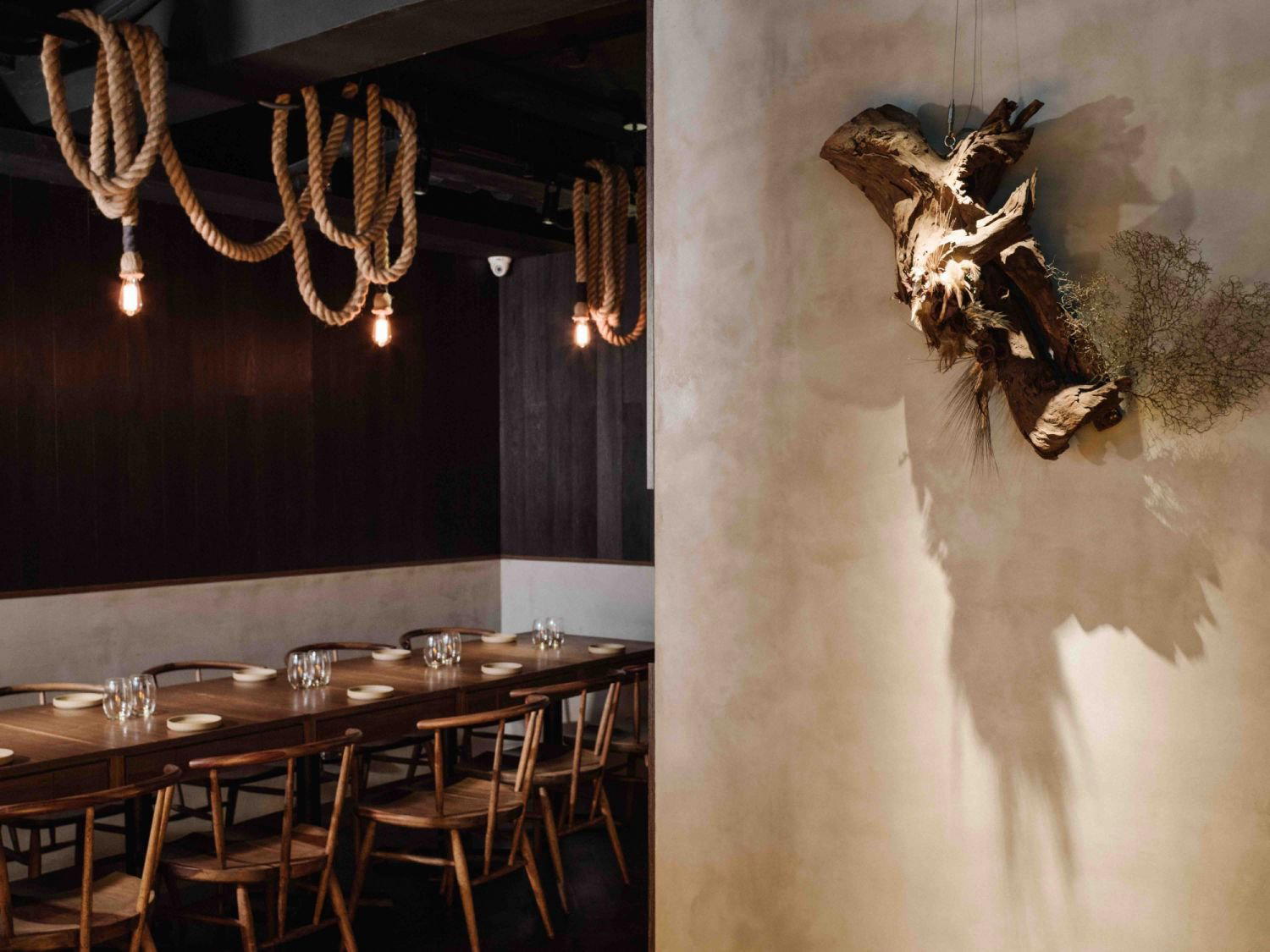
Where Taiwanese Ingredients Meet Northern European Discipline
Da'an District's dining corridor has become the address for Taipei's most considered modern restaurants, and Siwei Road in particular draws a crowd that reads menus the way others read wine labels. The room at Mume lands somewhere between Berlin and Taipei: dim light over raw surfaces, a faux-industrial interior that offers deliberate contrast to the delicate, herb-scattered plates that arrive from the kitchen. That tension is not accidental. It maps onto a broader direction in Taiwanese fine dining, where the language of Northern European restraint has been absorbed into a kitchen rooted firmly in local seasons and island produce.
This strand of cooking emerged with force in Taipei during the mid-2010s, as a generation of chefs who trained internationally returned with Nordic and contemporary European frameworks but chose to apply them to Taiwanese farmers, fishermen, and foragers rather than imported ingredients. Mume became one of the clearer expressions of that argument. The name references the plum blossom, a botanical marker for Taiwanese seasons, and the kitchen's sourcing logic follows accordingly: vegetables hold significant weight on the menu, and the supply chain connecting the restaurant to local producers is treated as a design choice rather than a marketing footnote.
The Award Record and What It Signals
Recognition across multiple ranking systems tells a more precise story than any single award. Mume holds a Black Pearl 2 Diamond for 2025, sits at #52 on Asia's 50 Best Restaurants for 2025, and has tracked through the Opinionated About Dining Asia rankings across three consecutive years: #41 in 2023, #81 in 2024, and #86 in 2025. La Liste placed it at 86 points in 2025 and 85 in 2026. The OAD trajectory shows a restaurant that entered the upper tier of regional recognition and has maintained position, even as the competitive field in Taipei has broadened.
For context, Taipei's fine dining market has grown considerably more crowded since 2020. logy operates at the $$$$ tier with a Modern European and Asian Contemporary approach. Taïrroir works the Taiwanese-French intersection at the same price tier. Le Palais anchors the Cantonese end. L'Atelier de Joël Robuchon Taipei and Molino de Urdániz represent European imports operating at the city's upper price bracket. Mume sits at the $$$ tier, one notch below several of its peer-set competitors on price, which has consistently positioned it as the entry point into serious contemporary Taiwanese cooking for visitors who want credentials without the full commitment of Taipei's $$$$ rooms.
That figure matters: it suggests the restaurant functions well beyond the awards cycle and serves a local audience with genuine regularity.
The Cultural Logic of the Menu
The neo-Nordic influence on Taipei's contemporary restaurants deserves some explanation for readers approaching it as a curiosity rather than a framework. Nordic cuisine, as it developed through the Noma generation and its successors, was fundamentally about place: foraging, fermentation, and the refusal to import prestige when local materials could do the work. When Taiwanese chefs absorbed that logic, it mapped cleanly onto an island with exceptional agricultural diversity, a strong fishing culture, and a tradition of seasonal eating already embedded in Taiwanese food culture at every price level.
What changed in the hands of chefs like those at Mume was the application of modern technique to that existing material. The result is a style where vegetables carry the same weight as protein, where the sourcing relationship with specific farmers and fishermen becomes part of the restaurant's identity, and where the ecological argument against imported ingredients has practical expression on the plate. La Liste's assessment specifically notes the kitchen's attention to local producers across farming and fishing, and its intention to reduce reliance on imported supply. That is not a standard fine dining posture; it requires active investment in relationships outside the kitchen.
Herbs and flowers appear on plates with regularity at Mume, a visual marker that signals the kitchen's orientation toward seasonal, botanical sourcing. Against the industrial interior, that detail reads as a considered statement about the relationship between setting and content.
Mume in the Wider Taiwan Dining Picture
Taipei is the entry point for most international visitors to Taiwan's restaurant scene, but the island's serious cooking extends well beyond the capital. JL Studio in Taichung has built its own international profile with a different approach to Singaporean-Taiwanese ingredient sourcing. GEN in Kaohsiung represents the southern city's emerging fine dining presence. Akame in Wutai Township applies indigenous Taiwanese ingredients within a contemporary framework at a remove from the capital entirely. And for a different register of Taiwanese eating, A Cun Beef Soup in Tainan represents the deep, unglamorous tradition that contemporary restaurants like Mume draw on for cultural authority.
Mume operates at the intersection of those contexts. It is a Taipei restaurant shaped by international training but oriented toward an island-wide ingredient conversation. Chef Richie Lin's name appears consistently in the restaurant's public record, and the three-chef collaborative structure noted in La Liste's commentary positions the kitchen as a shared creative project rather than a single-voice operation. That structure is relatively unusual in Taipei's fine dining tier, where the chef-as-singular-author model dominates.
For readers who have eaten at restaurants operating within similar intellectual frameworks internationally, the comparisons are instructive. The emphasis on local sourcing, seasonal vegetables, and ecological supply chain at Mume echoes concerns that have driven restaurants like Atomix in New York toward deeper engagement with ingredient provenance, though the specific cultural materials differ entirely. The contrast with European fine dining institutions like Le Bernardin or American contemporary rooms like Emeril's in New Orleans makes the Mume approach read as distinctly of its region and moment.
Planning a Visit
Mume operates dinner service across all seven days, opening at 5:30 pm and running through 11 pm. The $$$ price positioning makes it one of the more accessible restaurants in Taipei's award-tier bracket. Da'an District is well-served by Taipei's MRT system; the Da'an and Xinyi Anhe stations both sit within walkable range of Siwei Road. For broader planning across Taipei's dining, bar, hotel, and cultural options, the EP Club city guides cover the full picture: our full Taipei restaurants guide, our full Taipei bars guide, our full Taipei hotels guide, our full Taipei wineries guide, and our full Taipei experiences guide. For those staying outside the capital, Volando Urai Spring Spa and Resort in Wulai District offers a different register of the Taiwan experience within easy reach of the city.
Know Before You Go
- Address: No. 28, Siwei Road, Da'an District, Taipei
- Hours: Monday to Sunday, 5:30 pm to 11:00 pm
- Price range: $$$
- Cuisine: Creative Cuisine, European Contemporary with Taiwanese ingredient focus
- Awards: Asia's 50 Best Restaurants #52 (2025), Black Pearl 2 Diamond (2025), OAD Asia #86 (2025), La Liste 85pts (2026)
- Booking: Advance reservation advised; check the restaurant's official channels directly
What People Recommend at Mume
Mume's public reputation consistently centres on its vegetable-forward courses and the kitchen's use of fresh herbs and flowers as garnish and flavour element rather than decoration. The contrast between textured and delicate components within single courses draws repeated attention in diner commentary, reflecting the kitchen's stated interest in contrasts of taste and texture. The neo-Nordic technique applied to Taiwanese seasonal ingredients produces preparations that are unfamiliar enough to reward attention but grounded in recognisable island flavours. Chef Richie Lin and the collaborative kitchen team sit within a lineage of internationally trained chefs returning to Taiwan with European frameworks retooled for local materials, a movement that has defined serious Taipei dining since the mid-2010s.
Comparable Spots, Quickly
| Venue | Cuisine | Price | Awards | Notes |
|---|---|---|---|---|
| MumeThis venue — the venue you are viewing | Modern Taiwanese-European Fusion | $100–150 | 1 Michelin Star · World's 50 Best #61 | Not listed |
| logy | Modern Japanese-Taiwanese Fusion Omakase | $100–150 | 2 Michelin Stars · World's 50 Best #22 | Modern European, Asian Contemporary |
| Le Palais | Fine Dining Cantonese | $150–200 | 3 Michelin Stars · La Liste Top Restaurants | Cantonese |
| Taïrroir | Taiwanese-French Fusion Fine Dining | $150–200 | 3 Michelin Stars · La Liste Top Restaurants | Taiwanese/French, Taiwanese contemporary |
| Mudan Tempura | Michelin-Starred Tempura | Not listed | 2 Michelin Stars · La Liste Top Restaurants | Tempura |
| de nuit | Contemporary French | $150–200 | 1 Michelin Star · Star Wine List | French Contemporary |
Recognition history
Dated appearances from independent guides and award organizations, with the underlying list record or original source where available.
Michelin 1 Star
Michelin
World's 50 Best Asia's Best Restaurants #61
World's 50 Best
La Liste Top Restaurants
La Liste
Black Pearl 2 Diamond
Black Pearl
Opinionated About Dining Top Restaurants in Asia Ranked #104
Opinionated About Dining
Full recognition history (14 entries)
Black Pearl 2 Diamond
Black Pearl
La Liste Top Restaurants
La Liste
Opinionated About Dining Top Restaurants in Asia Ranked #86
Opinionated About Dining
We're Smart World 4 Radishes
We're Smart World
World Culinary Awards Taiwan's Best Restaurant 2025 #1
World Culinary Awards
World's 50 Best Asia's Best Restaurants #52
World's 50 Best
Michelin Plate
Michelin
Opinionated About Dining Top Restaurants in Asia Ranked #81
Opinionated About Dining
Opinionated About Dining Top Restaurants in Asia Ranked #41
Opinionated About Dining
Continue exploring
More in Taipei
Restaurants in Taipei
Browse all →
Bars in Taipei
Browse all →
Hotels in Taipei
Browse all →
Wineries in Taipei
Browse all →
Details
- Modern
- Elegant
- Intimate
- Sophisticated
- Minimalist
- Date Night
- Special Occasion
- Business Dinner
- Open Kitchen
- Private Dining
- Craft Cocktails
- Local Sourcing
- Farm To Table
- A La Carte
- Small Plates
- Tasting Menu
- Vegetarian Friendly
- Vegan Options
- Gluten Free Options
Current opening hours
- Monday
- 5:30–11 PM
- Tuesday
- 5:30–11 PM
- Wednesday
- 5:30–11 PM
- Thursday
- 5:30–11 PM
- Friday
- 5:30–11 PM
- Saturday
- 5:30–11 PM
- Sunday
- 5:30–11 PM
Hours can change for holidays and private events. Last verified .
Dimly-lit faux-industrial interior with moody, dark, and intimate atmosphere contrasting fresh herb and flower garnishes.