

1 Michelin Star · Gault & Millau Remarkable Restaurant
Our verdict
On Montmartre's upper slopes, Sushi Shunei carries forward a house legacy through an omakase counter that draws on the precise traditions of Japanese nigiri craft. Michelin Plate-recognised and operating evenings only (plus Saturday lunch), it occupies a small, focused space where the meal unfolds according to the pacing and hospitality codes of Japan rather than Paris. Two omakase formats are available; the choice must be made at booking.

Pearl is the En Primeur Club membership app, where members save venues, book tables and use the concierge.
A Counter with Continuity: Omakase on the Hill
Paris has accumulated a serious cohort of Japanese-run omakase counters over the past two decades, a development that tracks both the depth of Japanese culinary migration to France and the city's long appetite for Japanese craft. Within that field, a smaller subset carries genuine house history: restaurants where the address, the aesthetic, and the standard predate the current wave of openings. Sushi Shunei, at 3 Rue Audran in the 18th arrondissement, belongs to that group. The counter was established by Shunei Kimura, and the work of sustaining what he built now falls to Chizuko Kimura and sushi master Takeshi Morooka, a continuity arrangement that is less common in this category than one might expect.
That founding legacy matters because Paris omakase counters are increasingly evaluated as a single competitive set, benchmarked against each other and against the better-capitalised rooms in the city's broader Japanese dining tier. Venues like L'Abysse au Pavillon Ledoyen operate with the infrastructure of a grand address behind them. Sushi Yoshinaga and Hakuba pursue their own lines of Japanese precision in different parts of the city. Sushi Shunei's position in Montmartre, away from the 8th and 1st arrondissement concentration, is not a disadvantage so much as a signal: the counter draws guests who have made the deliberate choice to come here, which shapes the room's atmosphere in a specific way.
The Ritual Encoded in the Room
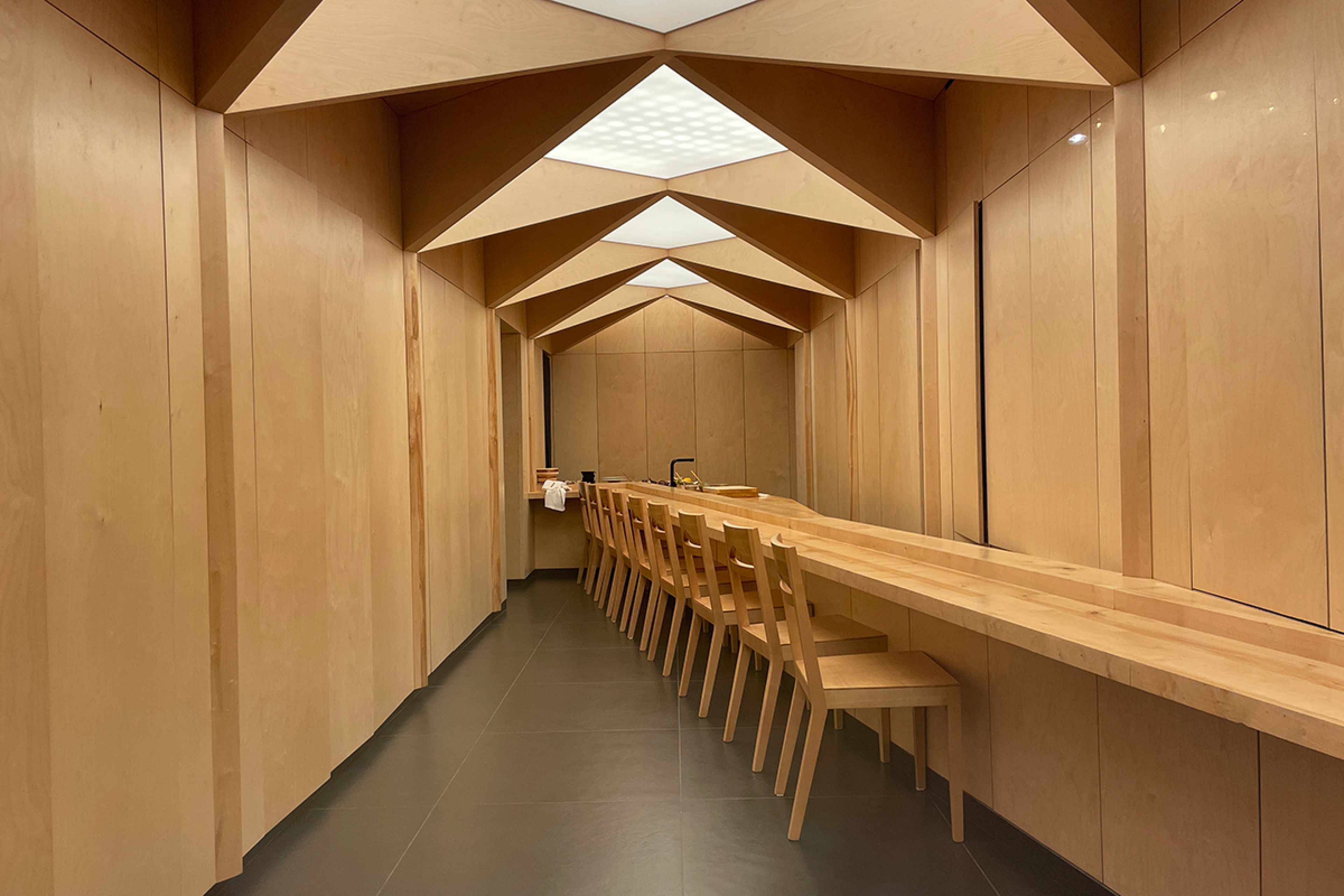
Japanese dining at the counter level is, at its core, a conversation between space, sequence, and attention. The interior at Sushi Shunei commits to that logic without hedging: light wooden furnishings, a long counter oriented toward the chef's work, and an origami-inspired ceiling designed by an interior design firm. That last element is worth noting not as decoration but as intent. The ceiling is a formal reference to Japanese craft tradition in a setting where craft is the entire subject. The minimalism of the room is not austerity for its own sake; it is a frame that keeps the eye and the attention directed at what is happening in front of the guest.
This approach to spatial design aligns with a broader principle in high-end Japanese dining: the room should not compete with the meal. Where French restaurants of equivalent price range, such as Paul Bocuse - L'Auberge du Pont de Collonges or Auberge de l'Ill, tend toward richly layered interiors that are themselves part of the statement, the Japanese counter tradition inverts this: the room recedes so that the sequence of preparation, presentation, and hospitality becomes the entire sensory register.
Two Formats, One Philosophy of Pacing
The omakase at Sushi Shunei is offered in two versions, and the choice between them is made at the point of booking, not on arrival. This is standard practice at serious omakase counters and serves a function beyond logistics: it commits the guest to a particular format of engagement before they sit down, which is itself a hospitality stance. You are not browsing a menu at the table. You have already agreed to surrender the sequence to the house.
Within the omakase framework, the pacing of a meal at a counter of this type follows an established structure. Nigiris arrive in sequence, each piece presented at the moment it is formed, with the rice at a specific temperature and the fish conditioned to match it. The selection of fish is described in the awards notes as drawing on a broad sourcing range, with the emphasis on precision rather than volume. Seasonings are applied with restraint rather than layered for effect, which requires the underlying ingredient quality to carry the piece without augmentation.
Omotenashi, the Japanese code of hospitality that is both unobtrusive and acutely attentive, governs the service register here. In practice, this means staff anticipate without interrupting, adjust without asking repeatedly, and maintain a pace that follows the guest rather than the turn schedule. For diners more accustomed to the rhythm of a French tasting menu, where courses arrive at intervals managed by a brigade, the omakase counter operates on a different logic: slower in some passages, continuous in others, with the chef's work visible throughout.
For context on how Japanese culinary traditions translate across formats and settings, Chakaiseki Akiyoshi and Abri Soba represent adjacent Japanese dining registers in Paris: kaiseki ceremony and soba craft respectively, each with their own ritual structure and guest expectations. Tokyo-based references like Myojaku and Azabu Kadowaki illustrate the originating context from which Paris's Japanese counter scene draws its standards.
Recognition and Positioning
Sushi Shunei holds a Michelin Plate recognition for 2024, which places it in the Michelin-tracked tier without carrying a star. In the Paris omakase category at the €€€€ price point, Plate recognition functions as a signal of consistent quality and format discipline rather than a ceiling.
The price tier of €€€€ positions Sushi Shunei in the same bracket as significant French dining rooms: Mirazur in Menton, Flocons de Sel in Megève, Bras in Laguiole, and Troisgros - Le Bois sans Feuilles. These are not direct competitors in cuisine terms, but they establish the frame within which a guest is making a spending decision. The case for Sushi Shunei at this level rests on the specificity of the format: an omakase counter with house history, Japanese-trained craft, and a room designed around the principle of undivided attention.
Know Before You Go
- Address: 3 Rue Audran, 75018 Paris, France (Montmartre, 18th arrondissement)
- Hours: Tuesday to Friday, 7 PM to 11 PM; Saturday, 1 PM to 3 PM and 7 PM to 11 PM; closed Sunday and Monday
- Price range: €€€€
- Format: Omakase counter; two menu versions available, selection required at booking
- Awards: Michelin Plate (2024)
- Booking note: Choose your omakase format when making the reservation, not on arrival
For further Paris dining, drinking, and hotel options, see our full Paris restaurants guide, our full Paris hotels guide, our full Paris bars guide, our full Paris wineries guide, and our full Paris experiences guide.
Frequently asked questions
at Sushi Shunei?
The menu is omakase: the sequence is set by the house, not selected by the guest. What distinguishes the counter, according to Michelin's Plate recognition and its awards notes, is the nigiri precision, the sourcing range of the fish selection, and the restraint in seasoning. The two formats differ in scope and are presented at booking; the choice between them determines the length and depth of the sequence rather than the underlying standard. Guests who want the fuller expression of the counter's fish range should confirm which format runs longer when booking.
Where the Accolades Land
| Venue | Cuisine | Price | Awards | Notes |
|---|---|---|---|---|
| Sushi ShuneiThis venue (the venue you are viewing) | Modern Japanese Omakase | $200–300 | 1 Michelin Star · Gault & Millau Remarkable Restaurant | Not listed |
| Alléno Paris au Pavillon Ledoyen | Modern French Fine Dining | $150–200 | 3 Michelin Stars · World's 50 Best #79 | Creative |
| Kei | Modern French with Japanese Influences | $300–500 | 3 Michelin Stars · World's 50 Best #93 | Contemporary French, Modern Cuisine |
| L'Ambroisie | Classic French Haute Cuisine | $300–500 | 2 Michelin Stars · World's 50 Best #23 | French, Classic Cuisine |
| Le Cinq - Four Seasons Hôtel George V | Modern French Fine Dining | $300–500 | 3 Michelin Stars · World's 50 Best #24 | French, Modern Cuisine |
| Plénitude | Modern French Sauce-Led Fine Dining | $300–500 | 3 Michelin Stars · World's 50 Best #14 | Contemporary French |
Recognition history
Dated appearances from independent guides and award organizations, with the underlying list record or original source where available.
Michelin 1 Star
Michelin
Gault & Millau Remarkable Restaurant
Gault & Millau
Full recognition history (4 entries)
Michelin 1 Star
Michelin
Michelin Plate
Michelin
Continue exploring
More in Paris
Restaurants in Paris
All restaurants in Paris →
Bars in Paris
All bars in Paris →
Hotels in Paris
All hotels in Paris →




Details
- Elegant
- Minimalist
- Intimate
- Sophisticated
- Special Occasion
- Date Night
- Chefs Counter
- Open Kitchen
- Design Destination
- Sake Program
- Sommelier Led
- Sustainable Seafood
- Omakase
- Counter Dining
- Sake
- Tea
- Pescatarian Friendly
Current opening hours
- Monday
- Closed
- Tuesday
- 7–11 PM
- Wednesday
- 7–11 PM
- Thursday
- 7–11 PM
- Friday
- 7–11 PM
- Saturday
- 1–3 PM, 7–11 PM
- Sunday
- Closed
Hours can change for holidays and private events. Hours as of .
Warm, elegant minimalist interior with light wooden furnishings, a long sushi counter, and an origami-inspired ceiling; intimate and focused atmosphere with close seating that amplifies the sensory experience of watching the chef work.