Stella Blu
Our verdict
On East Pearl Street in downtown Nashua, Stella Blu occupies a distinct position in a city whose dining scene has grown steadily more ambitious. The kitchen draws on ingredient-driven cooking at a time when New Hampshire's local sourcing networks have expanded considerably, placing Stella Blu in a tier that rewards attentive diners rather than casual passers-by.

Pearl is the En Primeur Club membership app — saves, bookings, and concierge access live there. Same editors, same standards.
- Address
- 70 E Pearl St, Nashua, NH 03060
- Phone
- (603) 578-5557
- Hours
- Mon ClosedTue–Thu 5–9 PMFri–Sat 4–11 PMSun 4–9 PM
- Website
- stellablu-nh.com
- Directions
- Get directions
- Booking
- Book on OpenTable
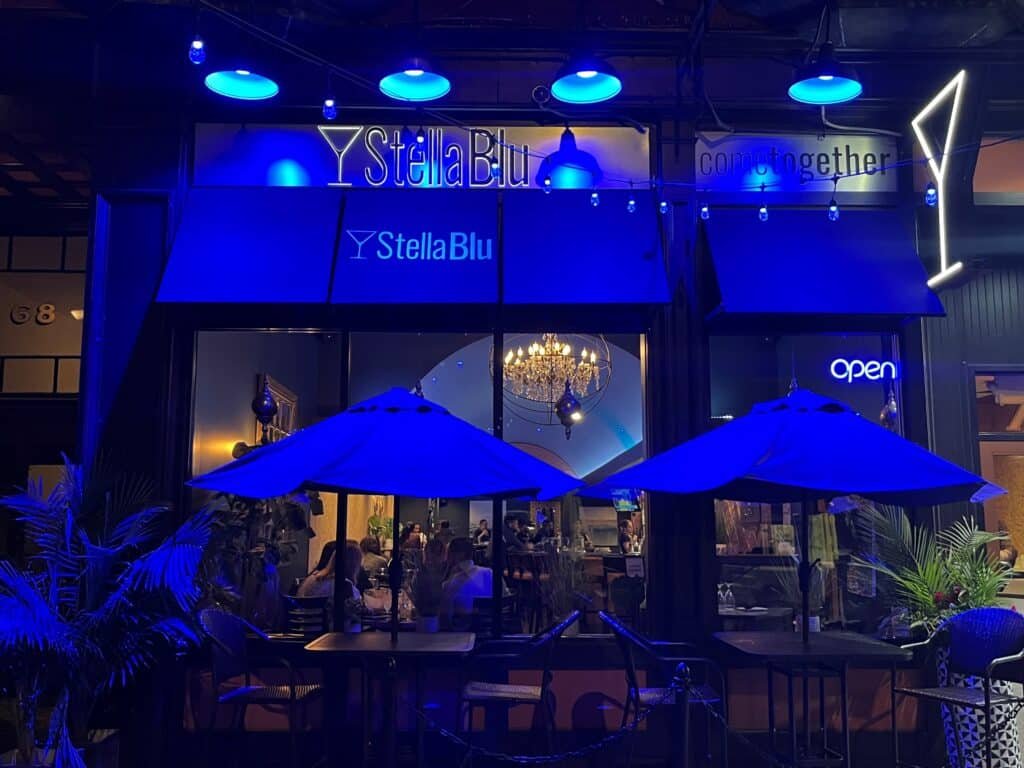
East Pearl Street and the Shift in Nashua Dining
Downtown Nashua has spent the better part of the last decade building a restaurant culture that no longer looks entirely to Manchester or Boston for reference points. East Pearl Street, where Stella Blu occupies its address at number 70, sits at the center of that shift. The street-level approach gives little away: the exterior reads as composed rather than showy, which tends to be the register of restaurants more confident in the plate than in the façade. Inside, the room settles into the kind of atmosphere that positions the cooking, not the décor, as the primary event. That orientation matters in a city where a number of operators are still working out whether ambition or accessibility should lead.
New Hampshire's dining scene has divided along a familiar national fault line: high-volume casual operators on one side, and a smaller cohort of kitchens pursuing ingredient discipline and sourcing specificity on the other. Stella Blu belongs to that second group, and its address in Nashua rather than Portsmouth or Manchester gives it a particular local relevance. For diners mapping the city's more serious options, Stella Blu appears consistently in the conversation alongside Collins Brothers Chowder and Surf Restaurant as places where the kitchen is working from a defined point of view. Our full Nashua restaurants guide maps this cohort in more detail.
Ingredient Sourcing as Editorial Position
The most durable differentiator in American restaurant cooking over the past fifteen years has not been technique or format but sourcing. Kitchens that built direct relationships with farms, fisheries, and regional producers during that period now operate with a supply-side advantage that is difficult to replicate quickly. The Northeast is a particularly instructive case: Vermont dairy, Maine seafood, and New Hampshire valley farms have produced a regional ingredient network dense enough to support serious cooking without relying on national distributors for the most consequential items on the plate.
This matters for how Stella Blu should be read. A kitchen working from that ingredient base is making a set of choices that shapes everything from menu cycle length to flavor profile. Seasonality becomes less of a marketing claim and more of a structural constraint, which tends to produce menus that change with genuine frequency and dishes that reflect what is actually available rather than what photographs well year-round. The leading American restaurants to frame this approach include farm-anchored operations like Blue Hill at Stone Barns in Tarrytown and Single Thread Farm in Healdsburg, both of which have made ingredient provenance the core of their identity at the leading price tier. Stella Blu operates at a different scale and price point, but the orientation toward sourcing places it in a recognizable tradition.
Nationally, ingredient-led kitchens have proliferated across price tiers. At the upper end, places like The French Laundry in Napa, Lazy Bear in San Francisco, and Alinea in Chicago treat sourcing as a prerequisite rather than a differentiator. Further down the price range, the same logic produces more accessible but no less serious kitchens. Regional examples like Bacchanalia in Atlanta and Brutø in Denver show that ingredient discipline translates across geography. In that broader context, Stella Blu represents Nashua's entry point into a national conversation about what American cooking owes to the land around it.
What the Menu Signals
What can be said with confidence is that kitchens with this sourcing orientation tend to produce menus organized around seasonal availability, with proteins and produce arriving from identifiable regional suppliers rather than anonymous national chains. That structural commitment usually shows up in a shorter menu with higher per-item cost of goods, which in turn concentrates the kitchen's effort on fewer preparations executed at greater depth.
Seafood from the Gulf of Maine, dairy from Vermont's hill farms, and produce from the Merrimack Valley are the raw materials that New Hampshire kitchens with serious sourcing programs tend to draw on. Whether Stella Blu's menu reflects all or some of that network is a question leading answered by visiting, but the broader tradition it participates in is well-established. For comparison, the seafood-first discipline at Le Bernardin in New York City or Providence in Los Angeles shows what sustained sourcing focus produces at the top of that specific category. Closer in spirit to the mid-tier regional model are kitchens like Causa in Washington, D.C. and Addison in San Diego, where regional identity shapes the plate without requiring a tasting-menu format or tasting-menu prices.
International reference points that share the sourcing-forward framework, such as 8½ Otto e Mezzo Bombana in Hong Kong or Atomix in New York City, show how ingredient provenance can anchor a kitchen's identity even when the cuisine type varies considerably. Technique and tradition matter, but they work leading when the raw material is worth the attention. That principle applies in Nashua as much as anywhere else.
Planning a Visit
Stella Blu is located at 70 East Pearl Street in downtown Nashua, a walkable stretch of the city center accessible from the main commercial district. Downtown Nashua's compact geography means that a dinner at Stella Blu can anchor an evening that also takes in the city's bar and casual dining options without requiring a car between stops. Restaurants in this part of New Hampshire operate at a different booking cadence than major urban markets: weekends fill faster than the city's size might suggest, and diners familiar with the sourcing program tend to return with enough regularity to compress available tables. Booking ahead rather than walking in is the more reliable approach, particularly during the summer and fall seasons when regional produce supply is at its fullest and menus are typically at their most varied. For a broader picture of where Stella Blu fits in the local dining geography, our Nashua dining guide maps the full range of options across price tiers and cuisine types, including how places like Emeril's in New Orleans or The Inn at Little Washington represent what sustained commitment to regional identity produces over decades. Stella Blu is an earlier chapter in that kind of story, which makes it worth attention now.
Frequently asked questions
Is Stella Blu child-friendly?
Stella Blu's East Pearl Street location in downtown Nashua puts it in a walkable, accessible part of the city center, which tends to suit family visits.
Is Stella Blu formal or casual?
Downtown Nashua's dining culture has shifted toward relaxed but considered settings over the past decade, and Stella Blu at 70 East Pearl Street fits that register.
How does Stella Blu fit into Nashua's broader dining scene?
Stella Blu occupies 70 East Pearl Street, a walkable stretch of downtown Nashua that has accumulated a cluster of independent restaurants over the past decade. That concentration gives the city's center a coherence it previously lacked, and Stella Blu is part of the generation of venues making the downtown corridor a credible dining destination within New Hampshire rather than merely a stopover en route to Boston.
What should I order at Stella Blu?
Kitchens operating in Nashua's evolving dining scene tend to reflect seasonal New England sourcing, so asking the floor staff what is freshest that week is the most reliable approach to ordering well.
How do I find Stella Blu?
Stella Blu is located at 70 E Pearl St, Nashua, NH 03060, Nashua.
What's the best way to book Stella Blu?
Checking third-party reservation platforms or walking the East Pearl Street block directly will establish current booking options.
What do critics highlight about Stella Blu?
Its position on East Pearl Street places it within a downtown Nashua corridor that has drawn increasing editorial attention as the city's restaurant culture has developed independent of Manchester and Boston.
In Context: Similar Options
Comparable venues nearby, for context on price, style, and recognition.
| Venue | Cuisine | Price | Awards | Notes |
|---|---|---|---|---|
| Stella BluThis venue — the venue you are viewing | Contemporary American Small Plates | $30–50 | Not listed | Not listed |
| Surf Restaurant | Modern Seafood and Sushi | $50–100 | Not listed | downtown |
| Collins Brothers Chowder | New England Soups & Chowders | $10–20 | Not listed | Temple Street |
| Copper Door | Modern American Gastropub | $30–50 | Not listed | Bedford |
| Bedford Village Inn Restaurant | Contemporary New England Farm-to-Table | $50–100 | Wine Spectator Best of Award of Excellence | Bedford |
| Dinnerhorn | Classic American Seafood | $20–30 | Not listed | Route 1 |
Continue exploring
More in Nashua
Restaurants in Nashua
Browse all →
Bars in Nashua
Browse all →

Hotels in Nashua
Browse all →


Wineries in Nashua
Browse all →

Details
- Elegant
- Sophisticated
- Lively
- Date Night
- Group Dining
- Special Occasion
- Open Kitchen
- Craft Cocktails
- Small Plates
- A La Carte
- Cocktails
Current opening hours
- Monday
- Closed
- Tuesday
- 5–9 PM
- Wednesday
- 5–9 PM
- Thursday
- 5–9 PM
- Friday
- 4–11 PM
- Saturday
- 4–11 PM
- Sunday
- 4–9 PM
Hours can change for holidays and private events. Last verified .
Upscale casual atmosphere with upbeat dining experience and friendly staff.