
Soup Curry Kamui puts Hokkaido-born soup curry into Tokyo’s Kanda-Akihabara orbit, where curry culture ranges from office-worker lunches to specialist counters with serious followings. Its 2024 Tabelog Curry TOKYO 100 selection and 3.74 score place it in a recognized city bracket, but the appeal is narrower and more useful: a focused soup-curry stop for travelers tracing Japanese curry beyond the standard roux plate.
Pearl is the En Primeur Club membership app — saves, bookings, and concierge access live there. Same editors, same standards.
- Address
- Japan, 〒101-0041 Tokyo, Chiyoda City, Kanda Sudacho, 2 Chome−3−24 神田須田町ビル 1F KT
- Phone
- +81 3-3258-5858
- Website
- soupcurry-kamui.jp
 Saves & bookings on Pearl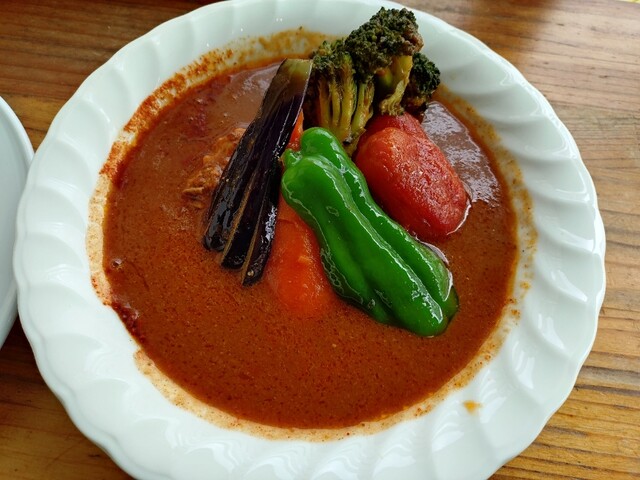
Around Kanda Sudacho, the city changes register fast: electronics streets, old office blocks, train-line underpasses, and lunch traffic that keeps Tokyo’s curry culture honest. This is everyday dining, where a narrow category becomes serious specialization and soup curry must justify itself against soba counters, ramen shops, kissaten, and salaryman curry rooms within a few blocks.
Soup Curry Kamui belongs to that specialist layer. Soup curry came to national attention through Sapporo, where it developed around a broth-like curry base, vegetables, and a looser relationship to rice than thick Japanese curry served over a plate. In Tokyo, the distinction matters. The city has plenty of curry built for speed and volume; soup curry asks the kitchen to show its thinking about stock, spice, and vegetables as separate parts rather than one roux-driven mass.
Soup curry in Tokyo is a question of broth, vegetables, and speed
Tokyo curry is not one tradition. It runs from yoshoku-style roux to South Asian thalis, spice-curry counters, old-school coffee-shop plates, and regional imports that survive because the city has enough diners for small formats. Soup curry sits slightly apart: lighter than the standard Japanese curry plate, more broth-forward than many spice-curry rooms, and more ingredient-legible when handled with discipline.
That visibility is the point. In thick curry, vegetables often vanish into sauce or act as garnish. In soup curry, they become architecture: the bowl depends on contrast between liquid, rice, spice, and pieces carried through the broth. Without naming a house recipe or inventing a shopping list, the category explains why sourcing and preparation matter. Poor vegetables read immediately; thin stock has nowhere to hide; spice heat without depth becomes novelty.
Kamui’s recognition in the Tabelog Curry TOKYO 100 for 2024 is a useful external marker in a crowded field. Its Tabelog score of 3.74 puts it where specialist appeal has become sustained diner approval, not passing curiosity. That matters in Tokyo curry, where inexpensive meals can draw attention, but only disciplined operators keep repeat traffic after novelty fades.
The comparison set clarifies the niche. Topca Kanda honten sits in a related Kanda curry orbit with a different price signal, while AROMAS of INDIA operates in the Indian-restaurant lane rather than soup curry. Nemurian, Takayama Coffee, and THE GRABBER hamburger pub show the same neighbourhood rewards small, format-specific businesses across categories. One does not replace another; Kanda and nearby Akihabara reward precision at modest scale.
Kanda's low-price specialist culture gives the bowl its context
Tokyo visitors often over-index on Ginza sushi, hotel dining rooms, and omakase booking drama. Kanda offers another education: serious casual food built on repetition, speed, and category mastery. A restaurant can become destination-worthy without luxury signals when the format is narrow and execution consistent. That is why a soup-curry address here can matter to travelers who have already eaten the obvious Tokyo meals.
The geography helps. Kanda, Iwamotocho, Awajicho, and Akihabara sit close enough for a food walk to shift from curry to coffee to grilled fish without a full transit plan. Readers building a broader Tokyo itinerary can pair the district with nearby casual dining such as . 鮪と炭火焼き うお炭 秋葉原店, then compare the city’s curry vocabulary through 3 Chome no Curry Ya San. For a wider map, Our full Tokyo restaurants guide is the better planning spine than treating one curry stop as the whole story.
Ingredient sourcing here is less about luxury provenance than suitability. Soup curry rewards produce that holds texture, aromatics that survive in broth, and rice that works as partner rather than base layer. That quality differs from wagyu marble-score logic or tuna auction prestige. It is practical, visible, and unforgiving; the dish quickly tells diners whether the kitchen understands the form.
There is also a cultural point. Japanese curry is often discussed abroad as comfort food, which is accurate but incomplete. Tokyo’s curry scene includes technical specialization, regional borrowing, and strong spice-preference subcultures. A Sapporo-derived soup curry shop in Chiyoda shows how regional Japanese formats are absorbed by the capital: not as museum pieces, but as working lunch-and-dinner restaurants competing on pace, consistency, and price discipline.
How to place Kamui inside a Tokyo food itinerary
The smart use of Soup Curry Kamui is not as a grand occasion. It is a corrective to a Tokyo schedule overloaded with high-ceremony meals. Slot it into a Kanda or Akihabara day and let the contrast work: a broth-based curry specialist before an evening of yakitori, sake, or hotel-bar drinking teaches more about the city than another luxury reservation stacked onto the same itinerary.
For category range inside Tokyo, set it against 12/10 Shinjuku ten, 124. KAGURAZAKA (Yakitori), and 2D Cafe; the point is not sameness, but how tightly Tokyo supports niche formats. Visitors extending the trip can use Our full Tokyo hotels guide for base selection, Our full Tokyo bars guide for post-dinner planning, Our full Tokyo wineries guide for wine-led detours, and Our full Tokyo experiences guide for non-restaurant scheduling.
Across Japan, the curry comparison sharpens. Sapporo remains the reference for soup curry as regional identity, making [Curry Senmon Ten] Maruyama Kyoju. in Sapporo a useful counterpoint for travelers following the form north. Elsewhere, different casual traditions pull focus: -Grilled beef Sukiyaki- KAMAKURA TANUKIAN 鎌倉 たぬき庵 in Kamakura.cafe in Osaka.know in Kumamoto, (Shoku) Vietnam in Kawasaki, and [ki:] in Kyoto each point to another version of regional specificity.
For overseas readers, the lesson travels beyond Japan. Los Angeles and Pasadena have Japanese casual-food ecosystems, visible in places like Jōdo Saké Bar in Los Angeles and Onigiri Time in Pasadena, but Tokyo’s density changes the stakes. In Kanda, a focused soup-curry room need not explain itself through spectacle. It only has to be precise enough to survive where lunch decisions are fast and repeat visits are earned bowl by bowl.
Snapshot
Comparable venues at the same tier for side-by-side context.
| Venue | Cuisine | Price | Notes |
|---|---|---|---|
| Soup Curry KamuiThis venue — the venue you are viewing | Sapporo-style Japanese soup curry | $ | Not listed |
| BROWNIE | Japanese Curry / Yoshoku | $ | Chiyoda |
| Nezu no Taiyaki | Traditional Taiyaki Shop | $ | Bunkyō |
| Ten mame | Japanese Traditional Sweets | $ | Chūō |
| YOU | Classic Japanese kissaten & omurice café | $ | Chūō |
| Kameju | Traditional Japanese wagashi & dorayaki shop | $ | Taitō |
Recognition history
Dated appearances from independent guides and award organizations, with the underlying list record or original source where available.
Tabelog 100 #38 · No. 38
Tabelog · Tabelog 100 - Curry - TOKYO - 2024









At a Glance
- Cozy
- Lively
- Trendy
- Solo
- Casual Hangout
- After Work
- Late Night
- Standalone
Current opening hours
- Monday
- 11 AM–2:30 PM, 5–8:30 PM
- Tuesday
- 11 AM–2:30 PM, 5–8:30 PM
- Wednesday
- 11 AM–2:30 PM, 5–8:30 PM
- Thursday
- 11 AM–2:30 PM, 5–8:30 PM
- Friday
- 11 AM–2:30 PM, 5–8:30 PM
- Saturday
- 11 AM–2:30 PM
- Sunday
- 11 AM–8:30 PM
Hours can change for holidays and private events. Last verified .
Casual and compact curry shop with traditional Japanese touches, anime-style artwork on the walls, and a playful, slightly maid-café feel on weekends; atmosphere is lively but relaxed, with a warm neighborhood ‘hidden spot’ vibe rather than a formal restaurant setting.