
Ten mame places Tokyo’s wagashi ritual in a Tsukiji register: modest scale, early-day rhythm, and a take-out-friendly format rather than hotel-lounge ceremony. Its Tabelog 100 selection for Tokyo Japanese traditional sweets and sweets cafes in 2023 signals a serious address for readers mapping the city beyond sushi counters and kaiseki rooms.
Pearl is the En Primeur Club membership app — saves, bookings, and concierge access live there. Same editors, same standards.
- Address
- 東京都中央区築地2-8-1 築地永谷タウンプラザ 107
- Phone
- +81362640782
- Website
- tabelog.com
 Saves & bookings on Pearl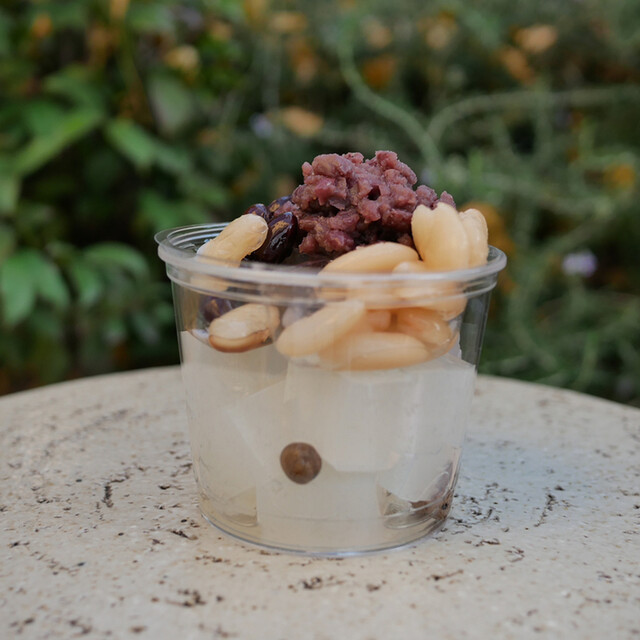
Tsukiji mornings have a particular tempo: shutters rising, delivery carts in narrow streets, office workers crossing the old market district with breakfast in hand. Here, Japanese sweets feel different from polished department-store tea-room versions: part of the city’s working rhythm, bought early, eaten simply, and judged by texture, restraint, and disciplined repetition.
Ten mame belongs to the Tokyo category where scale is modest and reputation comes from a narrow brief. Its field is Japanese traditional sweets, not a broad café proposition, and its 2023 inclusion in Tabelog’s Tokyo list for Japanese traditional sweets and sweets cafés places it in a crowded arena where consistency matters more than spectacle. For a Tokyo food itinerary, it is a counterweight to reservation-led dining: shorter, quieter, and closer to daily life.
Tsukiji gives wagashi a market-neighbourhood pace
Tokyo sweet shops split into tribes: formal wagashi houses tied to tea culture, department-store counters built for gifting, café formats where sweets become an afternoon seat, and neighbourhood specialists that serve as daily stops. Tsukiji sharpens the last model. Its food identity was shaped by wholesale market habits: early hours, compact transactions, and customers who value efficiency without tolerating carelessness.
That context explains why a small sweets counter in Chuo carries editorial weight. The old market district is no longer Tokyo food’s only gravitational centre, but its habits remain legible. A place like this does not need the theatre of a Ginza counter or the wine-service architecture of a modern tasting menu. Its credibility rests on whether the sweet-shop ritual survives compression: choose, receive, leave, and know quickly whether craft is present.
It also diverges from higher-spend Tokyo dining in the same broad geography. Teppanyaki Kurosawa works in another economic and ceremonial register, while 日本料理 つきぢ田村 belongs to formal Japanese dining rather than the everyday sweets circuit. Tokyo Chinese Ichirin and Primo Passo show the city’s specialist range, but wagashi asks a different question: how much precision can fit a small format without becoming a full meal?
In Tokyo, the answer often lies in repetition, not novelty. Japanese traditional sweets use seasonality as a cultural frame, but the customer experience is grounded in familiar forms and exacting execution. Diners are not asked to decode a chef’s biography or follow a narrative menu. The custom is direct: respect the shop’s pace, order with focus, and treat the sweet as a measured object rather than a dessert afterthought.
The ritual is short, but the standards are not casual
Ten mame’s recognition on the Tabelog 100 Tokyo sweets list in 2023 matters because the category is dense with long-established specialists and fiercely local preferences. Its 3.73 Tabelog score places it in a serious band for a casual-format sweets address, especially in a city where users tend to reserve high scores for repeat value. The award is not a Michelin-style hierarchy, but it is a meaningful local signal: Tokyo diners compare it with other wagashi and kanmidokoro specialists, not generic cafés.
The format reinforces that reading. Take-out is part of the service model, counter seating is listed, private rooms are not part of the proposition, and the setting is non-smoking. These details describe the ritual more accurately than décor would. This is not a long-lunch address, but a compact stop where value lies in precision, access, and suitability for solo diners, families, or small groups who understand Japanese sweets can be a destination without becoming an occasion.
There is a useful lesson for travellers who over-index Tokyo on omakase and tasting menus. The city’s food culture is not only scarce seats and chef-led performance. It is also narrow shops doing one category with discipline, often at a price tier that lets locals return. Ten mame sits in that second system, which visitors miss when every meal is built around dinner reservations.
That does not make it less serious. Sweets specialists face a different scrutiny. Wagashi is unforgiving because its pleasure is quiet: sweetness, temperature, proportion, and texture leave little cover for excess. In a kaiseki room, context can carry a course; in a sweet shop, the object must work quickly. The etiquette follows: do not linger theatrically, do not treat the counter like a photo studio, and do not expect a Western dessert-bar rhythm.
How to place it in a Tokyo food day
The smarter use of this address is as a punctuation mark in a wider Tokyo itinerary. Tsukiji can anchor a morning, then give way to restaurants, bars, hotels, and cultural stops across the city. Readers planning by neighbourhood rather than isolated bookings can pair the area with Our full Tokyo restaurants guide, then widen the trip architecture with Our full Tokyo hotels guide, Our full Tokyo bars guide, Our full Tokyo wineries guide, and Our full Tokyo experiences guide.
Within the restaurant map, the point is contrast. A sweets stop in Tsukiji teaches something different from the grill-and-seafood register of. 鮪と炭火焼き うお炭 秋葉原店, the Shinjuku framing of 12/10 Shinjuku ten, the yakitori focus at 124. KAGURAZAKA (Yakitori), the visual café culture around 2D Cafe, or the curry-house specificity of 3 Chome no Curry Ya San. Together, they show why Tokyo rewards category-by-category eating rather than one grand narrative.
For travellers extending the logic beyond the capital, the comparison becomes national rather than local: sukiyaki tradition at -Grilled beef Sukiyaki- KAMAKURA TANUKIAN 鎌倉 たぬき庵 in Kamakura, café culture at.cafe in Osaka, regional dining at.know in Kumamoto, Vietnamese cooking at (Shoku) Vietnam in Kawasaki, curry specialization at [Curry Senmon Ten] Maruyama Kyoju. in Sapporo, and Kyoto’s contemporary register at [ki:] in Kyoto. Even outside Japan, the same editorial thread appears in focused formats such as Jōdo Saké Bar in Los Angeles and Onigiri Time in Pasadena.
The takeaway is simple: the restaurant is strongest as a lesson in Tokyo’s small-format food culture. It gives the day a sweet, precise interval and suits diners who want evidence of craft without building every meal around rarity, ceremony, or expense.
Compact Comparison
Comparable venues at similar price and category levels.
| Venue | Cuisine | Price | Notes |
|---|---|---|---|
| Ten mameThis venue — the venue you are viewing | Chūō, Japanese Traditional Sweets | $ | Not listed |
| KAMAYOSHI | Chiyoda, Japanese Udon | $ | Not listed |
| Kameju | Not listed | $ | Taitō, Traditional Japanese wagashi & dorayaki shop |
| Gion Tsujiri Toukyou sukaitsurii taun soramachi ten | Sumida, Matcha sweets & Japanese cafe | $ | Not listed |
| Uoriki | Not listed | $ | Shibuya, Traditional Japanese fish set-meal diner (teishoku) |
| Sansanto | Not listed | $ | Kita, Tonkotsu-gyokai ramen & tsukemen shop |
Recognition history
Dated appearances from independent guides and award organizations, with the underlying list record or original source where available.
Tabelog 100 #98 · No. 98
Tabelog · Tabelog 100 - Japanese traditional sweets / Japanese sweets cafe - TOKYO - 2023











At a Glance
- Quiet
- Cozy
- Classic
- Solo
- Family
- Casual Hangout
- Standalone
Relaxed, simple, and counter-seating focused, with a calm traditional sweets-shop atmosphere that suits quick visits or a quiet solo stop.