
Sogetsu places Osaka’s everyday flour-and-griddle tradition inside a recognised Tabelog 100 okonomiyaki tier, with yakisoba and udon widening the frame beyond a single dish. The appeal is not luxury theatre; it is the way Tenjinbashi’s casual dining grammar, semi-private seating, and low-key drink options make okonomiyaki feel like a complete neighbourhood meal rather than a snack between stops.
Pearl is the En Primeur Club membership app — saves, bookings, and concierge access live there. Same editors, same standards.
- Address
- 大阪府大阪市北区天神橋3-9-9
- Phone
- +81663584509
- Website
- sougetsu3.com
 Saves & bookings on Pearl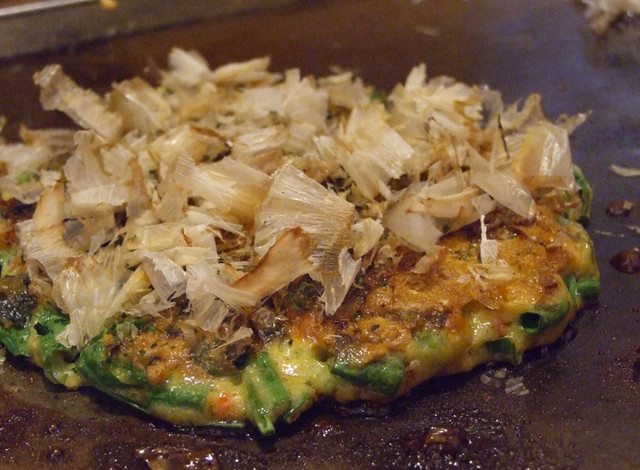
Tenjinbashi has a particular rhythm: covered shopping arcade light, quick-moving local traffic, and restaurants that read less like destinations than habits. In that setting, okonomiyaki belongs to the city’s daily operating system. The griddle is not a prop; it is the centre of a meal built around heat, batter, cabbage, sauce, and conversation. Sogetsu sits inside that Osaka grammar, where the room matters because okonomiyaki is social before it is ceremonial.
Osaka’s premium dining conversation often runs toward sushi counters, kappo rooms, and tasting-menu precision, but the city’s more revealing food culture is frequently cheaper, louder, and closer to the street. Okonomiyaki is one of the clearest examples. It carries the improvisational confidence of a port city and the practicality of a dish that can absorb pork, seafood, noodles, eggs, and whatever the house chooses to make central. Recognition from Tabelog’s Okonomiyaki 100 selection in 2025 places Sogetsu in a narrower field than the many casual griddle shops that define the category at ground level.
Okonomiyaki as Osaka's low-counter serious dining
The useful way to read this address is not as a temple of a single pancake, but as part of Osaka’s broader resistance to separating serious eating from casual formats. The city has long treated value, speed, and appetite as compatible with craft. A Tabelog score of 3.54 and repeated Okonomiyaki 100 selections from 2018, 2019, 2022, 2023, 2024, and 2025 signal consistency in a category where nostalgia alone does not hold attention for long.
The menu frame matters. Okonomiyaki, stir-fried noodles, and udon put the kitchen in the konamon tradition, Osaka’s flour-based comfort register, rather than in a chef-driven tasting format. That distinction is useful for travellers who plan meals by category. This is not the same decision as booking a higher-spend contemporary room such as Pres, nor is it the snack logic of Happy Camper Bagel. It belongs closer to the city’s everyday eating circuit, where a meal can be structured around one hot plate and still carry enough local meaning to justify a detour.
Compared with Ogimachi Udonya Asuro, another Osaka name in the neighbourhood’s noodle-and-flour orbit, Sogetsu leans toward the communal griddle side of the tradition rather than the bowl as the main event. THE MUNCHIES BURGER WORKS. and Sangourmand occupy similarly accessible spend bands in Osaka, but they tell a different story: imported forms adapted to local appetite. Okonomiyaki, by contrast, is one of the city’s own arguments for informality as a serious culinary position.
For readers mapping a wider Osaka eating day, the useful companions are not only comparable restaurants. A morning pastry stop at 52CHO-ME BAKERY, a snack run to 551 Horai (551蓬莱), or coffee at .cafe shows how the city layers quick-service pleasure with neighbourhood specificity. For a more Italian-led contrast, 99 Pizza Napoletana Gourmet and a canto (Italian) sit in a different register, useful when comparing how Osaka handles foreign technique beside its own griddle culture.
The drink question is modest, and that is the point
The assigned cellar lens needs adjustment here because this is not a wine-list restaurant. The more honest reading is beverage compatibility rather than cellar depth. Shochu and cocktails are listed, which places the meal in a flexible, casual drinking frame: stronger than a soft-drink stop, less formal than a sommelier-led progression. In Osaka’s okonomiyaki rooms, that can be the correct level of ambition. The food is built for heat and sauce; the drink programme supports pace and appetite rather than asking for attention of its own.
That restraint separates the experience from the growing class of Japanese restaurants where beverage pairing has become a second menu. Here, the more relevant curation is format discipline: a compact category set, family-friendly positioning, non-smoking service, and semi-private seating that suits small groups. Those details change how the meal behaves. Okonomiyaki can be quick, but this format nudges it toward a shared table rather than a stand-and-go bite.
There is also a practical cultural point. Osaka’s konamon tradition rewards appetite management. Visitors often arrive after takoyaki, kushikatsu, department-store sweets, or ramen; the better move is to treat okonomiyaki as the meal’s centre, not an add-on. That is especially true in Tenjinbashi, where the surrounding arcade can turn grazing into a default setting. The griddle demands focus because the dish is filling by design.
How to place it within an Osaka itinerary
Sogetsu works strongest for travellers who want Osaka without converting every meal into a reservation trophy. The city’s luxury hotels, cocktail bars, and cultural programming can frame the trip, but the food memory often comes from a table that locals would recognise as ordinary in the right way. For broader planning, Our full Osaka restaurants guide, Our full Osaka hotels guide, Our full Osaka bars guide, Our full Osaka wineries guide, and Our full Osaka experiences guide give the surrounding context.
The decision point is simple: choose this for a recognised okonomiyaki address in a neighbourhood where the cuisine makes cultural sense. Choose elsewhere if the night calls for a deep wine cellar, chef-counter pacing, or a long-form tasting menu. That is not a downgrade; it is category accuracy. Osaka dining becomes clearer when its casual formats are treated with the same attention usually reserved for expensive rooms.
Travellers extending the comparison across Japan can use other EP Club entries as category markers rather than substitutes: -Grilled beef Sukiyaki- KAMAKURA TANUKIAN 鎌倉 たぬき庵 in Kamakura for beef-centred regional dining. 鮪と炭火焼き うお炭 秋葉原店 in Tokyo for tuna and charcoal.know in Kumamoto for a different city scale, (Shoku) Vietnam in Kawasaki for imported comfort cooking, [Curry Senmon Ten] Maruyama Kyoju. in Sapporo for specialist curry, and [ki:] in Kyoto for Kyoto’s different dining tempo. Beyond Japan, Jōdo Saké Bar in Los Angeles and Onigiri Time in Pasadena show how Japanese drinking and rice-shop formats translate abroad. Against that wider field, Sogetsu’s value is precise: Osaka flour culture, recognised by a category-specific award list, served without the need to dress it up as fine dining.
Comparable venues nearby, for context on price, style, and recognition.
| Venue | Cuisine | Price | Notes |
|---|---|---|---|
| SogetsuThis venue — the venue you are viewing | Traditional Osaka Okonomiyaki | $$ | Not listed |
| Menya JouRoku (麺屋 丈六) | Takaida-Style Tamari Shoyu Ramen | $$ | Namba |
| sumibi yaki tori kamo jin Ohatsu tenjin ten | Japanese Yakitori & Duck Hot Pot | $$ | Kita |
| Satsuma | Traditional Yakiniku (Japanese BBQ) | $$ | Kita |
| Man masa | Yakiniku (Japanese BBQ) | $$ | Ikuno |
| Kodou | Soba, duck and fermented Japanese dishes | $$ | Toyonaka |
Recognition history
Dated appearances from independent guides and award organizations, with the underlying list record or original source where available.
Tabelog 100 #14 · No. 14
Tabelog · Tabelog 100 - Okonomiyaki - 2025
Tabelog 100 #85 · No. 85
Tabelog · Tabelog 100 - Udon - WEST - 2024
Continue exploring
More in Osaka
Restaurants in Osaka
Browse all →




Bars in Osaka
Browse all →




Hotels in Osaka
Browse all →




Wineries in Osaka
Browse all →
At a Glance
- Classic
- Cozy
- Lively
- Casual Hangout
- Family
- Group Dining
- Solo
- After Work
- Standalone
- Design Destination