
Ramen 1/20 belongs to Tokyo’s small-shop ramen culture, the end of the spectrum where counter seats, repeat customers, and disciplined daytime service matter more than spectacle. In Higashiogu, its appeal is built around a compact room, no-reservation rhythm, and a Tabelog Ramen TOKYO 100 selection history that places it inside the city’s serious ramen conversation.
Pearl is the En Primeur Club membership app — saves, bookings, and concierge access live there. Same editors, same standards.
- Address
- 東京都荒川区東尾久2-19-10 西脇ビル 1F
- Website
- tabelog.com
 Saves & bookings on Pearl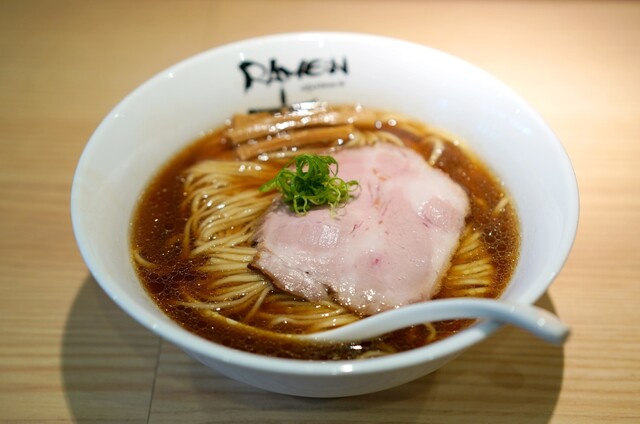
Approaching a Tokyo ramen shop of this scale is rarely theatrical. The revealing cues are practical: narrow frontage, counter seating, a room governed by timing, and customers who know the choreography before it is explained. Ramen 1/20 sits in that tradition. Its draw is not a long tasting arc or chef-led performance, but the concentration of a small room where regulars know how to order, eat, and leave space for the next bowl.
Tokyo ramen rewards repetition. Unlike fine dining, where one booking can define the experience, ramen shops are judged across return visits: consistency, queue discipline, broth clarity, noodle handling, and whether the shop’s rhythm survives daily service. With only a handful of counter seats, there is little room for drift. Repeat inclusion in Tabelog’s Ramen TOKYO 100 list from 2019 through 2025 therefore matters, signalling sustained local attention in a city where ramen is both common and fiercely parsed.
A counter built for regulars, not spectators
The room format shapes the meal. Small-counter ramen in Tokyo works through compression: limited seats, short service windows, and customers who usually arrive knowing what they want. Ramen 1/20 operates within that grammar. On weekdays, the shop runs with fewer seats than on Sundays, changing the feel of service as much as capacity. The experience belongs to the regulars’ side of Tokyo dining, where fluency is measured by how little explanation is needed.
That perspective explains why a ramen shop in Arakawa can matter beyond its neighbourhood. Tokyo visitors often cluster around central wards for sushi, yakitori, tempura, and hotel dining, then treat ramen as late-night convenience. The stronger reading is different: ramen is one of the city’s serious daily crafts, and shops outside the hotel orbit show how local allegiance forms. Higashiogu is not Ginza or Aoyama; the point is that the ramen map is tied less to luxury addresses than to repeatable execution.
The no-reservation format keeps the balance closer to the street. There is no concierge layer, table category, or elaborate prepayment system. The audience is mixed in the usual Tokyo ramen way: solo diners, friends, and families with older children all fit, though the small footprint suits people comfortable at a compact counter. That is not a flaw, but part of the genre’s discipline.
Tokyo ramen at the low-price, high-scrutiny end of dining
Ramen occupies a strange Tokyo position: low in price, high in technical scrutiny. A meal can sit in a modest spend band while attracting the online parsing elsewhere reserved for tasting menus. Ramen 1/20’s Tabelog score of 3.79 and its place in the 2025 Ramen TOKYO 100 selection put it in a competitive field where small differences count. The ranking order is not a formal hierarchy, but selection is a meaningful signal.
Tokyo’s everyday dining categories are not interchangeable. Udon has its own craft priorities, as at Teuchi Udon Akau, while curry, yakitori, and casual Chinese restaurants belong to different regular-driven forms. The city’s range is better understood through parallel routines than one luxury scale. Comparing ramen with a curry shop such as 3 Chome no Curry Ya San, a yakitori address such as 124. KAGURAZAKA (Yakitori), or a casual café like 2D Cafe is less about prestige than dining tempo.
Within ramen, the decisive question is whether a shop earns return visits. Small shops cannot rely on breadth; they live or die by the core bowl and service repeated across days. No private rooms, counter focus, and cash-only payment place the restaurant firmly in Tokyo’s practical ramen lane rather than a polished restaurant category. Some travellers may find that austere. For ramen people, it is the point.
How to place it in a Tokyo food day
The restaurant works well as a focused stop, not part of an overbuilt itinerary. Arakawa rewards slower reading, away from the hotel-dense west and luxury-retail centre. Nearby transit options connect several lines, but this is not a place to squeeze between high-pressure reservations. Treat the meal as the anchor of a northern or eastern Tokyo day, then leave room for walking that makes neighbourhood restaurants legible.
The practical constraints are part of the recommendation. Small capacity means timing matters; service is not built for lingering; no reservations shift responsibility back to the diner. Payment is local and simple rather than card-led. Evening service, when offered, is irregular and tied to social updates, so daytime is safer for planning. These details do not diminish the experience; they clarify it as direct, compact, and tied to regular customer behaviour.
For broader Tokyo planning, pair this ramen stop with categories showing other parts of the city’s food culture. Akihabara-area seafood and grill rooms such as . 鮪と炭火焼き うお炭 秋葉原店, Shinjuku addresses such as 12/10 Shinjuku ten, and the wider listings in Our full Tokyo restaurants guide frame how varied casual dining can be. For another trip structure, cross-reference Our full Tokyo hotels guide, Our full Tokyo bars guide, Our full Tokyo wineries guide, and Our full Tokyo experiences guide.
Ramen tourism can become checklist-driven, but comparison is stronger. See how a compact Tokyo ramen counter differs from sukiyaki in Kamakura at -Grilled beef Sukiyaki- KAMAKURA TANUKIAN 鎌倉 たぬき庵 in Kamakura, café culture at.cafe in Osaka, regional dining at.know in Kumamoto, Vietnamese cooking in Kanagawa at (Shoku) Vietnam in Kawasaki, curry in Hokkaido at [Curry Senmon Ten] Maruyama Kyoju. in Sapporo, Kyoto dining at [ki:] in Kyoto, or Japanese drinking-food formats abroad at Jōdo Saké Bar in Los Angeles and Onigiri Time in Pasadena. The comparison sharpens the point: Tokyo ramen is not a simplified version of Japanese dining. It is its own exacting category, and the restaurant is a serious small-room example.
A Credentials Check
Comparable venues at a similar level for quick context.
| Venue | Cuisine | Price | Notes |
|---|---|---|---|
| Ramen 1/20This venue — the venue you are viewing | Ramen shop | $$ | Not listed |
| tonkatsu.jp表参道 | Premium Tonkatsu Specialist | $$ | Omotesando |
| Ginza Kagari (銀座 篝) | Chicken Paitan Ramen | $$ | Ginza |
| Tonkatsu Yutaka | Traditional Asakusa Tonkatsu & Japanese Cuisine | $$ | Taitō |
| Sakanoue Cafe | Japanese kakigori cafe | $$ | Bunkyō |
| Amanoya | Traditional Japanese sweets café & okonomiyaki | $$ | Chiyoda |
Recognition history
Dated appearances from independent guides and award organizations, with the underlying list record or original source where available.
Tabelog 100 #29 · No. 29
Tabelog · Tabelog 100 - Ramen - TOKYO - 2025








At a Glance
- Cozy
- Intimate
- Solo
- Casual Hangout
- Family
- Standalone