Popi's Oysterette
Popi's Oysterette on Chestnut Street brings the raw bar tradition to the Marina District with the focused informality that San Francisco's best casual seafood counters do well. In a city where tasting-menu prestige dominates the conversation, this is a neighborhood spot built around the pleasure of cold shellfish and a well-poured glass. Consider it the counterpoint to the city's more elaborate seafood programs.
Pearl is the En Primeur Club membership app — saves, bookings, and concierge access live there. Same editors, same standards.
- Address
- 2095 Chestnut St, San Francisco, CA 94123
- Phone
- +14159935338
- Website
- popisoysterette.com
- Directions
- Get directions
 Saves & bookings on Pearl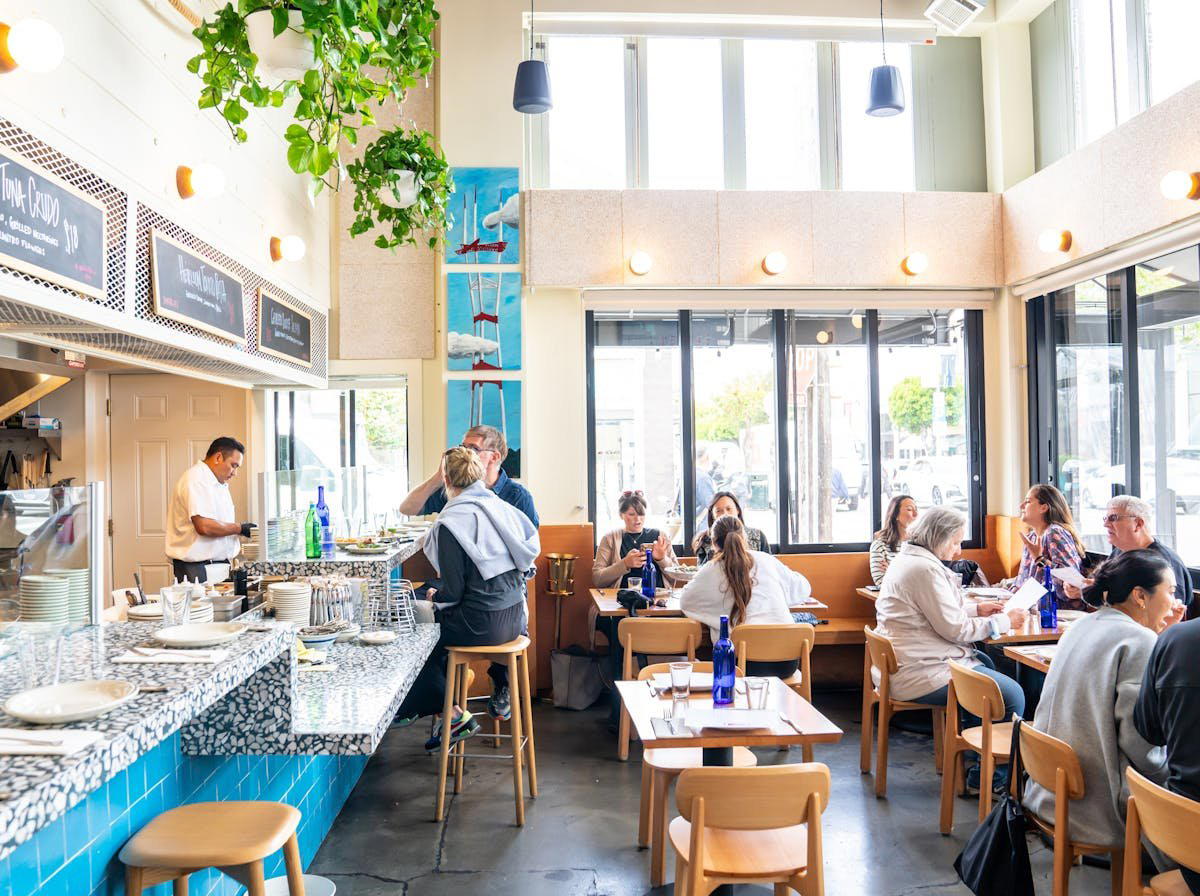
Salt Air and Chestnut Street: The Raw Bar at the Edge of the Marina
There is a particular sensory grammar to a well-run oyster bar. The cold zinc counter, the faint brine that hits you a half-second before you see the ice, the soft clatter of shucking knives, the low-register conversation of people who are not trying to impress anyone. Popi's Oysterette at 2095 Chestnut Street operates in that register. The Marina District is not where San Francisco sends its formal dining ambitions; it is where the city eats without ceremony, and a neighborhood oysterette fits that character naturally.
The raw bar, as a category, has a complicated position in American fine dining. At one end sits the theatrical seafood palaces, places like Le Bernardin in New York City, where fish is the vehicle for serious classical technique. At the other end is the corner oyster counter: no courses, no performance. The oysterette format lands closer to the second category, which is not a criticism. Particularly pleasurable eating in any coastal city happens at exactly this kind of place, where the product's quality does the work and the room stays out of its own way.
The Marina District and What It Asks of Its Restaurants
Chestnut Street runs through the heart of the Marina, a neighborhood defined by its proximity to the bay, its younger professional population, and a dining culture that prizes accessibility over occasion-dining formality. The stretch between Divisadero and Fillmore contains a concentration of neighborhood restaurants that would be the anchors of almost any other American city's dining scene. In San Francisco, they compete with a tasting-menu circuit that includes Atelier Crenn, Lazy Bear, Benu, Quince, and Saison, all operating at the $$$$ tier with Michelin recognition behind them.
That competitive context matters because it clarifies what a neighborhood oysterette is actually doing. It is not competing with those rooms. It is answering a different question: where do you eat on a Tuesday without a dress consideration, without committing to three hours? In coastal California, that answer has historically involved shellfish, and the oysterette format has a long, practical lineage in that tradition.
The Sensory Case for Shellfish in a Simple Room
The appeal of raw shellfish is fundamentally about restraint and provenance. A well-sourced Pacific oyster from Tomales Bay or Hog Island arrives at the counter carrying its own argument: cold, saline, mineral, finished with whatever the water gave it that season. No kitchen technique improves on that. The leading oyster bars understand this and keep their intervention minimal: a clean shuck, proper temperature, a few condiment options that don't compete with the shell liquor.
That philosophy of restraint is not distinctive to casual formats. Single Thread Farm in Healdsburg and The French Laundry in Napa both make provenance central to their programs, even if the execution context is entirely different. The oysterette condenses that provenance argument into its most direct form: the product, the ice, the lemon wedge.
Northern California's position in the American shellfish story is strong. The cold upwelling waters of the Pacific, the protected estuaries north of the Golden Gate, and the decades-long aquaculture tradition of producers like Hog Island Oyster Co. mean that San Francisco sits within reach of some of the country's most expressive oyster growing regions. An oysterette on Chestnut Street, operating with access to that supply chain, is working with material that coastal restaurants in landlocked metropolitan areas can only approximate.
Where Popi's Sits in the Broader San Francisco Seafood Conversation
San Francisco's seafood reputation predates its current tasting-menu prestige by decades. The Dungeness crab tradition at Fisherman's Wharf, the cioppino that the Italian fishing community developed in North Beach, the clam chowder bowls that still anchor the tourist waterfront, these formats share a lineage that prioritizes abundance and directness over refinement. The oysterette is a more edited version of that same coastal-city instinct.
The comparison extends beyond the Bay Area. Providence in Los Angeles represents what happens when seafood becomes the subject of serious fine-dining technique. Addison in San Diego applies similar rigor in a different California context. Emeril's in New Orleans works within a Gulf seafood tradition that values richness and spice. The oysterette occupies none of those registers, it is deliberately narrow in scope, which is what makes it legible and repeatable as a neighborhood destination.
Across the country, the casual seafood counter has held its ground even as fine dining formats have multiplied. Blue Hill at Stone Barns in Tarrytown pursues farm-to-table at the opposite end of the formality spectrum. Alinea in Chicago, Atomix in New York City, Bacchanalia in Atlanta, and The Inn at Little Washington each represent the high-investment, high-ceremony end of American restaurant culture. The oysterette's value is precisely that it asks nothing of that kind from its guests.
For international visitors accustomed to similarly focused formats, the comparison point is the European brasserie de la mer or the Hong Kong seafood counter, where the room's modesty is understood to be the point. 8½ Otto e Mezzo Bombana in Hong Kong works at the opposite register of that city's seafood culture; Popi's occupies a position closer to what you find in a covered market in Brittany or a corrugated-roof fish shack in the Outer Sunset.
Planning Your Visit
Popi's Oysterette is located at 2095 Chestnut Street, San Francisco, CA 94123, in the Marina District. Getting there: The 22 and 30 Muni lines serve the Chestnut Street corridor; street parking is available but competitive on evenings and weekends. When to go: Oyster bars in this format tend to be busiest on Friday and Saturday evenings; a weekday late afternoon visit typically means shorter waits and the freshest incoming product. Booking: Reservations are recommended. The restaurant is a casual seafood and raw bar at about $35 per person.
Fast Comparison
Comparable venues nearby, for context on price, style, and recognition.
| Venue | Cuisine | Price | Notes |
|---|---|---|---|
| Popi's OysteretteThis venue — the venue you are viewing | Coastal Seafood & Raw Bar | $$ | Not listed |
| Sotto Mare | Italian Seafood | $$ | North Beach |
| Billingsgate | Seafood Market & Cafe | $$ | Noe Valley |
| The Old Clam House | Classic San Francisco Seafood | $$ | Bernal Heights |
| Capurro's | Italian Seafood | $$ | Russian Hill |
| Fog Harbor Fish House | Sustainable San Francisco Seafood | $$$ | North Beach |
Continue exploring
More in San Francisco
Restaurants in San Francisco
Browse all →
Bars in San Francisco
Browse all →
Hotels in San Francisco
Browse all →


At a Glance
- Cozy
- Lively
- Casual
- Casual Hangout
- Date Night
- Open Kitchen
- Craft Cocktails
- Local Sourcing
- Sustainable Seafood
- Street Scene
Current opening hours
- Monday
- 12–8:30 PM
- Tuesday
- 12–8:30 PM
- Wednesday
- 12–8:30 PM
- Thursday
- 12–8:30 PM
- Friday
- 12–9 PM
- Saturday
- 12–9 PM
- Sunday
- 12–8:30 PM
Hours can change for holidays and private events. Last verified .
Relaxed and welcoming neighborhood atmosphere with warm staff service, open kitchen views, and ocean breezes on sidewalk seating.