Pizza fritta, the fried pizza that predates Neapolitan wood-fired tradition in the city's working-class memory, is the format at Fernanda's address on Via Speranzella, deep in the Quartieri Spagnoli. The stall sits within a neighbourhood that has shaped street food culture across southern Italy, and the product itself draws a consistent local crowd that rarely needs a reason to explain itself to tourists.
Pearl is the En Primeur Club membership app — saves, bookings, and concierge access live there. Same editors, same standards.
- Address
- Via Speranzella, 180, 80134 Napoli NA, Italy
- Directions
- Get directions
 Saves & bookings on Pearl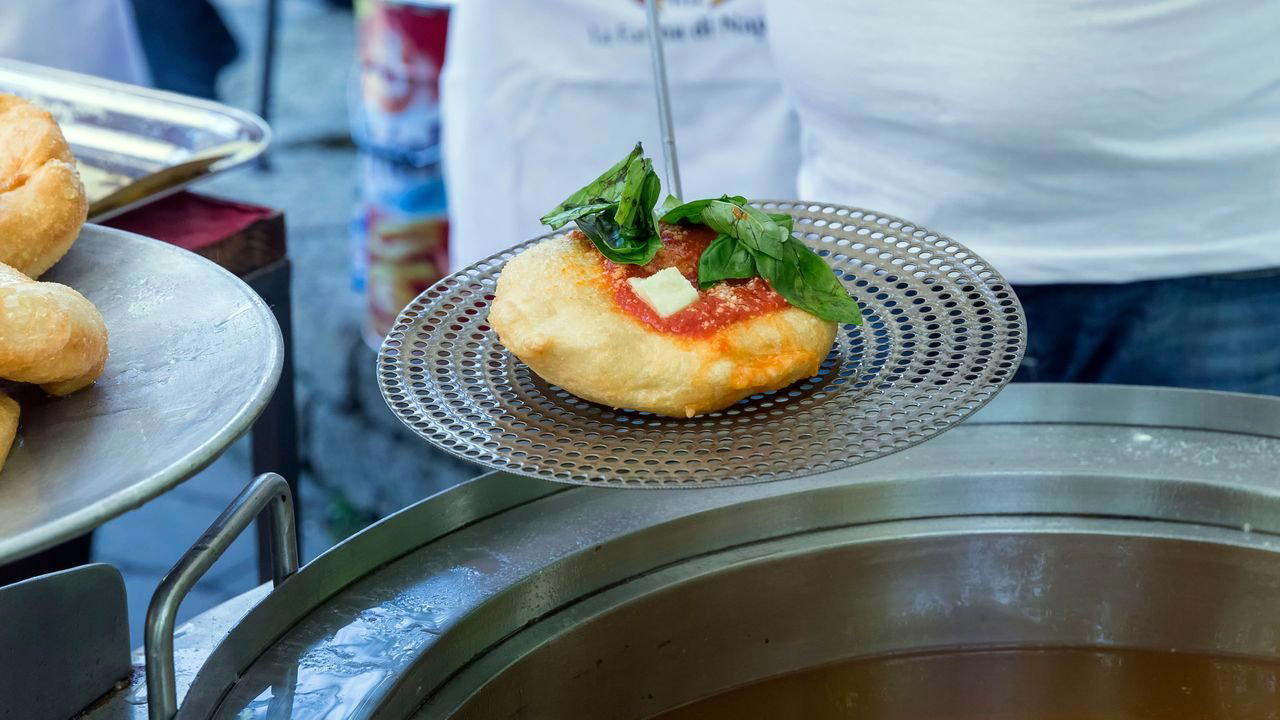
Fried Before It Was Fashionable
In Naples, the debate about which pizza format holds deeper roots is settled more by economics than by gastronomy. Pizza fritta, the folded, deep-fried dough pocket filled with ricotta, cicoli, and black pepper, was the version that fed the city's working population after World War II, when wood-fired ovens and their fuel costs were a luxury most streets couldn't sustain. The round, blistered Neapolitan pizza that now fills international restaurant guides came later to many quartieri. Pizza fritta was already there. Pizza Fritta da Fernanda, on Via Speranzella in the Quartieri Spagnoli, operates within that tradition and within a neighbourhood that has never drifted far from it.
The Quartieri Spagnoli as Context
The Quartieri Spagnoli is a grid of narrow streets built in the sixteenth century to house Spanish garrison troops, and it has spent several centuries functioning as one of the city's most densely populated and commercially active residential districts. It is not a tourist zone that has been repurposed, it is a neighbourhood that tourism has partially reached, without the area renegotiating its identity to accommodate that fact. The street food culture here operates on its own terms: small formats, cash transactions, no menus to study, consumption on the street or the nearest available surface. Via Speranzella runs through this grid and carries the same register. Fernanda's address at number 180 places it squarely within walking reach of the Spanish Quarter's daily foot traffic, not on its touristic periphery.
For reference on how Naples distributes its dining, the city's more formal restaurant tier, places like George Restaurant in the Contemporary bracket or Veritas in the Campanian fine-dining space, operates in a separate register entirely from street-level friggitorie. The gap between those formats is not just price; it is function, occasion, and the role food plays in the rhythm of the day. Pizza fritta belongs to the category that Neapolitans eat standing up, in transit, or on a lunch break, and that category has its own quality hierarchy independent of Michelin acknowledgement.
What Pizza Fritta Actually Is
The format warrants description for readers encountering it outside its Neapolitan context. Pizza fritta is leavened dough, portioned and folded around a filling, then lowered into hot lard or oil until the exterior blisters and turns golden. The interior steams rather than bakes, creating a dough texture that is chewy, yielding, and distinct from anything produced in a wood-fired oven. The classical filling combines ricotta, cicoli (rendered pork fat and scraps), and black pepper, though variations exist. The result is rich, savoury, and designed for the conditions under which it was invented: maximum caloric value at minimum cost, portable, produced at speed.
What has changed since the postwar period is the context, not the product. Pizza fritta is now consumed by choice rather than necessity, which means quality has become a meaningful variable. The spread between a carelessly made version and a well-executed one is legible to anyone paying attention: dough that has proofed correctly, oil at the right temperature, filling ratios that hold together rather than leaking, a crust that stays crisp for the two minutes it takes to eat it. These are the measures by which street-level friggitorie are assessed in Naples, where the population has been eating the product for generations and has low tolerance for shortcuts.
For the wider Italian dining context, including the starred end of the spectrum, EP Club covers venues such as Osteria Francescana in Modena, Le Calandre in Rubano, and Piazza Duomo in Alba. The comparison is useful not to suggest equivalence but to illustrate that Italian food culture sustains both registers simultaneously, and that the street-level format is not the lesser version of the formal one. It is a different tradition answering different demands.
comparable set on the Ground
Within Naples specifically, the pizza fritta format has several well-known addresses. 1947 Pizza Fritta operates in the same category and draws its own consistent following. The wood-fired pizza tier is dominated by names with national profiles: 12 Morsi and the broader pizzeria circuit that includes Gino Sorbillo and L'Antica Pizzeria da Michele, both of which have expanded well beyond Naples while retaining their base. Pizza fritta addresses tend to remain more local in profile, serving a neighbourhood population rather than managing international demand. That is partly a function of format, fried pizza does not translate as cleanly to the export market, and partly a function of the venues themselves, which are typically small, owner-operated, and not structured for high-volume tourist throughput.
Fernanda's position in the Quartieri Spagnoli aligns it with this local-facing model. The address on Via Speranzella is not the kind of location that appears on tourist itineraries by default, which means the queue, when there is one, is predominantly made up of people from the area.
Planning a Visit
Visitors to Naples approaching Via Speranzella will find it most accessible on foot from the Toledo metro station or via the lower end of Via Toledo, the city's main commercial artery. The Quartieri Spagnoli's grid streets are narrow and largely closed to through traffic, so arriving by car is impractical. Given the street-level, cash-forward format typical of friggitorie in this district, carrying small denomination euros is advisable. The full Naples restaurants guide covers the broader range of options across price tiers and formats. Readers with appetite for more formal Campanian dining can also consider 177 Toledo, which sits nearby in the Italian Contemporary tier. For destination context beyond Naples, EP Club's Italy coverage extends to Quattro Passi in Marina del Cantone, Uliassi in Senigallia, Reale in Castel di Sangro, Dal Pescatore in Runate, Atelier Moessmer Norbert Niederkofler in Brunico, Enoteca Pinchiorri in Florence, and Enrico Bartolini in Milan. For readers also tracking the international high-end dining circuit, EP Club covers Le Bernardin in New York City and Lazy Bear in San Francisco.
Budget and Context
Comparable venues nearby, for context on price, style, and recognition.
| Venue | Cuisine | Price | Notes |
|---|---|---|---|
| Pizza Fritta da FernandaThis venue — the venue you are viewing | Not listed | $ | Not listed |
| Cibi Cotti | Not listed | $ | Piedigrotta, Authentic Neapolitan Trattoria |
| Pastfood | Mater Dei, Neapolitan Street Food | $ | Not listed |
| Fresco Trattoria Pizzeria | Acquario, Neapolitan Pizza Trattoria | $$ | Not listed |
| Vasinikò | Antignano, Neapolitan Pizza | $$ | Not listed |
| Pizzeria Triunfo 2.0 | Antignano, Neapolitan Pizza | $ | Not listed |
Continue exploring
More in Naples
Restaurants in Naples
Browse all →
Bars in Naples
Browse all →
Hotels in Naples
Browse all →


At a Glance
- Rustic
- Cozy
- Casual Hangout
- Historic Building
Current opening hours
- Monday
- 11 AM–6 PM
- Tuesday
- 11 AM–7 PM
- Wednesday
- 10:30 AM–4 PM
- Thursday
- 11 AM–5 PM
- Friday
- 11:30 AM–9 PM
- Saturday
- 11 AM–10 PM
- Sunday
- 11 AM–2:30 PM
Hours can change for holidays and private events. Last verified .
Casual and authentic homey atmosphere in a charming elderly woman's traditional Spanish Quarters residence.