
Tabelog 100 #40
Our verdict
Oimatsu Miyamoto is an eight-seat Nishitenma yakitori counter with repeated Tabelog 100 Yakitori recognition for western Japan, including the 2025 selection. The draw is the compact, reservation-only counter format: chicken, charcoal, sake and shochu placed in the same disciplined register as Osaka’s serious sushi and kappo rooms, rather than casual skewer-bar territory.

Pearl is the En Primeur Club membership app, where members save venues, book tables and use the concierge.
The menu
What to order
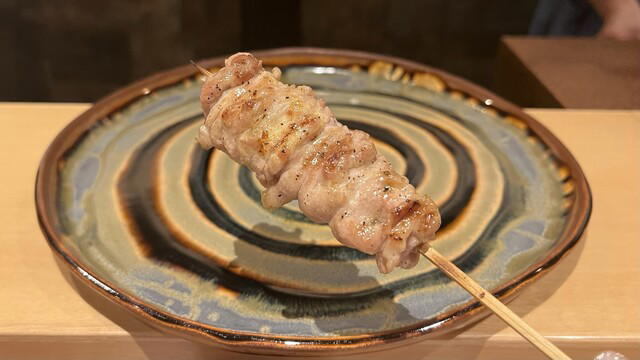
- Yakitori omakase of Aizu chicken
- Skewers grilled over Kishu Binchotan charcoal
- Yakitori with 60-year aged tare sauce
Osaka changes tone after dark. Busy commercial blocks lose some of their daytime formality, and the important dining decisions can become quieter and more exacting. Here, yakitori is not only Osaka’s noisy after-work default. At the serious end, it can read as a focused meal: sequence, rhythm, rules and close attention setting the evening’s temperature.
Oimatsu Miyamoto belongs to that narrower Osaka category of yakitori worth planning around. The appeal is not spectacle so much as attention to the form. High-end yakitori tests control: heat management, pacing and part-by-part treatment of grilled chicken skewers. Inclusion in Tabelog’s 2025 Yakitori 100 conversation puts it in the local critical frame. Its 4.02 Tabelog score signals hard-won consensus in Japan’s user-review culture, especially for restaurants dependent on diners who care about the details.
Yakitori in Osaka's serious-counter register
Osaka’s visitor reputation often begins with speed: takoyaki, okonomiyaki, kushikatsu, station snacks, late trains and quick decisions. That version is real, but it obscures the city’s more focused dining culture. Serious Osaka dining often prefers compression over theatre: a defined format, fixed rhythm and narrow craft can feel more native than a grand room.
Yakitori fits that temperament when treated as sequence rather than bar snack. Its grammar looks simple only from a distance: chicken is broken into parts, each cooked for fat, fibre and collagen, with the grill as central instrument. At this level, the comparison is less casual skewer houses than Japanese dining rooms where timing and proximity create value. Oimatsu Miyamoto’s recognition reinforces that reading; the case for booking rests on focused yakitori rather than breadth.
That also explains why awards matter. A Tabelog 100 selection is not decorative in Japan; it sorts a crowded category. For yakitori, where many rooms are local and lightly publicised, recognition can signal more clearly than broad international fame. Oimatsu Miyamoto’s 2025 Tabelog Yakitori recognition places it among restaurants assessed within the category rather than as a tourist-facing name.
For Osaka itineraries, the distinction matters. A casual night might centre on other Osaka dining rooms, bakeries or modern casual detours. The serious yakitori tier asks for a different evening. It can sit in the same planning conversation as compact Japanese rooms such as Oryori Amenimomakezu, Shoroku and Sushiroku, while staying firmly inside yakitori rather than borrowing prestige from sushi or kaiseki.
Osaka rewards small rooms and punctual diners
Osaka suits this dinner because it can move easily between businesslike daytime energy and quieter, more appointed meals after dark. The city rewards diners who know where they are going. This is not a meal to treat as casual grazing doorway to doorway, but as a planned dinner built around a specific craft.
Oimatsu Miyamoto is best approached with that discipline in mind. The better approach is to book carefully, arrive prepared and treat the meal as a focused yakitori reservation rather than a flexible drop-in stop. Strong scent is never minor etiquette around grilled food; it can interfere with the shared experience. The general rule is simple: let the room, the grill and the skewers lead.
That makes it a weaker fit for a loose, last-minute Osaka evening and stronger for diners treating yakitori with the seriousness often given to more formal Japanese meals. The listed dinner band is JPY 15,000 to JPY 19,999, far above everyday skewer drinking but below many luxury sushi counters. Locally, Sumibi Yakitori Ikoka Nishitenma offers another Osaka point of comparison, while Oimatsu Miyamoto sits in the awards-recognised tier where focus is part of the value.
Category discipline is part of the argument. The strongest version of this meal does not need to turn yakitori into a broad international tasting format. In Osaka, the strongest meals often feel grounded in category rather than dressed for export. The better move is to understand how repetition, heat and sequence create depth in a narrow field.
How to place it within an Osaka itinerary
Oimatsu Miyamoto works well as the anchor of a focused dinner night, not one stop in a heavy crawl. Pair it with broader planning rather than another counter meal. For the wider restaurant map, Our full Osaka restaurants guide gives the useful sweep: casual institutions, bakeries, Italian rooms, sushi, Japanese counters and late-night options. If the evening is part of a longer stay, Our full Osaka hotels guide, Our full Osaka bars guide, Our full Osaka wineries guide and Our full Osaka experiences guide help separate food-led nights from hotel, bar and cultural planning.
The restaurant also clarifies Japanese dining for travellers. The country’s strongest meals are not always the grandest, but often defined by category discipline. A yakitori restaurant, curry specialist, sake bar, bakery or onigiri shop can each compel when the format is tightly held. That lens applies beyond Osaka in a general way: across Japan, specialization matters, and the most memorable meals are often those that hold one format with unusual care.
For a lighter Osaka day around it, contrast helps. Other cafes, bakeries and casual rooms sit in different registers, which is the point. Osaka is not one food mood. It can be casual, fast and generous, then exacting after dark. Travellers from North America may recognise that category discipline in Japanese-format rooms abroad, but the Osaka version is sharper because expectations are local and unforgiving.
The editorial case is clear: choose this room for awards-backed yakitori in Osaka, not breadth, flexibility or tourist convenience. The value is seeing Osaka’s grilled-chicken-skewer tradition treated with focus usually reserved for higher-prestige genres. In a city often reduced to appetite and noise, that restraint is the more interesting story.
Frequently asked questions
Is Oimatsu Miyamoto more mid-range or high-end?
Pricing at Oimatsu Miyamoto is listed as JPY 15,000 - JPY 19,999.
What time does Oimatsu Miyamoto open and close?
Current opening hours for Oimatsu Miyamoto should be confirmed directly with the restaurant before visiting.
How do I find Oimatsu Miyamoto?
Oimatsu Miyamoto is located in Osaka.
What is Oimatsu Miyamoto known for?
Oimatsu Miyamoto is known for yakitori in Osaka and for its 2025 Tabelog Yakitori 100 recognition.
Price Lens
Nearby venues at a similar price tier for orientation.
| Venue | Cuisine | Price | Awards | Notes |
|---|---|---|---|---|
| Oimatsu MiyamotoThis venue (the venue you are viewing) | High-end Yakitori Counter | $100–150 | Tabelog 100 #40 | Not listed |
| Kamon | Luxury Teppanyaki at Imperial Hotel Osaka | $100–150 | Tabelog 100 #17 | Kita, Luxury Teppanyaki at Imperial Hotel Osaka |
| Sushi Uchida | Seasonal Osaka Sushi Omakase | $150–200 | Tabelog 100 #11 | Kita, Seasonal Osaka Sushi Omakase |
| Kita Mura | Traditional Kansai-style Sukiyaki | $50–100 | Tabelog 100 #76 | Chūō, Traditional Kansai-style Sukiyaki |
| Ishii Jr. | Yakitori & Chicken Dishes Omakase | $50–100 | Tabelog 100 #98 | Kita, Yakitori & Chicken Dishes Omakase |
| Ichioka 45 | Farm-to-table chicken and sake counter | $50–100 | Tabelog 100 #25 | Kita, Farm-to-table chicken and sake counter |
Recognition history
Dated appearances from independent guides and award organizations, with the underlying list record or original source where available.
Tabelog 100 #40 · No. 40
Tabelog · Tabelog 100 - Yakitori - WEST - 2025
Continue exploring
More in Osaka
Restaurants in Osaka
All restaurants in Osaka →




Bars in Osaka
All bars in Osaka →



Hotels in Osaka
All hotels in Osaka →



Wineries in Osaka
Browse all →
Details
- Intimate
- Elegant
- Cozy
- Sophisticated
- Date Night
- Special Occasion
- Solo
- After Work
- Chefs Counter
- Standalone
- Design Destination
- Sake Program
- Beer Program
- Local Sourcing
- Omakase
- Tasting Menu
- Counter Dining
- Sake
- Beer
Current opening hours
- Monday
- 6–8:30 PM
- Tuesday
- 6–8:30 PM
- Wednesday
- 6–8:30 PM
- Thursday
- 6–8:30 PM
- Friday
- 6–8:30 PM
- Saturday
- 6–8:30 PM
- Sunday
- Closed
Hours can change for holidays and private events. Hours as of .
A serene, adult-oriented counter space inspired by a Japanese tea room, with a minimalist, stylish interior and a calm, unhurried atmosphere suited to quiet, contemplative dining.