Michelin Bib Gourmand
Our verdict
Night Market in Shibuya brings the energy of Southeast Asian street stalls to a Tokyo dining room, with an à la carte menu spanning Vietnam, Thailand, Indonesia, and Malaysia. Dishes are mapped by national flag, sourced through Japanese ingredients, and served in an atmosphere that mirrors the organised chaos of a real hawker market. For Tokyo's mid-range dining scene, it is a rare full-commitment concept.

Pearl is the En Primeur Club membership app, where members save venues, book tables and use the concierge.
Southeast Asian Street Food, Reframed Through Japanese Ingredients
Tokyo's mid-price dining tier is crowded with loose interpretations: pan-Asian menus that borrow aesthetics without conviction, or single-country concepts that soften spice for local palates. Night Market, located on the ground floor of COERU SHIBUYA EAST in Shibuya, takes a different position. The concept is explicitly structured around the night market tradition of Southeast Asia, and the menu holds to that architecture with enough discipline to make the premise feel earned rather than decorative.
The à la carte format is the first signal of intent. Where Tokyo's more formal dining rooms at this price point often default to set menus that smooth out regional edges, Night Market asks guests to choose across national lines. Each dish is flagged with the country of origin, Vietnam, Thailand, Indonesia, Malaysia, so the menu functions as a kind of edited itinerary through the hawker tradition. The sourcing, however, runs through Japanese ingredients, which is where the concept generates its most interesting tension: familiar regional flavour profiles rendered through produce shaped by a different food culture.
That intersection, Southeast Asian technique meeting Japanese ingredient quality, is not accidental, and it places Night Market in a small but growing category of Tokyo restaurants that treat the city's ingredient infrastructure as a creative resource rather than an obstacle. Tokyo's access to precision-farmed vegetables, high-grade proteins, and rigorous supply chains gives even mid-range concepts a material advantage over their source-country counterparts, and the hawker format is particularly well-suited to showcasing that gap.
Where Night Market Sits in Tokyo's Dining Hierarchy
Tokyo's restaurant scene sorts itself into clear tiers. At the leading end, counters such as Harutaka (Sushi) and RyuGin (Kaiseki, Japanese) operate on long booking horizons, omakase formats, and price points well above ¥¥¥¥. French-influenced rooms including L'Effervescence, Sézanne, and Crony occupy a separate prestige lane. Night Market, priced at ¥¥, is two full tiers below that bracket, which in Tokyo is not a compromise, but a different game entirely.
The ¥¥ tier in Shibuya trends toward ramen specialists, yakitori counters, and izakaya formats. A Southeast Asian concept with genuine cross-country range and sourcing integrity is a less common entry in that bracket. The concept's reception, signalled by the attention it has drawn as a conceptual restaurant rather than a neighbourhood convenience, reflects how rarely a mid-price room in Tokyo commits this fully to a non-Japanese culinary tradition.
For comparison, restaurants of equivalent ambition elsewhere in Japan, HAJIME in Osaka, Gion Sasaki in Kyoto, and akordu in Nara, operate at significantly higher price points and with set-format discipline. The contrast illustrates the degree to which Night Market has chosen accessibility over prestige signalling, which is itself a critical decision with real implications for how the room feels.
The Atmosphere and What It Delivers
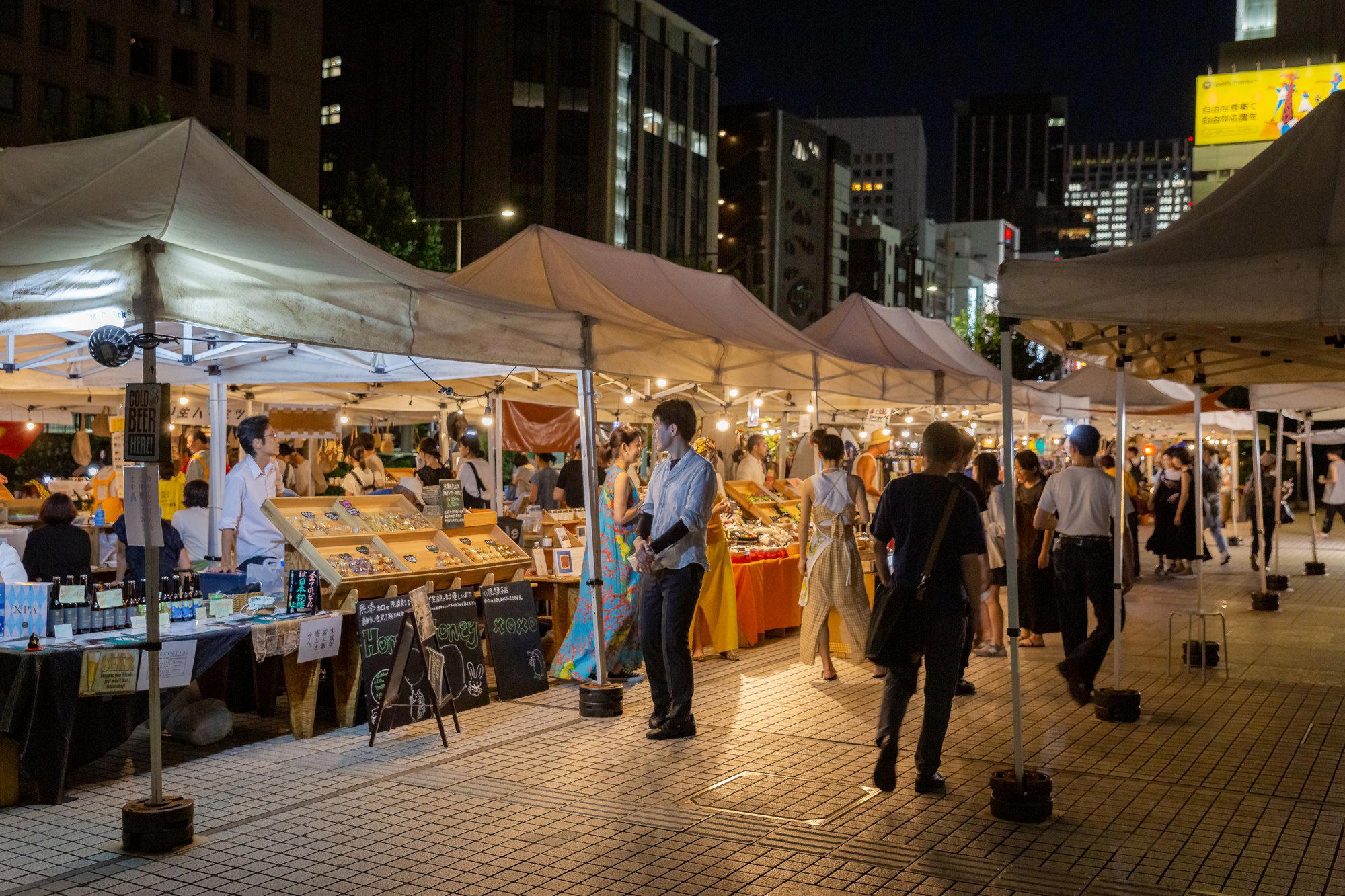
Night markets in Southeast Asia are not primarily about the food. They are about the condition of the food: the noise, the proximity of strangers, the smoke, the sense that dozens of independent operators are competing for the same guests within a few square metres. Translating that into a seated restaurant format in a Shibuya commercial building requires editorial choices. What Night Market appears to retain is the structural plurality, multiple countries, multiple styles, no dominant single cuisine, and the informality of the à la carte order.
The atmosphere is described as exotic, which in this context means deliberately dissonant with the composed minimalism of most Tokyo dining rooms at any price. The decision to foreground the Southeast Asian street-market register rather than sand it down for Tokyo sensibilities is what gives the room its character. Whether the physical space reinforces or merely suggests that energy is the kind of detail that only a visit can settle, but the concept architecture points in the right direction.
The guest experience is framed around movement through four national cuisines in a single sitting, a structure that rewards ordering broadly rather than anchoring on a single dish or country. That is a meaningful ask in a city where dining culture often rewards precision and restraint, and it suggests the room attracts guests with at least some prior relationship to the source cuisines.
Shibuya as a Setting
Shibuya's dining mix spans several distinct registers. The neighbourhood's commercial density makes it a reasonable base for a mid-price concept with broad appeal, though the COERU SHIBUYA EAST address puts Night Market in a building development rather than a traditional restaurant street, which affects foot traffic patterns. Ground-floor positioning in a mixed-use building in Shibuya means the room is more likely to draw intentional guests than casual walk-bys, which in turn implies that awareness of the concept spreads through recommendation rather than discovery.
For visitors working through Tokyo's full range, Shibuya's bars, hotels, and broader dining circuit are well documented in our full Tokyo restaurants guide, our full Tokyo hotels guide, our full Tokyo bars guide, our full Tokyo wineries guide, and our full Tokyo experiences guide. Night Market functions well as an early-evening anchor before moving into Shibuya's bar circuit, given the à la carte format allows a flexible dining pace.
Planning a Visit
Night Market sits at the ¥¥ price level, which places it comfortably in the mid-range for Tokyo, broadly comparable in spend to a well-run izakaya or ramen specialist rather than to the city's formal dining tier. The Shibuya address (2 Chome-6-6 COERU SHIBUYA EAST, 1F) is accessible from Shibuya Station, Tokyo's most heavily connected transit hub. Walk-in availability will depend on the room's capacity and evening demand; given the Shibuya location and the concept's growing reputation, arriving early in the evening service or checking ahead is the more reliable approach.
The à la carte format means there is no fixed dining duration, a practical advantage over the city's many set-menu rooms, and the multi-country menu structure rewards return visits, since the Vietnamese, Thai, Indonesian, and Malaysian sections offer enough range to justify exploring across multiple evenings. For those building a broader Japan itinerary, comparable conceptual ambition at different price points can be found at Goh in Fukuoka, 1000 in Yokohama, and 6 in Okinawa. For those comparing the format against global references in innovative cuisine, Le Bernardin in New York City and Atomix in New York City represent what structured ambition looks like at the other end of the price and formality spectrum.
Frequently asked questions
Where do I go for Night Market?
Night Market is located at Japan, 〒150-0002 Tokyo, Shibuya, 2 Chome−6−6 COERU SHIBUYA EAST, 1階, Tokyo.
What's the cuisine at Night Market?
Does Night Market have a Michelin star or similar recognition?
Night Market has received recognition including: The very name of the restaurant builds excitement ahead of guest’s visit. The concept is a night market, which has roots in Southeast Asia. The chef, inspired by hawker cuisine experienced across multiple countries, interprets street-market….
What do regulars order at Night Market?
The menu is structured à la carte with each dish flagged by national origin, covering Vietnam, Thailand, Indonesia, and Malaysia. Regulars tend to order across countries rather than sticking to one cuisine, treating the meal as a progression through different hawker traditions. Because Japanese ingredients replace the originals, signature preparations from each country are worth anchoring any order around.
Do they take walk-ins at Night Market?
Night Market sits at the ¥¥ price level inside COERU SHIBUYA EAST, a commercial complex in Shibuya, a neighbourhood where mid-range restaurants frequently accommodate walk-ins during off-peak hours. Booking ahead is advisable for evenings and weekends given the concept's appeal, but the venue's à la carte format and casual night-market atmosphere suggest a more relaxed entry policy than counter-format restaurants in the same city.
Quick Comparison
Comparable venues nearby, for context on price, style, and recognition.
| Venue | Cuisine | Price | Awards | Notes |
|---|---|---|---|---|
| Night MarketThis venue (the venue you are viewing) | Modern Pan-Asian Southeast Asian | $30–50 | Michelin Bib Gourmand | Not listed |
| Côte D'or | French | Not listed | Tabelog Chef's Gold #2 | Tokyo |
| Ginza HARU CHAN Ramen | Shio Ramen | $10–20 | Michelin Bib Gourmand | Chūō |
| YŌSHOKU BISTRO TŌYAMA | Yoshoku Bistro | Not listed | Michelin Plate · Tabelog 100 #41 | Minato |
| Tonkatsu Enraku | Traditional Tonkatsu | $10–20 | Michelin Bib Gourmand · Tabelog 100 #89 | Ōta |
| Teuchi Asama | Hand-Cut Shoyu Ramen | $10–20 | Michelin Bib Gourmand | Meguro |
Recognition history
Dated appearances from independent guides and award organizations, with the underlying list record or original source where available.
Michelin Bib Gourmand
Michelin