Tabelog 100 #10
Our verdict
Negiyaki Yamamoto Honten puts Osaka’s griddle culture in its leaner, scallion-driven register rather than the heavier okonomiyaki stereotype. The Juso counter has 20 seats, no reservations, Tabelog 100 Okonomiyaki selections across multiple years, and a JPY 2,000–2,999 spend that keeps it in the everyday dining bracket despite its reputation.

Pearl is the En Primeur Club membership app, where members save venues, book tables and use the concierge.
The menu
What to order
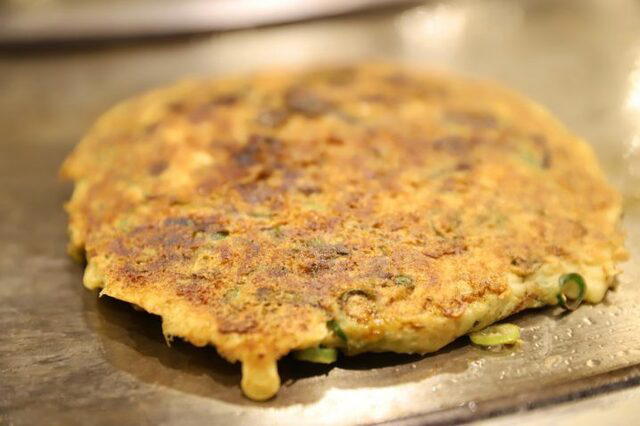
- Negiyaki
- Beef negiyaki
- Yamaimo-yaki
Osaka is not only the polished city of hotel lobbies and department-store dining floors. It is also railway Osaka: narrow streets, quick decisions, steam from griddles, and restaurants built for regulars as much as visitors. That setting matters for negiyaki, a dish too often flattened into the foreign shorthand of “Osaka pancake.” The better reading is more specific: a griddle tradition where batter is only part of the structure, scallions do much of the talking, and the counter is not theatre so much as a working line.
Negiyaki Yamamoto Honten belongs to that category of Osaka restaurant where the format explains the city. The menu sits around okonomiyaki and stir-fried noodles rather than the broader tasting-menu grammar that defines many premium Japanese dining rooms. Its selection for Tabelog Hyakumeiten in 2025 gives the place a public credential inside a genre that is usually judged locally, informally, and over many repeat meals.
Why negiyaki changes the Osaka griddle conversation
Okonomiyaki is often treated as Osaka’s default comfort dish, but negiyaki narrows the focus. The name points to negi, scallions, and the style shifts attention away from bulk and toward a thinner, greener, more savoury construction. That distinction is useful for travellers who arrive expecting a single Osaka griddle canon. The city’s konamon culture, food built around flour-based batters and doughs, runs from takoyaki and okonomiyaki to yakisoba and beyond, but each format carries its own balance of starch, sauce, heat and speed.
The Osaka setting places the dish within the city’s broader dining orbit without needing the language of luxury dining enclaves. That geography is part of the point. Griddle restaurants make sense here: fast enough for weekday meals, substantial enough for groups, and technical enough that locals still debate the details. For broader city planning, pair this stop with Our full Osaka restaurants guide, then use Our full Osaka hotels guide, Our full Osaka bars guide, Our full Osaka wineries guide, and Our full Osaka experiences guide to build the rest of the trip around the city rather than around a single meal.
A counter format with everyday pricing and serious recognition
The useful tension here is price against reputation. A JPY 2,000–2,999 lunch or dinner budget keeps Negiyaki Yamamoto Honten in a range closer to everyday Osaka eating than destination fine dining. In the same city, Chuka Soba Kirimen Souhonten, Nomiba Umeda Umeda, Meganeya, Wagyu Teppanyaki OUSAKA and ku:de kiyo can frame other kinds of meals, but this venue remains a clear case of genre prestige without luxury positioning.
Recognition also needs the right interpretation. Tabelog’s Hyakumeiten lists are not Michelin stars, and they do not turn a griddle counter into a formal restaurant. They do signal sustained attention from Japan’s restaurant-review ecosystem within a defined category. For okonomiyaki and related griddle cooking, that matters because the field is dense, local and price-sensitive. A restaurant can be culturally important without white tablecloths, a wine pairing, or a chef biography built for export.
Osaka’s wider casual dining range helps put the choice in perspective. Travellers comparing snack, bakery and casual counters can find entirely different readings of the city’s appetite across other Osaka dining rooms. The meal here is narrower: griddle cooking, okonomiyaki, stir-fried noodles, and a local dish whose reputation depends less on luxury ingredients than on timing, proportion and heat management.
How to read the room before you go
The practical signals are straightforward. Negiyaki Yamamoto Honten is best understood as a focused Osaka venue for okonomiyaki and stir-fried noodles, with a budget that sits at JPY 2,000–2,999 for both lunch and dinner. Its Tabelog score is listed at 3.57, a useful data point, though not a substitute for understanding the category on its own terms.
Planning should stay simple and flexible. The appeal is not a long-form restaurant evening or a formal tasting-menu structure, but a direct encounter with Osaka griddle cooking. The better editorial stance is simple: treat this as a focused Osaka stop, not as a luxury dining room trying to imitate another format.
For readers building a wider Japan itinerary around specialist casual food, the comparison is less about cuisine than format discipline. A tightly defined Osaka counter has more in common, structurally, with other focused Japanese formats than with formal dining rooms. The same lesson applies across many casual dining categories: the format works when its limits are part of the appeal.
The verdict is not that every Osaka visitor needs to chase a single meal. It is that negiyaki gives a sharper reading of Osaka’s griddle culture than a generic okonomiyaki stop, and this restaurant has the recognition, price point and city setting to make that reading credible. Go for specificity: scallion-led konamon, griddle pacing, and a meal that explains why Osaka’s casual food traditions remain more precise than their tourist shorthand suggests.
Frequently asked questions
What's the price range at Negiyaki Yamamoto Honten?
Pricing at Negiyaki Yamamoto Honten is listed as JPY 2,000 - JPY 2,999 for both lunch and dinner.
What's Negiyaki Yamamoto Honten's location?
Osaka.
Do they take walk-ins at Negiyaki Yamamoto Honten?
The provided listing does not give a confirmed reservations policy. Plan around it as a focused Osaka venue for okonomiyaki and stir-fried noodles.
What is Negiyaki Yamamoto Honten known for?
It is known for okonomiyaki and stir-fried noodles, and it was selected for Tabelog Hyakumeiten in 2025.
Can Negiyaki Yamamoto Honten accommodate dietary restrictions?
The provided listing identifies okonomiyaki and stir-fried noodles as the main categories, but does not confirm specific dietary accommodations.
Where It Fits
Comparable venues by category and price.
| Venue | Cuisine | Price | Awards | Notes |
|---|---|---|---|---|
| Negiyaki Yamamoto HontenThis venue (the venue you are viewing) | Japanese Negiyaki | $10–20 | Tabelog 100 #10 | Not listed |
| Ramen Chonmage Osaka Tenroku | Japanese Ramen | $10–20 | Not listed | Tenjinbashi |
| Naniwa Menjiro Zen | Japanese Ramen | $10–20 | Tabelog 100 #54 | Kita |
| CHIKICHIKI Hanshin umeda ten | Modern yakitori in Hanshin Umeda | $30–50 | Tabelog 100 #61 | Kita |
| Okonomi Tamachan Viva | Okonomiyaki, Teppanyaki & Korean Izakaya | $30–50 | Tabelog 100 #50 | Nishi |
| Junkissa American | Traditional Japanese Kissaten / Cafe | $10–20 | Tabelog 100 | Chūō |
Recognition history
Dated appearances from independent guides and award organizations, with the underlying list record or original source where available.
Tabelog 100 #10 · No. 10
Tabelog · Tabelog 100 - Okonomiyaki - 2025