
Tabelog 100
Our verdict
Junkissa American places Osaka’s kissaten tradition in a large-format Dotonbori setting, with pancakes, sandwiches, coffee-shop staples, and a price point that keeps the occasion casual rather than ceremonial. Its Tabelog 100 Kissaten selections in 2021 and 2022 give it a credible marker in a category where atmosphere, pacing, and old-school breadth matter as much as the plate.

Pearl is the En Primeur Club membership app — saves, bookings, and concierge access live there. Same editors, same standards.
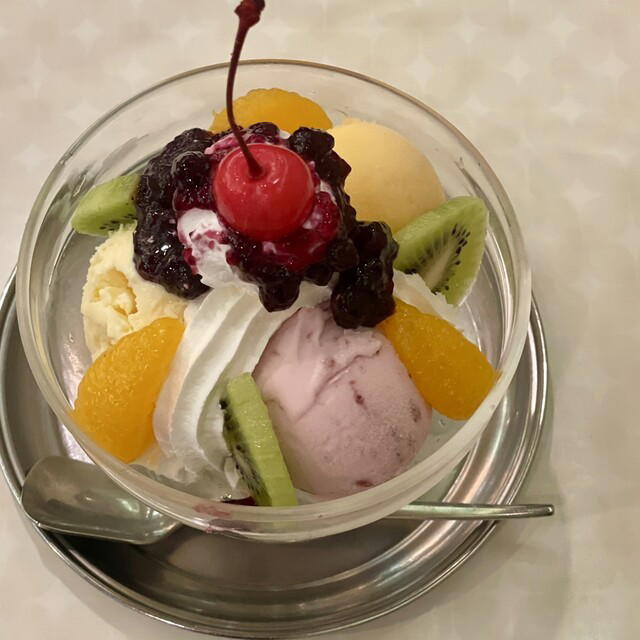
The menu
What to order
- Hot coffee
- Hot sandwiches
- An mitsumame
Osaka announces itself in neon, queues, and quick decisions, but the Japanese kissaten works on a different rhythm. The appeal is not scarcity or tasting-menu theatre; it is a room built for lingering, a menu broad enough to cover coffee, pancakes, and sandwiches, and a sense that an afternoon can be treated as an occasion without turning formal. Junkissa American belongs to that older Osaka grammar: a coffee-shop format with accessibility and enough ceremony in the room to make birthdays, family catch-ups, and low-key celebrations feel planned rather than improvised.
That matters in a city often reduced to takoyaki, okonomiyaki, and counter dining. Osaka’s casual food culture is serious precisely because it refuses to separate pleasure from utility. A kissaten can be breakfast, dessert, a meeting point, or a pause between shopping and theatre. In that frame, recognition by Tabelog’s Kissaten 100 in 2022 is useful not as decoration, but as a signal that the room sits inside a national conversation about Japan’s classic coffee-shop culture rather than merely serving as a convenient Osaka stop.
A Osaka kissaten built for occasions that do not need a dining room script
Milestone dining in Osaka does not always mean formality. A comparison with other Osaka dining rooms, including Honkogetsu, shows the other end of the occasion spectrum: reservations, pacing, and a clearer sense of restaurant ceremony. The kissaten occasion is looser. It suits multi-generation groups, friends who want to talk longer than a quick counter allows, and travellers who want a recognisably Japanese social setting without committing an evening to fine dining.
The venue’s format is central to that role. The experience belongs to a different category from the narrow, single-purpose stops that define much of Japan’s contemporary café culture. A broader coffee-shop model changes the social use of a room: it makes space for mixed appetites and a higher tolerance for the indecision that comes with groups. That is why the format can handle celebration without the stiffness of a formal restaurant. The menu categories, Japanese coffee shop, pancake, and sandwich, point toward accessible comfort rather than chef-led progression.
Osaka has plenty of compact, single-purpose eating, from bakery runs to focused coffee stops and quick snack counters. Junkissa American occupies the broader middle ground, where the point is not speed alone but the ability to settle in. For travellers building an Osaka day around food, that middle ground is often more useful than another high-demand counter.
The old coffee-shop category is wider than coffee
The Japanese kissaten predates the current specialty-coffee era and carries different expectations. It is less about origin transparency and more about a complete civic function: coffee, sweets, sandwiches, regulars, dates, and post-shopping breaks. In Osaka, that function has particular weight because the city’s dining culture values informality without treating it as lesser. A low listed price band does not automatically mean a minor experience; it can mean the room is designed for repeat use rather than rare splurge.
That distinction helps explain why an Osaka kissaten can be a credible occasion choice. The occasion is not the anniversary dinner with wine pairings. It is the family meeting place before the evening crowd, the celebratory pancake stop after a school event, the intergenerational coffee break where nobody needs to decode a formal tasting-menu structure. The point is a functioning café rhythm: practical, social, and familiar, with enough old-school character to make the stop feel intentional rather than purely convenient.
There is also a useful contrast with nearby casual dining categories. Other Osaka dining rooms channel the city’s appetite for varied formats; Alcyon Houzenji honten, in the comparison set, sits in a different café lane. The kissaten here remains more democratic, anchored by familiar categories and a broad coffee-shop model. That is a different kind of value than rarity, and in Osaka it may be the more practical luxury.
How to place it in an Osaka food day
The strongest use case is a pause in the day rather than treating it as a final-destination dinner. Osaka can flatten appetite into grazing, and a classic kissaten restores structure: sit down, order within a familiar set of categories, and give the city’s pace a controlled pause. For visitors, it pairs well with a wider itinerary that treats Osaka as more than a sequence of famous snacks. Use Our full Osaka restaurants guide for the dining spread, then build around bars, hotels, and cultural time through Our full Osaka bars guide, Our full Osaka hotels guide, Our full Osaka experiences guide, and Our full Osaka wineries guide.
The critical point is expectation. This is not chef-biography dining, and it should not be judged by the vocabulary of tasting menus. It is a Tabelog 100 Kissaten 2022-noted venue with a broad menu and a listed Tabelog score of 3.66, built around the categories of Japanese coffee shop, pancake, and sandwich. That makes it strongest for casual celebrations, mixed-age groups, and travellers who want a culturally specific coffee-shop setting in Osaka. Readers comparing Japanese casual formats beyond Osaka can also think generically about everyday dining in other cities. The through-line is not luxury in the usual sense; it is format clarity, the ability to read a city through everyday rituals, and the discipline to choose the right room for the right occasion.
Frequently asked questions
How would you describe the vibe at Junkissa American?
It feels like a classic kissaten rather than a formal dining room, with a practical coffee-shop rhythm suited to mixed groups. The venue is listed in the categories of Japanese coffee shop, pancake, and sandwich.
When is Junkissa American open?
Check directly with Junkissa American for current opening hours before you go.
How much does it cost to eat at Junkissa American?
Pricing at Junkissa American is listed as - JPY 999 - JPY 999.
How do I find Junkissa American?
Osaka.
What do critics highlight about Junkissa American?
The main credential is its selection for Tabelog 100 Kissaten 2022, with a listed Tabelog score of 3.66. The format matters too: it is listed as a kissaten with pancake and sandwich categories.
Is Junkissa American allergy-friendly?
It is not framed as an allergy-specific venue in the provided details. Anyone with allergies should ask before ordering.
A Lean Comparison
Comparable venues for orientation by cuisine and category.
| Venue | Cuisine | Price | Awards | Notes |
|---|---|---|---|---|
| Junkissa AmericanThis venue (the venue you are viewing) | Traditional Japanese Kissaten / Cafe | $10–20 | Tabelog 100 | Not listed |
| Naniwa kappo Kigawa | Naniwa Kappo (Osaka-style Kaiseki) | $150–200 | Not listed | Not listed |
| Honkogetsu | Traditional Kaiseki | $500+ | La Liste Top Restaurants · Tabelog Chef's Gold #4 | Kaiseki |
| Yakiniku Rikimaru Sennichimae | All-You-Can-Eat Yakiniku | $20–30 | Not listed | Not listed |
| Alcyon Houzenji honten | French-style tea salon & patisserie | $10–20 | Tabelog 100 #72 | JPY 2,000 - JPY 2,999 JPY 2,000 - JPY 2,999 |
Recognition history
Dated appearances from independent guides and award organizations, with the underlying list record or original source where available.
Tabelog 100
Tabelog · Tabelog 100 - Kissaten - 2026
Full recognition history (2 entries)
Tabelog 100 #15 · No. 15
Tabelog · Tabelog 100 - Kissaten - 2022
Continue exploring
More in Osaka
Restaurants in Osaka
All restaurants in Osaka →



Bars in Osaka
All bars in Osaka →
Hotels in Osaka
All hotels in Osaka →



Wineries in Osaka
Browse all →
Details
- Classic
- Cozy
- Well Known
- Casual Hangout
- Family
- Solo
- Brunch
- Historic Building
- Standalone
- Sake Program
- Street Scene
- A La Carte
- Coffee
- Tea
- Vegetarian Friendly
Current opening hours
- Monday
- 10 AM–9:45 PM
- Tuesday
- 10 AM–9:15 PM
- Wednesday
- 10 AM–9:45 PM
- Thursday
- 10 AM–9:45 PM
- Friday
- 10 AM–9:45 PM
- Saturday
- 10 AM–9:45 PM
- Sunday
- 10 AM–9:45 PM
Hours can change for holidays and private events. Last verified .
Retro, nostalgic, and spacious, with a preserved old-fashioned kissaten feel that emphasizes a calm break from the busy Dotonbori area.